
To look back on 50 years of rap is not simply to celebrate a birthday. It is to trace the transformation of a local survival culture into a global industry, a moral battleground, a source of lifestyle aspiration, and a permanent laboratory of innovation. Across five decades, rap has documented neighborhoods, challenged institutions, glorified ambition, reflected pain, built legends, and rewritten the grammar of popular music again and again.
A Landmark Track in Hip-Hop History
To anchor this retrospective in a foundational moment, here is an embedded YouTube video for The Message, one of the defining records in rap history and one of the clearest bridges between early hip-hop energy and socially charged storytelling.
Prefer a direct link? Watch here:
Grandmaster Flash & The Furious Five – The Message
From the Bronx to the World
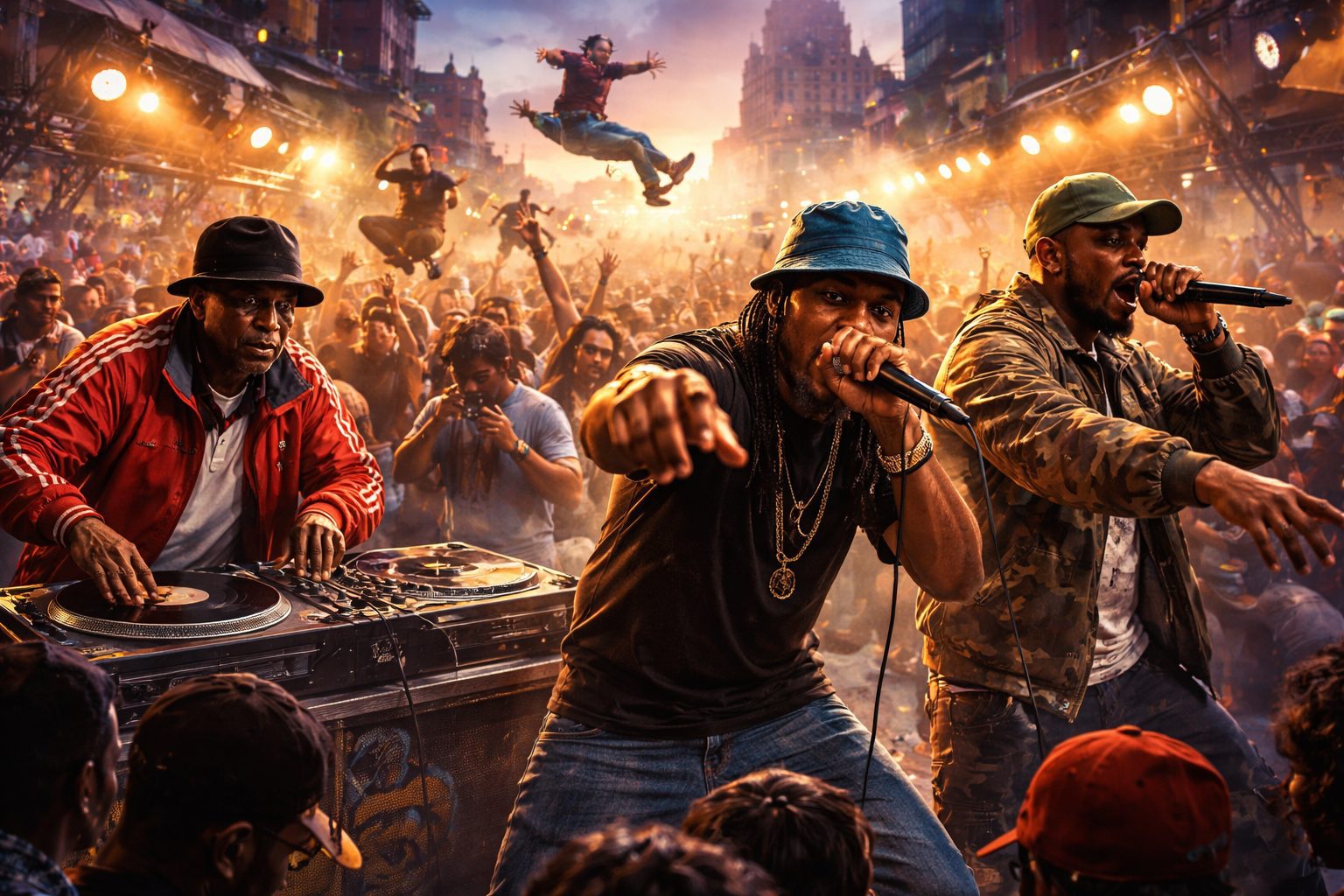
Hip-hop was born in a climate of abandonment and invention. In the South Bronx of the early 1970s, disinvestment, poverty, social fragmentation, and urban neglect created a brutal environment, but also the conditions for extraordinary creativity. DJs, dancers, MCs, and visual artists built a new culture from what was available: turntables, records, electricity, community spaces, sound systems, and imagination. It was not born in luxury. It was engineered under pressure.
The earliest foundations were laid by figures who understood that music could reorganize a room and, in a deeper sense, reorganize a community. DJ Kool Herc expanded the breakbeat, giving dancers and MCs more space to explode. Afrika Bambaataa brought vision, philosophy, and cultural structure. Grandmaster Flash sharpened technique and transformed DJing into precision architecture. These pioneers did more than make parties move. They invented a new social grammar. The DJ became conductor. The MC became narrator, instigator, and crowd architect. The dance floor became a public stage for style, competition, and belonging.
What began as neighborhood culture quickly developed its own codes: verbal prowess, rhythmic command, originality, reputation, and presence. Rap was not initially a studio craft in the modern sense. It was a live language, built in the electricity of the moment. When recorded rap began reaching wider audiences, that language did not lose its urgency. It simply found a larger speaker.
The Precursors and the Builders of the Form
Every genre has founding myths, but hip-hop also has a real lineage of architects whose influence remains audible today. The first generation did not work from a blueprint. They had to invent one. That includes not only the party founders and DJs, but also the first MCs who turned rhythm into personality, competition into theater, and boast into art. The Sugarhill Gang helped bring rap to a mainstream audience. Run-D.M.C. hardened its image and sonic force, proving that rap could become a dominant commercial form without losing its street identity. LL Cool J expanded charisma, crossover appeal, and emotional versatility. Public Enemy demonstrated that rap could function like a public alarm system, turning records into political voltage.
Then came Rakim, whose lyrical control changed everything. His flow, internal rhyme structures, calm authority, and technical sophistication elevated the MC into something closer to a literary tactician. KRS-One fused confrontation and pedagogy. Slick Rick made storytelling feel cinematic. Salt-N-Pepa carved out a vital female space in a genre too often presented through male mythology alone. Hip-hop was already richer, wider, and more intellectually ambitious than many outsiders understood.
The genre’s early growth was never linear. It was a clash of energies: party music, neighborhood testimony, style competition, political charge, street realism, and artistic experimentation. That tension would become rap’s great motor. It still is.
The Major Rappers of the Last 50 Years
No list of major rappers can ever be final, because rap history is not a monarchy with a single throne. It is a shifting field of eras, regional movements, revolutions, and counter-revolutions. Still, some names changed the genre so profoundly that rap sounds different because they existed.
Tupac Shakur and The Notorious B.I.G. became larger than rap itself, not only because of their commercial power, but because they embodied two immense and contrasting emotional poles of the genre: urgency and elegance, fire and command, vulnerability and swagger. Nas turned the rap verse into urban literature. Wu-Tang Clan brought rawness, mythology, and collective strategy into one unforgettable universe. Snoop Dogg made laid-back precision iconic. Dr. Dre transformed production into cinematic identity. OutKast shattered assumptions about geography and style, proving that Southern rap was not secondary, but visionary.
Jay-Z then became the great narrator of rap’s capitalist age, moving fluidly between lyrical excellence, street memory, and executive ambition. Eminem exploded technique, shock, and confessional rage at a scale few artists in any genre have ever reached. Lil Wayne redefined prolific creativity, making the punchline feel limitless. Kanye West altered the emotional palette of mainstream rap, bringing vulnerability, maximalism, soul recontextualization, and aesthetic risk into a new center.
Missy Elliott remains one of the most important innovators in hip-hop history, not just for her music, but for her total command of visual imagination, vocal elasticity, futuristic production, and performance. Nicki Minaj reasserted theatrical authority, technical agility, and crossover dominance in an era when women in rap were once again fighting for central space. Kendrick Lamar emerged as one of the most acclaimed rap artists of the modern era by combining technical brilliance, narrative depth, social consciousness, and conceptual ambition. Drake mastered melody, mood, and omnipresence in the streaming age. J. Cole preserved a lane rooted in introspection and lyrical discipline.
And that is only part of the map. Future, Young Thug, Travis Scott, 50 Cent, Lauryn Hill, Ice Cube, Scarface, DMX, Queen Latifah, Busta Rhymes, Method Man, Common, Mos Def, Pusha T, and many others each helped redefine what a rap artist could be. Rap history is not built by one sound. It is built by successive acts of disruption.
The Innovators Who Broke the Rules
Hip-hop has survived because it keeps generating artists who refuse to preserve it in amber. Innovation in rap is not one thing. It can be lyrical, sonic, structural, visual, regional, or emotional. Sometimes it arrives in a flow. Sometimes it arrives in a producer’s drum programming. Sometimes it arrives in a voice that sounds unlike anything before it.
When A Tribe Called Quest folded jazz textures into rap with elegance and lightness, they opened another road. When N.W.A. weaponized confrontation and reportage, they changed the social charge of the genre. When OutKast brought psychedelic color, Southern identity, and fearless experimentation into the center, they expanded rap’s imagination. When Kanye West brought vulnerability and widescreen production into a new era of mainstream appeal, he shifted the emotional contract between artist and audience. When Lil Wayne treated flow like a shape-shifting force, an entire generation took notes.
Atlanta later became one of rap’s most important innovation capitals, particularly through the rise of trap. The city did not merely produce hits. It redesigned the mainstream. The modern relationship between drums, melody, ad-libs, mood, and vocal texture owes an enormous debt to Atlanta’s ecosystem. Artists such as Future and Young Thug helped make rap more elastic, less bound by traditional notions of bar structure, and more open to emotional distortion, melody, and atmosphere.
Elsewhere, drill redrew the emotional temperature of rap. Chicago gave it one of its harshest and most immediate forms. Brooklyn reinterpreted it. The UK developed its own powerful variations. The result was not imitation, but proof that rap remains one of the most adaptable musical languages in the world. It moves fast because local scenes keep rewriting it from within.
The Evolution of Rap: From Bars to Atmosphere
Rap’s evolution is often oversimplified into a debate between “real lyricism” and “modern vibes,” but the truth is more interesting. The genre has never stopped mutating because each generation redefines what counts as impact. In one era, complexity means internal rhyme and breath control. In another, it means cadence, mood, or sonic architecture. In another, it means building a total world through voice, image, and internet presence.
Old-school rap prioritized live energy, rhythmic command, and direct crowd communication. The golden age deepened lyrical and conceptual sophistication. The 1990s intensified realism, storytelling, and regional identity. The 2000s pushed blockbuster ambition, crossover scale, and executive mythology. The 2010s blurred the lines between rap, R&B, pop, electronic music, and internet culture. The current era operates in a climate where genre borders mean less than emotional effect, visual identity, and algorithmic resonance.
Today’s rap can be brutally direct or deliberately abstract. It can be melody-heavy, rage-fueled, diaristic, minimalist, maximalist, nostalgic, fragmented, luxurious, politically charged, or emotionally numb. That diversity is not a sign of decline. It is a sign of expansion. Rap has become too vast to be measured by one criterion alone.
Rap as Social Voice, Survival Tool, and Mirror
One reason rap has remained central for so long is that it has never been only music. It has always carried testimony. It reports on inequality, violence, race, class, policing, incarceration, ambition, grief, masculinity, joy, trauma, power, pleasure, and spiritual hunger. It does not always speak with one politics or one morality, but it speaks with urgency. Even when contradictory, it is often brutally revealing.
Rap gave neighborhoods a microphone long before institutions were interested in listening. It became a language for those misrepresented, ignored, or reduced to statistics. Some of the greatest rap records are not merely songs. They are historical documents in rhythm. They tell us what policy sounds like at street level. They tell us how aspiration sounds in a hostile economy. They tell us what pride, paranoia, pain, and resilience sound like in a society that often demands performance from the marginalized while denying them security.
At the same time, rap has never belonged only to struggle. It also celebrates style, seduction, triumph, humor, and fantasy. That is part of its realism too. People do not only survive. They dream, flex, seduce, joke, invent, and escape. Rap has always understood that dignity can appear in resistance, but also in style.
From Counterculture to Lifestyle Empire
Few musical forms have influenced lifestyle as deeply as rap. What once emerged as street expression now shapes luxury markets, sneaker culture, sports branding, slang, nightlife, beauty, and social media aesthetics. The rapper is no longer merely an artist. In many cases, the rapper is a brand platform, fashion catalyst, tastemaker, entrepreneur, and cultural signal.
This transformation carries both power and tension. On one hand, rap’s movement into business, fashion, tech, and luxury has allowed artists to build wealth, ownership, and influence on an unprecedented scale. On the other, it raises questions about absorption. What happens when a genre built from local urgency becomes one of the most profitable engines in global entertainment? What is gained? What is diluted? Rap has lived inside that contradiction for decades. It criticizes capitalism and monetizes aspiration at the same time. It exposes social violence and sells fantasy. That friction is not an accident. It is part of what makes the genre so revealing.
The New Guard and the Pressure of the Infinite Feed
The new generation of rappers inherited a different battlefield. Earlier pioneers had to fight for legitimacy. Today’s artists enter a world where rap is already dominant, but attention is fragmented beyond recognition. The challenge is no longer simply to be accepted. It is to stand out in an environment where songs spread in seconds and disappear almost as quickly.
That has changed not only careers, but artistic choices. The new guard often builds identity across music, fashion, social media, memes, livestreams, aesthetics, and community signals all at once. Some artists lean into technical bars. Others prioritize tone, charisma, texture, or viral immediacy. This does not necessarily mean standards have vanished. It means the arena has changed. Presence itself has become a compositional tool.
Artists from the current generation often navigate a culture where visibility is instant but durability is rare. The winners are not always the loudest. They are often the ones who can transform attention into mythology, and mythology into staying power.
What Comes Next for Rap?
The future of rap will likely be defined by even greater fluidity. The genre is already intertwined with Afro-influenced rhythms, electronic experimentation, global scenes, alternative production styles, and digitally native forms of performance. Artificial intelligence, platform economics, short-form content, and direct-to-fan ecosystems will shape the next chapter, but they will not replace the core truth of rap: people still respond to voice, identity, originality, and conviction.
What may change is the meaning of authenticity. In earlier eras, authenticity was often tied to geography and biography. Today, it is also tied to coherence. Does the artist feel believable in the world they create? Does the voice feel distinct? Does the music carry a point of view? In an age of endless replication, distinct perspective becomes even more valuable.
Rap’s future will also depend on whether it continues making space for depth as well as speed, for artistry as well as performance metrics, for regional specificity as well as algorithmic universality. The genre has always thrived when multiple visions compete at once. Its health depends not on one dominant formula, but on friction, mutation, and surprise.
Fifty Years Later, Hip-Hop Still Refuses to Stand Still
Half a century after its birth, hip-hop remains one of the few cultural forces capable of being archival and futuristic at the same time. It honors pioneers while producing constant mutation. It remembers the block while ruling the global stage. It can still be reckless, brilliant, contradictory, insightful, commercial, radical, and emotionally devastating — often within the same song.
That is why the story of rap’s first fifty years cannot be told as a closed chapter. It is not a museum piece. It is an unfinished argument with society, technology, power, class, race, masculinity, beauty, language, business, and identity. The precursors built the spark. The major rappers turned it into history. The innovators kept breaking the frame. The new guard now carries the pressure of reinvention in real time.
And if the past fifty years prove anything, it is this: rap does not survive by standing still. It survives by finding the next voice bold enough to disturb the room.