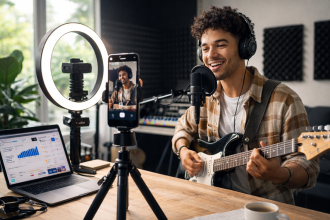

For many independent artists, advertising feels like a necessary evil. The moment you mention ads, the same fears surface: “I’ll look desperate.” “It’s fake growth.” “I’ll have to become a full-time content creator just to feed the funnel.”
- The Misunderstanding That Holds Artists Back
- From Broadcasting to Targeting
- Ads as Discovery Infrastructure
- Escaping the Content Treadmill
- Small Budgets, Real Impact
- Data Without Obsession
- Ethical Promotion in a Distrustful Era
- Ads Without Ego
- Supporting a Broader Ecosystem
- Quiet Growth, Lasting Results
- AUDIARTIST
But in 2026, the smartest artists are using ads in a radically different way. Not to inflate vanity metrics. Not to chase virality. Not to perform for attention. Instead, they use ads as infrastructure — quiet, targeted systems that connect the right listeners to the right music.
No daily posting. No trend chasing. No ego.
Just signal, delivered to intent.
The Misunderstanding That Holds Artists Back
Many musicians reject ads because they associate them with superficial growth: paid followers, empty views, and inflated numbers that disappear when the budget stops.
That fear is justified — when ads are used to simulate popularity. But when used to facilitate discovery, ads become something else entirely: a bridge between music and listeners who were already looking for that sound.
Ads don’t create demand. They accelerate connection.
From Broadcasting to Targeting
Traditional promotion blasts content into the void and hopes for engagement. Modern ad strategies invert this logic. Instead of speaking to everyone, they reach people already predisposed to listen.
Fans of similar artists. Listeners of specific genres. People who watch related content. Users searching for particular moods.
The result is not interruption, but alignment. The listener encounters your track not as an intrusion, but as a relevant suggestion.
Relevance reduces resistance. Resistance kills discovery.
Ads as Discovery Infrastructure
In 2026, ads function best when they support durable channels rather than replace them. A campaign might direct listeners to a YouTube mix optimized for search, a Spotify release with strong retention potential, or a landing page designed to convert curiosity into loyalty.
The goal is not the click. The goal is what happens after the click: the save, the follow, the repeat listen.
Ads open the door. Music keeps it open.
Escaping the Content Treadmill
One of the greatest advantages of strategic advertising is that it reduces the need for constant content production. A single compelling visualizer, mix clip, or static artwork can run for weeks or months, reaching new listeners continuously.
This shifts the artist’s role from content factory to creative director. Instead of producing daily posts, you create assets designed for longevity.
Time returns to music.
Small Budgets, Real Impact
Advertising in 2026 is not reserved for major labels. Even modest budgets can generate meaningful discovery when campaigns are targeted and optimized.
A small daily spend, focused on listeners already aligned with your genre, can produce high-quality streams, saves, and follows. These signals feed platform algorithms, extending reach beyond the paid campaign.
Paid discovery becomes organic momentum.
Data Without Obsession
Ads provide data: click-through rates, retention, saves, listener demographics. Used wisely, this information clarifies what resonates — not to dictate creativity, but to understand audience behavior.
The danger lies in obsession with metrics. Numbers are signals, not goals. The goal remains connection.
Data informs. It should not control.
Ethical Promotion in a Distrustful Era
Audiences today are wary of manipulation. Fake streams, inflated metrics, and deceptive promotion have eroded trust. Transparent, targeted advertising offers a cleaner alternative.
When listeners discover music through relevant placements, the experience feels natural. There is no illusion of popularity — only alignment between sound and listener.
Trust grows when promotion feels honest.
Ads Without Ego
The phrase “ads without ego” captures a mindset shift. The purpose of advertising is not to prove success, but to facilitate discovery. It is not about looking popular; it is about being heard by the right people.
Ego seeks validation. Strategy seeks connection.
Artists who embrace this approach stop measuring success in impressions and begin measuring it in meaningful interactions: saves, follows, repeat listens, and long-term engagement.
Supporting a Broader Ecosystem
Ads work best when integrated into a broader promotion strategy: consistent releases, playlist outreach, SEO, micro-sync opportunities, and direct audience channels. They amplify what already exists rather than compensating for its absence.
Think of advertising as wind in the sails, not the ship itself.
Quiet Growth, Lasting Results
When used strategically, ads do not create dramatic spikes. They create steady growth. They introduce your music to listeners who stay. They reinforce signals that platforms recognize. They help transform discovery into retention.
This growth may lack spectacle. But it endures.
In 2026, the most effective advertising is invisible to everyone except the people it reaches. No noise. No performance. No endless content treadmill.
Just music, finding its way to the listeners who were ready for it.
And perhaps the most radical act in today’s attention economy is not shouting louder — but connecting more precisely.