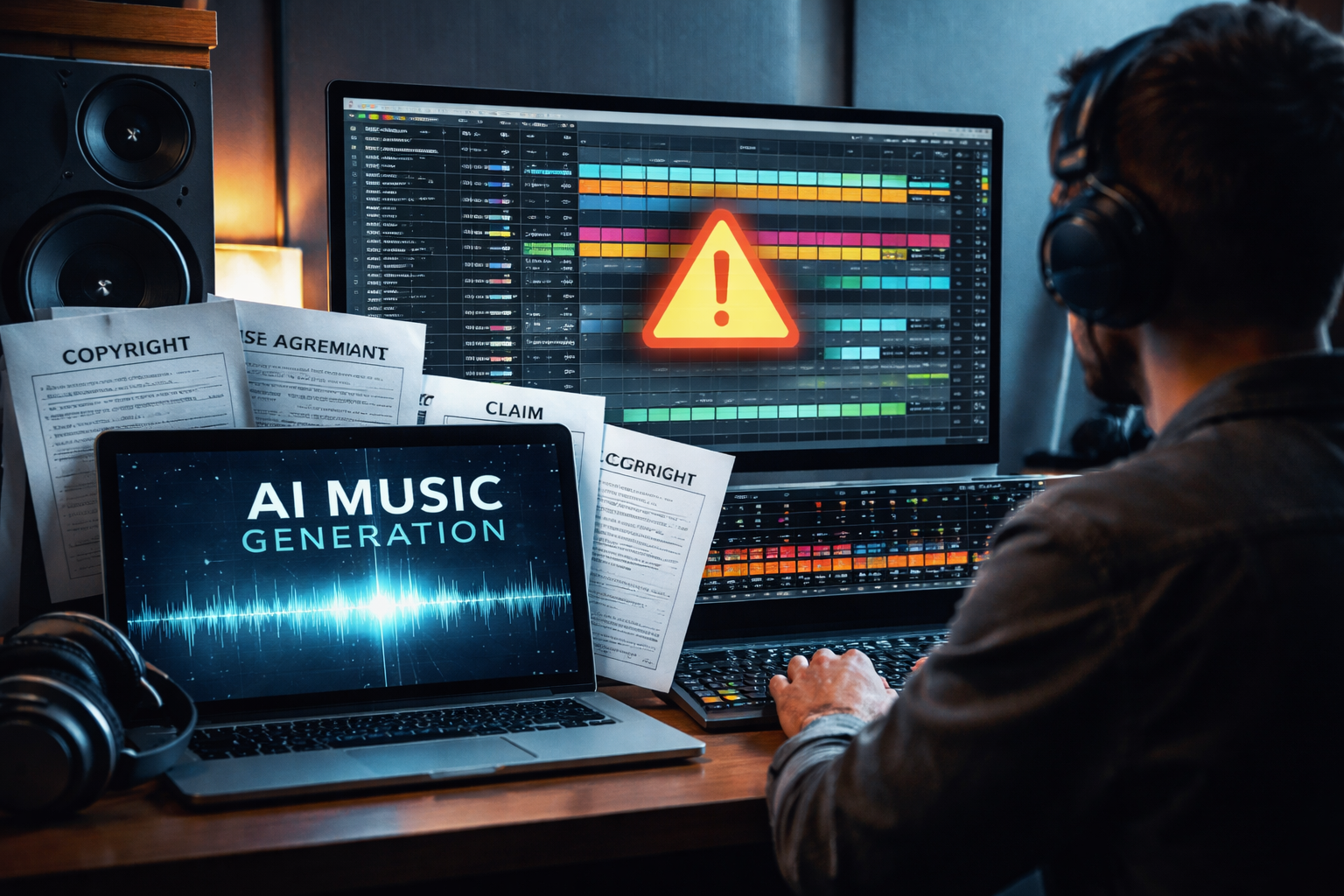

Who Really Owns the Music — and Are You at Risk of Plagiarism?
The promise is irresistible: type a mood, click a button, and within seconds an original soundtrack materializes. AI music generators have rapidly become tools of choice for content creators, indie artists, marketers, and even film studios seeking fast, affordable audio. Yet behind the frictionless experience lies a complex web of licensing terms, legal gray zones, and ethical dilemmas that many users overlook — often until a claim, takedown, or dispute forces a closer look.
- The Illusion of Instant Creation
- Ownership vs. License: The Fine Print That Defines Your Rights
- The Myth of Exclusivity in Generative Music
- Copyright Law Meets AI: A Legal Landscape in Motion
- Plagiarism and Claims: Yes, the Risk Is Real
- The Black Box of Training Data
- Voice Cloning, Style Emulation, and Identity Rights
- Hidden Platform Rights: How Your Creations Still Serve the System
- Protecting Yourself in the Age of AI Music
- A Turning Point for the Music Industry
- The Real Trade-Off Behind Instant Creativity
- AUDIARTIST
As AI-generated music moves from novelty to mainstream production tool, one question grows louder: who actually owns the music, and who carries the risk?
The Illusion of Instant Creation
AI music platforms thrive on simplicity. They promise royalty-free tracks, commercial usage rights, and “original” compositions generated on demand. For creators juggling deadlines and budgets, this is a revolution. But the convenience can obscure the fine print.
Terms like royalty-free, commercial use allowed, and you own your song often sound definitive. In practice, they describe licensing frameworks rather than true copyright ownership. The distinction matters. A license grants permission; ownership grants control. Many users assume they have the latter when they only hold the former.
The result is a growing population of creators publishing AI-generated music under the belief that they hold full rights — a misunderstanding that can have legal and financial consequences.
Ownership vs. License: The Fine Print That Defines Your Rights
Most AI music platforms operate under licensing models that vary by subscription tier, usage type, or distribution channel. While some services grant broad commercial rights, they frequently retain underlying ownership or impose conditions on usage.
Common contractual realities include perpetual platform rights to host or reuse generated content, revocable licenses tied to active subscriptions, and indemnification clauses that shift legal responsibility to the user. In simple terms, if a dispute arises, the burden often falls on the creator who published the track, not the platform that generated it.
This structure allows companies to scale rapidly while minimizing liability. For users, it means that downloading a track does not necessarily equate to owning it in the traditional sense recognized by copyright law.
The Myth of Exclusivity in Generative Music
AI-generated tracks feel personal, but they are rarely exclusive. Generative models produce outputs based on probabilities learned from vast datasets. Similar prompts can yield structurally or stylistically comparable results, even across different users.
This does not constitute direct copying, yet it can lead to multiple creators releasing music that shares melodic contours, harmonic progressions, or sonic textures. In commercial environments, where originality is a competitive asset, this overlap can dilute brand identity and trigger disputes over perceived similarity.
For artists seeking a unique sonic fingerprint, AI output alone rarely guarantees distinctiveness.
Copyright Law Meets AI: A Legal Landscape in Motion
Global copyright frameworks were designed around human authorship. In many jurisdictions, including the United States and the European Union, copyright protection requires a measurable degree of human creativity. Purely machine-generated works may fall outside traditional protections, leaving creators in a legal gray zone.
This does not mean AI-assisted music cannot be protected. When users significantly modify, arrange, or build upon generated material, the resulting work may qualify as a human-authored derivative. The key factor is creative contribution — decisions that shape structure, harmony, instrumentation, or production.
As courts and policymakers grapple with AI authorship, the safest assumption for creators is that human input strengthens both ownership claims and legal protection.
Plagiarism and Claims: Yes, the Risk Is Real
A persistent myth suggests that AI-generated music is immune to plagiarism claims. In reality, automated detection systems and copyright enforcement tools evaluate similarity, not intent. If a generated melody resembles an existing work closely enough, it can trigger content identification systems, demonetization, or takedown notices.
Platforms such as YouTube rely on fingerprinting systems like Content ID to detect overlaps in melody, harmony, or audio patterns. Even when a creator acts in good faith, a match can result in monetization being redirected or the content being blocked in certain territories.
In more serious cases, rights holders may pursue legal action based on substantial similarity — a legal standard that does not require proof of deliberate copying. The fact that an AI produced the material does not absolve the publisher of responsibility.
The Black Box of Training Data
One of the least transparent aspects of AI music generation is the data used to train the models. While some companies claim to rely on licensed or proprietary datasets, others provide limited disclosure about their sources.
This lack of transparency raises important questions. If training data includes copyrighted works, could generated outputs inadvertently replicate protected material? Regulators and industry groups are increasingly calling for clearer dataset disclosures and licensing standards to address these concerns.
The outcome of these debates will shape the future of AI music — determining whether it evolves into a trusted creative partner or remains a legally uncertain tool.
Voice Cloning, Style Emulation, and Identity Rights
Among the most controversial capabilities of AI audio tools are voice cloning and stylistic imitation. Generating vocals that resemble a specific artist or prompting a model to create music “in the style of” a living musician introduces ethical and legal risks.
Voice likeness may be protected under personality rights, publicity rights, or unfair competition laws, depending on the jurisdiction. Similarly, while musical style itself is not copyrightable, deliberate imitation that causes confusion in the marketplace can expose creators to legal challenges.
For commercial releases, these features represent one of the highest-risk use cases in AI music production.
Hidden Platform Rights: How Your Creations Still Serve the System
Even when users retain broad usage rights, many platforms reserve the ability to reuse generated outputs or prompts to improve their models. This feedback loop is central to AI development, but it also means that your creative inputs may contribute to future outputs generated for other users.
Additionally, some services include promotional licenses allowing them to showcase user-generated tracks in marketing materials. While often benign, these clauses underscore a broader reality: free or low-cost tools frequently operate on data exchange models rather than purely transactional ones.
Protecting Yourself in the Age of AI Music
For creators integrating AI into their workflow, risk management is becoming as essential as sound design. Reading key clauses on ownership, licensing, and indemnification can prevent misunderstandings. Transforming AI outputs through arrangement, instrumentation, and production not only enhances originality but also strengthens legal standing.
Testing tracks for automated claims before distribution, maintaining records of prompts and edits, and avoiding stylistic imitation of identifiable artists are practical safeguards in an evolving legal environment.
Ultimately, AI should be treated as a starting point — not a finished product.
A Turning Point for the Music Industry
AI music generation is reshaping production pipelines, lowering barriers to entry, and democratizing access to sound creation. At the same time, it challenges long-standing assumptions about authorship, originality, and ownership.
As the market becomes saturated with algorithmically generated content, trust and transparency will become defining currencies. Platforms that provide clear licensing terms and ethical data practices will earn credibility. Creators who combine AI efficiency with human artistry will stand out in an increasingly crowded landscape.
The Real Trade-Off Behind Instant Creativity
AI music generators offer extraordinary speed and accessibility, but they do not eliminate responsibility. Ownership is often conditional, exclusivity is rarely guaranteed, and plagiarism risks remain real. The convenience of instant composition comes with legal and ethical considerations that every creator must navigate.
In this new era, the most successful artists will not be those who create the fastest — but those who publish the smartest, transforming AI outputs into genuinely original works while understanding the rights that govern them.
The future of music may be generated in seconds, but its consequences will be felt for years.