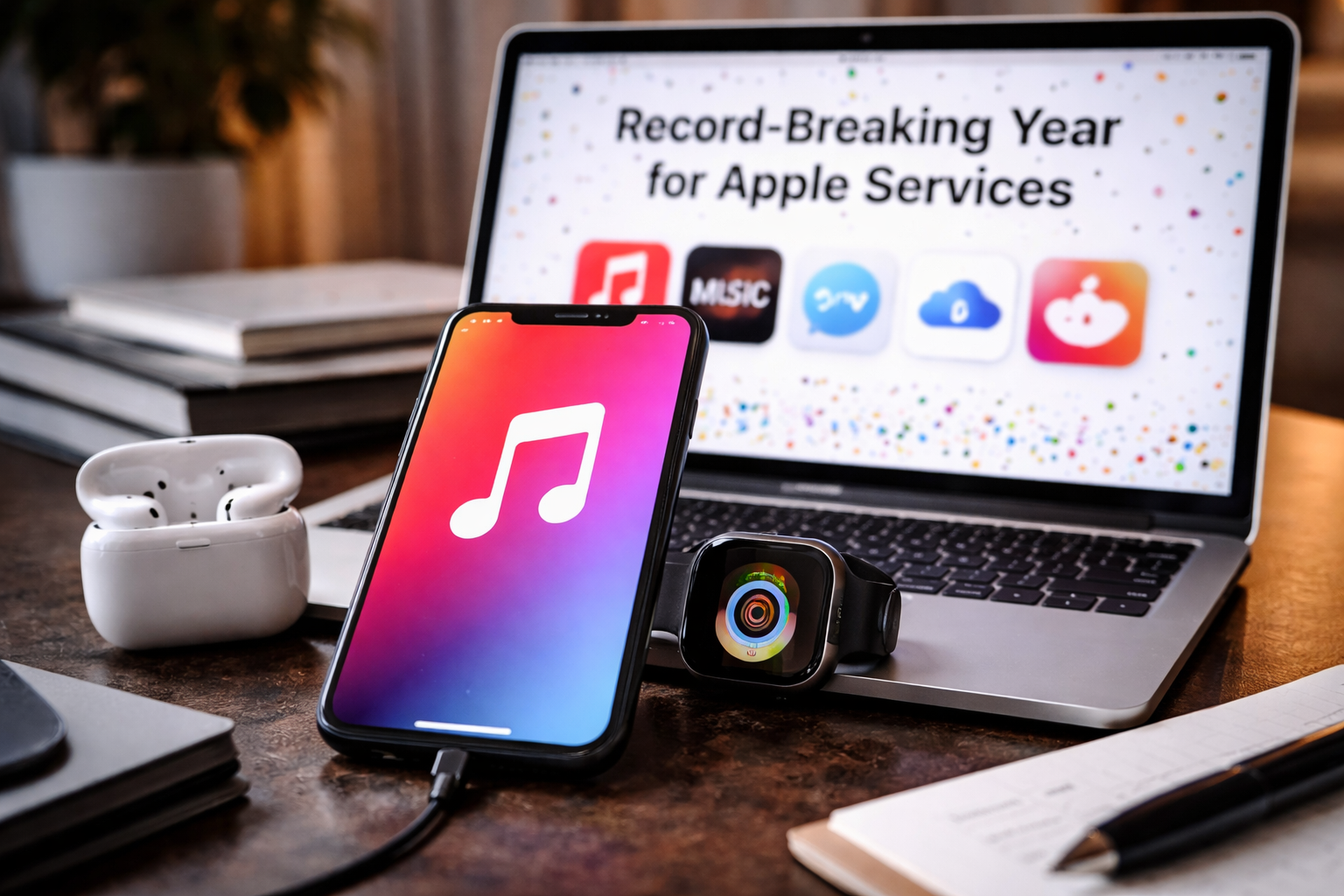

Apple doesn’t usually do chest-thumping without a reason. When it does, it’s rarely about a single product — it’s about the ecosystem. On January 12, 2026, Apple published an official look-back calling 2025 a record-breaking year for Apple Services, the increasingly dominant pillar that sits beside hardware. And yes: Apple Music is name-checked in the company’s own framing of that momentum.
This isn’t just a victory lap. It’s a message to Wall Street, to rivals, and to anyone still thinking “Apple = iPhone.” The subtext is clear: the devices may open the door, but Services keep people in the house — and they pay rent monthly.
A Services Story Told Like a Portfolio, Not a Product
Apple’s wording is intentionally wide-angle: growth, expansion, innovation, engagement — the kind of language that bundles Apple TV, Apple Music, Apple Pay, iCloud, News, and more into a single narrative. That’s the point. Apple doesn’t want this conversation to be “how many subscribers does Apple Music have?” It wants it to be: “Our paid universe is thriving.”
In that universe, Apple Music plays a strategic role: it’s culture, daily habit, and stickiness. Music is the service you use at breakfast, at the gym, during work, on the commute, and when you’re avoiding people in public. In other words: it’s not just entertainment — it’s routine.
Apple Music’s Best Year Ever… Without the Numbers You’re Looking For
Apple says Apple Music had its best year ever in 2025, including record performance across listening and new subscribers. The interesting part isn’t the claim — it’s the restraint.
Apple remains allergic to giving the clean, comparable metrics that would make “best year ever” easy to benchmark against Spotify’s public reporting. Instead, the company leans into signals:
- stronger engagement,
- subscriber momentum,
- global expansion,
- and product evolution tied to the service’s 10-year anniversary.
It’s a very Apple way of saying: we’re winning — trust us — and also, don’t ask for the scoreboard.
The Anniversary Wasn’t Just a Cake Moment
The company positions 2025 as a year where Apple Music didn’t merely celebrate turning ten — it used the milestone to refresh the pitch.
Notably, Apple has been investing in Apple Music as a broadcast and events culture machine, not just a streaming catalog. In 2025, that strategy became more visible through a major studio initiative in Los Angeles designed around radio, live sessions, and artist-driven programming — a physical reminder that Apple Music wants to be perceived as curation + culture, not only “a library with a play button.”
That matters because it’s one of the cleanest differentiators in the streaming wars: Spotify owns discovery at scale; Apple wants to own premium presentation, integration, and creative infrastructure.
Why Apple Is Talking About Services Now
There’s a timing logic here that has nothing to do with nostalgia and everything to do with business.
Services is the segment investors love because it reads as:
- recurring revenue,
- higher margins,
- and resilience when device upgrade cycles slow.
So when Apple highlights a record year for Services, it’s effectively reinforcing the idea that the company can keep growing even when hardware growth is uneven. Apple Music, Apple TV, Apple Pay, iCloud — these are the “always-on” engines.
What This Signals for the Streaming Market in 2026
Apple’s Services victory lap is also a quiet shot across the bow for streaming competitors:
- The bundle strategy will keep tightening. Apple’s strongest advantage isn’t “the best music app,” it’s the gravity of an ecosystem where services are stitched together across devices.
- Expect more investment in culture formats. Radio, live sessions, events, exclusive programming — anything that’s harder to replicate than a catalog.
- The platform battle won’t be fought only on price. It will be fought on identity, convenience, integration, and how “premium” the experience feels.
The Bottom Line
Apple didn’t publish this update just to celebrate a strong year. It published it to underline a transformation: Apple is increasingly a Services company wearing a hardware suit.
And Apple Music’s presence in that statement is telling. It’s not a side feature. It’s one of the daily rituals Apple is building its future around — the kind that turns “I have an iPhone” into “I live in Apple.”
If Spotify is the loud club at the center of town, Apple is building the private members’ lounge next door — quieter, curated, and designed to make you forget you ever needed to leave.