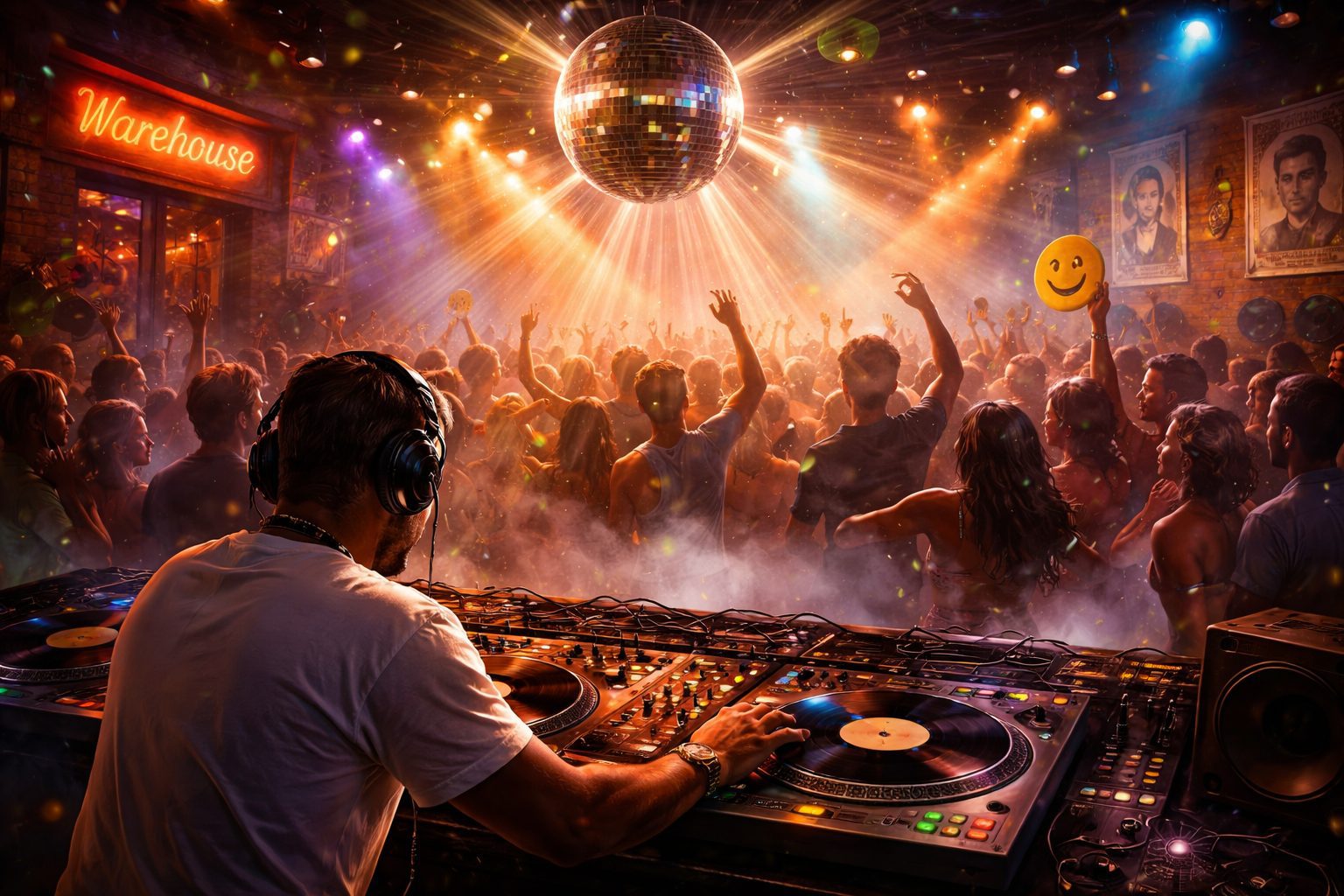

House music did not begin as a trend. It was not invented in a boardroom, polished for radio, or designed to fit a market category. It came from clubs, from communities pushed to the margins, from DJs who understood that rhythm could be more than entertainment. In its earliest form, house was a lifeline. It was movement, release, escape, identity, and celebration all at once. What started in Chicago in the late 1970s and early 1980s would go on to reshape global nightlife, redefine electronic music, and leave an imprint on pop, hip-hop, fashion, and festival culture that is still impossible to ignore.
To tell the history of house music is to tell the story of how an underground culture became one of the most enduring forces in modern music. It is also the story of how a local sound grew into a global language while never fully losing the pulse of the dance floor where it was born.
Before House Music Had a Name
House music did not emerge from silence. Its roots run through disco, soul, funk, gospel, and the more synthetic side of European electronic music. In the 1970s, disco had already transformed nightlife, especially in cities like New York, Philadelphia, and Chicago. It created a culture built on groove, repetition, strings, basslines, vocal ecstasy, and the power of the DJ to shape a room. But when disco faced a commercial backlash in the United States, the music did not disappear. It simply retreated from the mainstream and continued evolving in the clubs that still believed in it.
That moment mattered. Once disco was pushed out of the spotlight, it became freer. DJs started re-editing tracks, extending breaks, isolating rhythms, and favoring records that felt more stripped, more hypnotic, and more durable over long nights. The emotional richness of disco remained, but the sound became tougher, leaner, and more mechanical. Drum machines entered the picture. Synthesizers grew more central. A new dance language was taking shape.
Chicago: The Birthplace of House
If there is one city that can claim house music as its spiritual and historical birthplace, it is Chicago. More precisely, the genre’s story is inseparable from one club: The Warehouse. It was there that Frankie Knuckles, later known worldwide as the Godfather of House, developed a style of DJing that helped define the music before it even had a formal identity.
At The Warehouse, Knuckles was doing more than playing records. He was constructing journeys. He blended disco, soul, European synth music, and emerging electronic rhythms into sets that felt fluid, immersive, and emotionally charged. Dancers were not simply hearing songs; they were being carried by a continuous pulse. That pulse became the foundation of house.
The very name “house music” is widely linked to The Warehouse, where regulars and local record buyers began referring to certain tracks as “house” records, meaning the kind of music played at that club. Whether the label came from that exact origin or from the shorthand used in Chicago record stores, the association stuck. A local term became the name of a genre that would travel around the world.
The First Architects of the Sound
Frankie Knuckles may be the most iconic early figure, but house was not built by one person alone. It came out of a creative network of DJs, producers, promoters, and club communities. Ron Hardy, another essential Chicago figure, pushed the sound in a rawer, more intense direction through his work at the Music Box. His sets were louder, darker, more experimental, and more relentless. If Frankie Knuckles gave house elegance and emotional depth, Ron Hardy gave it danger and urgency.
Jesse Saunders is often credited with releasing one of the first house records, “On & On,” in 1984. That moment was crucial because it helped turn house from a live DJ culture into a recorded genre. Once the sound was pressed to vinyl, it could travel. What had been experienced inside clubs could now be distributed, collected, replayed, and reinterpreted elsewhere.
Marshall Jefferson brought another major ingredient into the mix: piano-driven intensity and musical uplift. His records helped shape the more melodic and anthemic side of house, adding emotional grandeur without losing the dance-floor drive. Larry Heard, under the name Mr. Fingers, pushed the music into deeper and more introspective territory. His work introduced warmth, mood, subtlety, and a sense of late-night reflection that would become central to deep house.
Then there was Phuture, whose experiments with the Roland TB-303 helped create acid house, one of the most recognizable and disruptive branches of the genre. What these artists shared was not one identical sound, but a common instinct: they were building music for bodies in motion, using machines in deeply human ways.
Why House Music Mattered So Much So Quickly
House music arrived at a time when club culture was more than nightlife. For many Black, Latino, and LGBTQ+ communities, clubs were places of freedom in a world that often offered very little of it. House carried that energy. It was inclusive without being soft, emotional without being sentimental, repetitive without ever feeling dead. The beat was a structure, but inside it there was room for joy, sensuality, release, and reinvention.
That social dimension is one reason house music resonated so deeply. It did not ask for permission. It did not need validation from mainstream culture to feel important. It created its own spaces, its own heroes, its own codes, and its own future. Long before the genre became fashionable on big stages, it had already changed lives in dark rooms filled with light, sweat, and bass.
From Chicago to the World
Once house records began circulating on labels and in specialist shops, the sound moved fast. By the mid-1980s, it had crossed the Atlantic and found a powerful second life in the United Kingdom. British club culture was ready for something new, and house arrived with exactly the right combination of groove, futurism, and underground credibility.
In the UK, house music did not remain just an import. It became a movement. Acid house in particular exploded across clubs, warehouses, and illegal raves. The smiley-face era, the all-night fields, the sense of youth rebellion tied to dance music culture — all of that helped turn house into a broader social force. What had started in Chicago was now rewriting nightlife across Europe.
From there, house spread into Ibiza, where it found a natural home in open-air hedonism and marathon DJ sets. It reached France, where producers would later develop their own elegant and sample-rich approach. It moved through Germany, Spain, Italy, South Africa, and beyond. Every territory adapted it. Every city added something. House was becoming less of a local genre and more of an international framework for dance music.
The Many Faces of House Music
One of the reasons house has lasted so long is that it never stayed fixed. It evolved early, and it kept evolving. Rather than one rigid sound, house became a vast musical family, with branches that sometimes overlap and sometimes pull in very different directions.
Deep House
Deep house brought a more soulful, atmospheric, and emotionally textured dimension to the genre. It often leaned into warm chords, subtle grooves, jazzy influences, and intimate moods. Compared with harder club sounds, deep house invited reflection as much as movement. It became the soundtrack for after-hours introspection, sunrise sets, and elegant late-night spaces.
Acid House
Acid house introduced one of the genre’s most recognizable sonic signatures: the squelching, fluid, almost psychedelic bassline of the TB-303. The result was weird, addictive, and unlike anything else. Acid house pushed house into more radical territory and became a cultural explosion in late-1980s Britain, where it helped fuel rave culture on a massive scale.
Garage House
Garage house developed with a stronger emphasis on soulful vocals, gospel influence, swing, and emotional richness. It remained deeply connected to house music’s Black club heritage and helped sustain the genre’s vocal and spiritual side. It also laid groundwork for future strands of soulful and vocal house that continue to thrive today.
Progressive House
Progressive house expanded the structure of the genre, often focusing on atmosphere, layering, long builds, and a more cinematic sense of evolution. Rather than relying purely on immediate impact, progressive house often prioritized the journey. In clubs and festivals, that gave DJs room to create longer emotional arcs.
Tech House
Tech house fused the groove of house with the discipline and minimalism of techno. It became one of the most durable hybrids in electronic music, especially in club settings that favored functional, percussive, stripped-back rhythms. Tech house could be sleek, punchy, and highly effective without sacrificing movement.
French House
French house, also known as French touch, brought disco loops, filter effects, compression, and stylish repetition to the forefront. It felt glamorous and gritty at the same time. Producers in France gave house a polished but playful identity that helped the genre cross into pop culture in a fresh new way.
Afro House
Afro house brought deeper percussion, hypnotic chant-like vocals, spiritual textures, and a strong rhythmic connection to African musical traditions. It has grown into one of the most exciting contemporary forms of house, bridging underground credibility with large-scale global appeal. Afro house feels both ancient and futuristic, rooted and expansive.
Soulful, Vocal, Jackin’, and Beyond
Beyond the better-known categories, house continued splintering into countless substyles: soulful house, vocal house, jackin’ house, funky house, tribal house, minimal house, organic house, melodic house, and more. Each variation shifts the balance between rhythm, melody, atmosphere, and energy. What unites them is the heartbeat underneath: the groove, the repetition, the sense that the track exists to move a room.
The Artists Who Made House Famous
Some artists helped invent house. Others helped carry it into the mainstream. Both roles mattered. In the foundational generation, Frankie Knuckles, Ron Hardy, Marshall Jefferson, Larry Heard, Jesse Saunders, and Phuture shaped the DNA of the genre. They created the grammar that later generations would speak fluently.
In the 1990s and early 2000s, another wave of artists expanded house’s reach. Masters at Work brought sophistication, rhythm, and crossover appeal. Kerri Chandler became a defining figure in deep and soulful house. Armand Van Helden injected charisma, sampling swagger, and club energy. Roger Sanchez, Todd Terry, and David Morales all played key roles in bringing house into a bigger international conversation.
Then came Daft Punk, who changed the scale of the genre’s visibility. Though their catalog moved fluidly between house, electro, disco, and pop, their impact on house culture was undeniable. They helped present dance music as art, spectacle, pop, and philosophy all at once. Alongside them, acts such as Cassius, Stardust, and Étienne de Crécy helped define the French house wave that made filtered grooves and sample-driven elegance irresistible to a huge global audience.
By the time house entered the festival era in a bigger way, it had already become one of the central languages of electronic music. It was no longer just a club genre from Chicago. It was a global reference point.
House and the Mainstream: A Complex Relationship
House music has always had a fascinating relationship with commercial success. It influenced the mainstream repeatedly, even when the mainstream did not always acknowledge the source. Pop music borrowed its drum patterns, piano riffs, basslines, diva vocals, and club structures. R&B absorbed its energy. EDM scaled up some of its mechanics for giant stages. Even contemporary chart music still carries traces of house in the way it builds momentum and frames the beat.
But house itself never became only mainstream. That is part of what makes it unusual. Even when elements of the genre dominate radio or streaming platforms, house still belongs to underground clubs, specialist labels, local scenes, and DJs whose names are known mainly by dancers, not the tabloids. It can be glamorous, but it remains rooted in spaces where music matters more than spectacle alone.
The House Scene Today
House music in the present day is broad, international, and highly fragmented in the best possible way. There is no single dominant sound. Instead, there are multiple parallel scenes feeding one another. Some artists operate in giant festival environments. Others remain attached to intimate clubs and boutique labels. Some lean into polished crossover appeal, while others keep their work rough, deep, or spiritually charged.
Among the most visible current names, Black Coffee stands as one of the defining global figures, helping bring Afro house and a deeper, more atmospheric dance aesthetic to massive audiences. Peggy Gou has become a major cultural presence, blending underground credibility with broad international visibility. Honey Dijon represents one of the most compelling links between classic house lineage, fashion culture, queer nightlife, and contemporary club energy.
On the more explosive end of the spectrum, artists like FISHER, Dom Dolla, and John Summit have pushed house-oriented sounds into larger mainstream and festival circuits, often with a more direct, punchy, high-impact approach. Chris Lake remains a key bridge between underground technique and crossover success. In another direction, Barry Can’t Swim has gained attention for bringing a more musical, emotional, and genre-fluid sensibility into today’s dance landscape.
At the same time, the deeper global scene remains rich with talent across Europe, Africa, Latin America, and beyond. Afro house, melodic house, organic house, and deep house continue to evolve through a new generation of producers who are less interested in rigid boundaries than in building atmosphere, identity, and movement. House today is both heritage and experiment.
Why House Music Still Matters
Some genres become historical artifacts. House did not. It remains active because its core idea is endlessly renewable. A drum machine, a bassline, a chord progression, a vocal fragment, a room full of people — that formula still has power. House adapts because it is not defined by one texture or one era. It is defined by a feeling of propulsion, connection, and release.
It also matters because its origins still carry meaning. House was born in spaces created by people who needed freedom and built it themselves. That history is not decorative. It is central. Even now, when house appears in luxury settings, glossy campaigns, and huge commercial environments, the genre’s emotional and cultural force still comes from that original sense of collective liberation.
There is something almost paradoxical about house music. It is repetitive, yet it rarely feels static. It can be minimalist, yet emotionally expansive. It can fill a stadium or transform a tiny basement. It can sound raw, elegant, spiritual, hedonistic, intimate, or explosive. Few genres have remained so adaptable without losing their pulse.
From the Warehouse to the Future
The history of house music is not a closed chapter. It is a living continuum. Every new generation inherits a groove shaped by those who came before: the Chicago pioneers, the acid revolutionaries, the soulful visionaries, the French stylists, the global innovators, the DJs who kept the flame alive in small rooms long before algorithms started categorizing everything.
From its beginnings in Chicago to its current forms across the world, house music has proven remarkably resistant to fading away. It reinvents itself, absorbs new influences, and keeps speaking to new audiences without abandoning its essence. That essence is simple and powerful: rhythm as freedom, repetition as elevation, the dance floor as a place where something larger than entertainment can happen.
And that is why house still matters. Not because it survives as nostalgia, but because it continues to live in the present. Every weekend, somewhere in the world, the beat drops, the room shifts, and house music begins again.