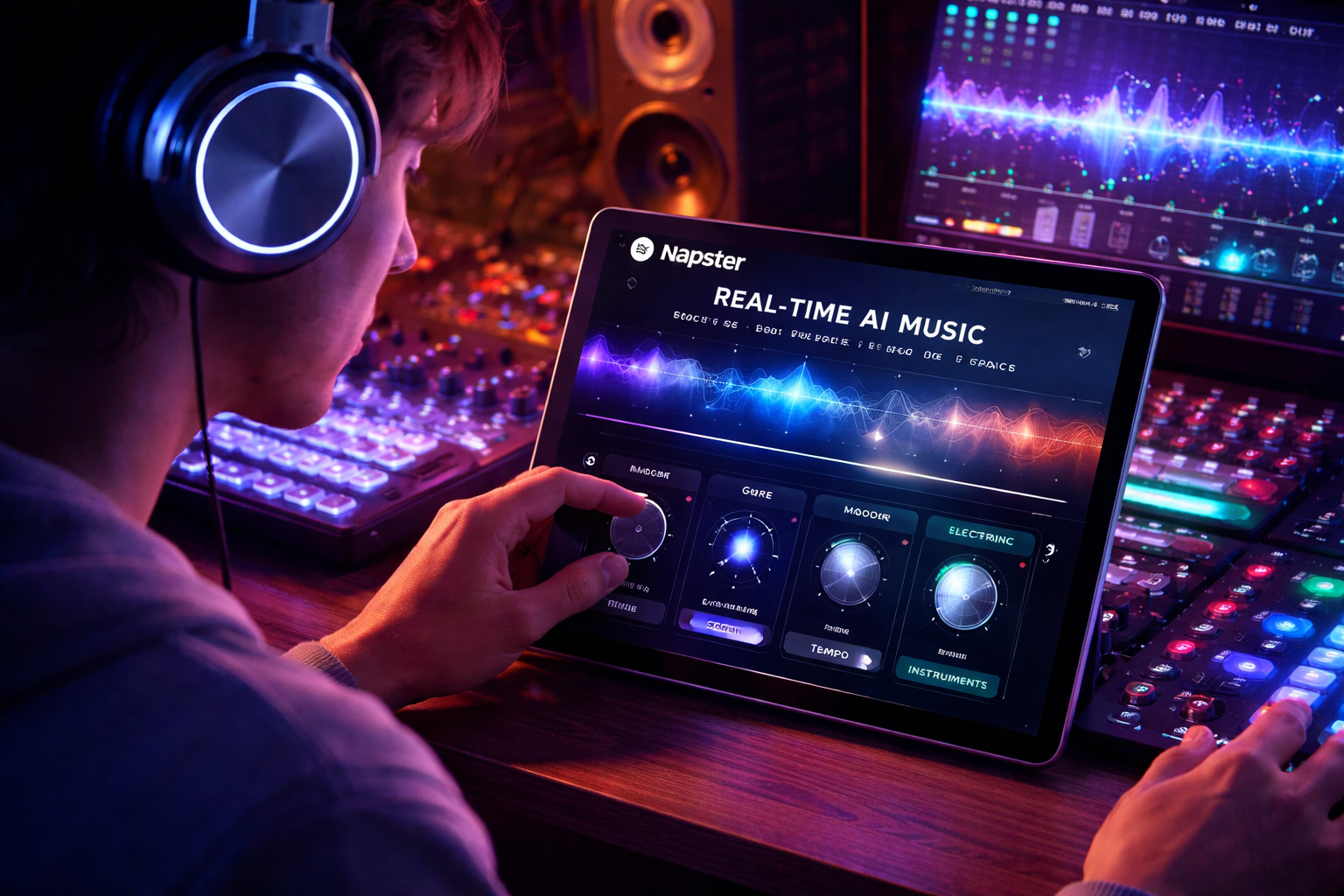

The return of Napster in 2026 marks one of the most radical shifts the music industry has seen since the birth of streaming. No longer centered on catalog access, the platform now experiments with AI-generated audio and interactive experiences where users co-create music in real time. This transformation raises a critical question: is this the future of music consumption — or a disruptive force that could reshape the very meaning of artistry?
From Streaming Libraries to Infinite Creation
Traditional streaming platforms are built on access: millions of tracks, instantly available. Napster’s new model flips that paradigm. Instead of browsing a catalog, users generate music tailored to their mood, activity, or environment. The result is a potentially infinite stream of personalized audio that never existed before the moment it was played.
This approach positions music not as a finished product, but as a living process — adaptive, responsive, and uniquely personal. A workout soundtrack can adjust its tempo to match heart rate. A focus session can evolve based on attention patterns. The listener becomes a participant, shaping the soundscape in real time.
The Promise: Hyper-Personalized Soundtracks
For listeners, the appeal is obvious. AI-generated music offers:
- Perfectly tailored moods and atmospheres
- Endless variety without repetition
- Context-aware soundtracks for daily life
- Interactive control over structure and style
This level of personalization goes beyond playlists and recommendations. It transforms music into a service that adapts continuously, aligning with the broader shift toward AI-driven experiences across digital platforms.
For wellness, gaming, productivity, and immersive media, the potential applications are enormous. Real-time generative audio could become the backbone of adaptive environments — from smart homes to virtual worlds.
The Concern: What Happens to Human Artists?
While the technology is impressive, its implications for musicians are complex. If users can generate infinite music on demand, the perceived value of recorded works may decline. The risk is not just economic — it is cultural.
Music has historically been a reflection of human experience: struggle, identity, community, and emotion. AI-generated tracks, optimized for utility, may prioritize function over expression. The danger lies in reducing music to background noise rather than a meaningful artistic statement.
However, history suggests that new technologies rarely eliminate art forms; they transform them. Photography did not kill painting. Streaming did not end live concerts. AI may similarly redefine the role of artists rather than replace them.
A New Role for Musicians: Designers of Sound Worlds
Rather than competing with AI, artists may evolve into creative directors of generative systems. They can design sound palettes, train models, and define stylistic boundaries that shape how AI produces music. In this model, musicians become architects of sonic ecosystems rather than sole creators of fixed tracks.
This shift could open new revenue streams through licensing AI models, sound packs, and generative frameworks. It also encourages collaboration between technologists and artists, fostering hybrid creative practices.
Ethical and Industry Challenges Ahead
Napster’s experiment also raises urgent questions:
- Who owns AI-generated music?
- How are royalties distributed when no fixed track exists?
- How do platforms prevent model training on copyrighted works without consent?
- Will listeners value music created by algorithms as much as human expression?
Regulation and industry standards will be essential to ensure transparency, fair compensation, and respect for intellectual property.
A Radical Vision — But Not the End of Music
Napster’s pivot toward real-time AI audio represents a bold vision: a world where music is not streamed but generated, not consumed but co-created. Whether this is a positive development depends on how the industry balances innovation with artistic integrity.
If implemented responsibly, generative audio could expand creative possibilities, empower listeners, and open new pathways for musicians. If mismanaged, it risks commodifying music into an endless stream of disposable sound.
The future will likely land somewhere in between — a hybrid ecosystem where human artistry and artificial intelligence coexist, each enhancing the other.
One thing is certain: the definition of “play” is changing.