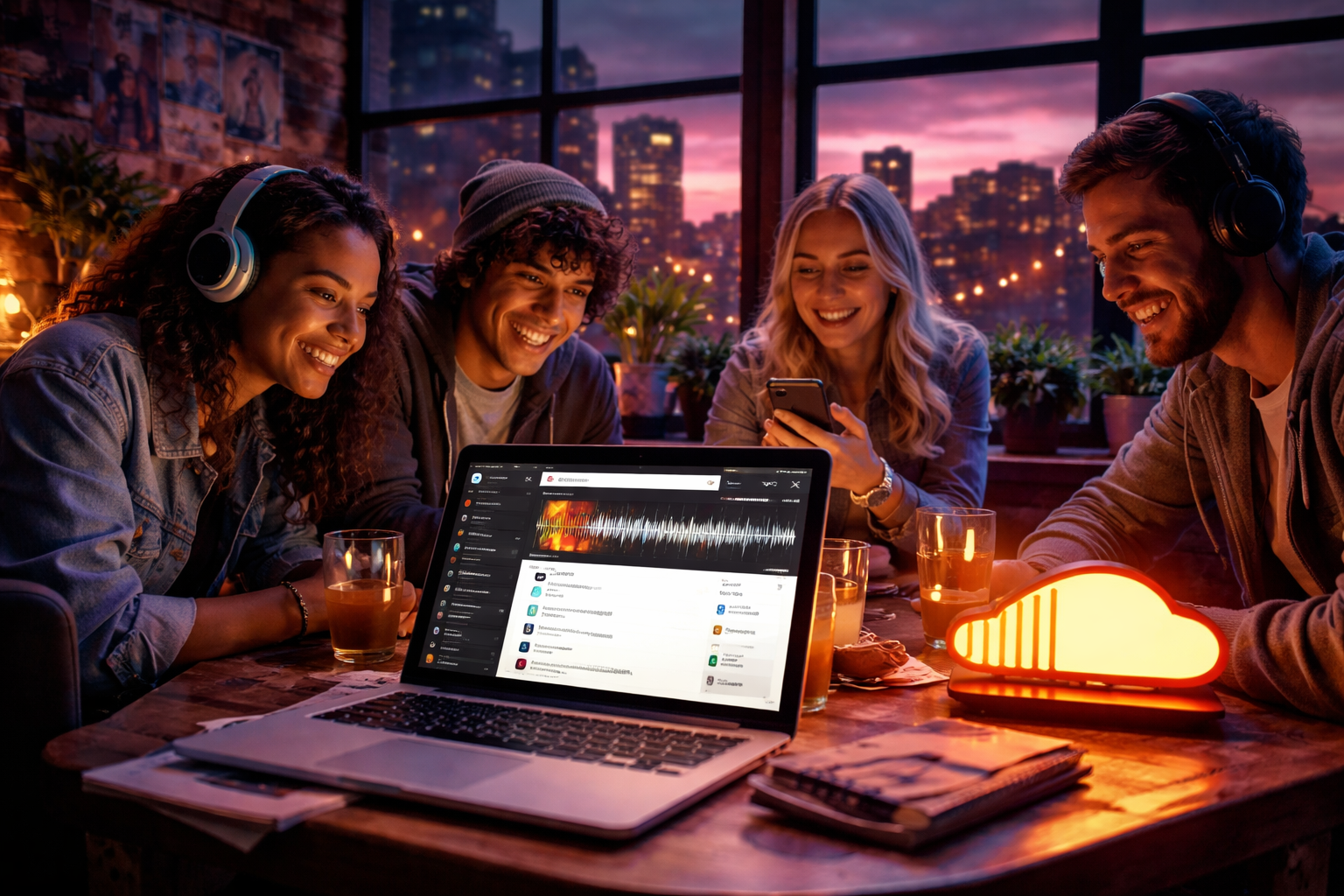

There’s a reason SoundCloud keeps showing up in conversations that start with “Have you heard this yet?” and end with a rabbit hole at 2:47 a.m. While most platforms act like polished storefronts, SoundCloud still feels like the backroom where the future gets tested in public — messy, exciting, and brutally real.
- The new “radio” is your community feed
- “Liked By” is not a feature — it’s a prediction machine
- Scenes are forming before they’re even searchable
- The “hip-hop decline” narrative is misleading — evolution is the headline
- Electronic music isn’t just growing — it’s diversifying at speed
- What this means for artists: stop chasing “placement,” start building signals
- What this means for labels and curators: SoundCloud is an early-warning system
- The bottom line: discovery is becoming social again — for real this time
- AUDIARTIST
SoundCloud’s Music Intelligence Report 2026 doesn’t just celebrate that vibe. It quantifies it. And the takeaway is loud: scenes don’t begin with genre labels or editorial playlists anymore. They begin with people — with likes, reposts, comments, and those tiny social signals that move faster than any chart.
The new “radio” is your community feed
On traditional streaming platforms, discovery often looks like a one-way street: the algorithm serves, the listener consumes, the track either sticks or disappears. SoundCloud’s model is different because discovery is participatory. When a listener likes something, reposts it, or leaves a comment, they aren’t simply reacting — they’re broadcasting.
That matters, because SoundCloud’s culture has always been built on visible momentum. You don’t just see numbers; you see movement. A track doesn’t only rack up plays — it becomes a shared object. A mini-flag planted by a listener saying: “This is mine. This is ours. Pay attention.”
The report reinforces a key point: social discovery doesn’t just reflect hype — it creates it. Those engagement signals become an engine, not an accessory.
“Liked By” is not a feature — it’s a prediction machine
One of the most telling insights in the report is how discovery through other users’ signals changes behavior. When listeners enter a track via community cues — especially through the “Liked By” pathways — they’re dramatically more likely to engage again themselves (liking, reposting, commenting).
In plain terms: SoundCloud’s social layer doesn’t only help people find music. It makes them more likely to participate once they arrive. That’s a feedback loop, and it’s the kind the rest of the industry keeps trying to simulate with “social” add-ons that feel… politely forced.
SoundCloud’s version works because it’s native. It’s been part of the ecosystem since the beginning.
Scenes are forming before they’re even searchable
Here’s the real flex: SoundCloud is mapping scenes before they’re named. Before critics agree on the terminology. Before playlist categories exist. Before labels can package it. The report frames SoundCloud as a place where movements form through interaction first, then become identifiable later.
This is huge for one simple reason: genres are labels applied after the fact. But culture happens in real time.
That’s why SoundCloud remains a radar, not a museum. It doesn’t just archive what already won — it reveals what’s still becoming.
The “hip-hop decline” narrative is misleading — evolution is the headline
The report pushes back on the easy storyline that hip-hop is “down.” The more accurate story is that hip-hop is mutating, cross-pollinating, splitting into fresh micro-scenes, pulling from punk energy, indie textures, electronic movement, and hybrid internet-born rhythms.
If you’re looking only at traditional top-line genre categories, you’ll miss it. If you’re watching community behavior — the way scenes form and accelerate — it becomes obvious: the center hasn’t vanished, it’s multiplied.
Electronic music isn’t just growing — it’s diversifying at speed
Another major current in the report is where electronic music is headed: not toward one dominant sound, but toward scene fragmentation and acceleration. In other words: more pockets, more hybrids, more fast-moving local flavors, more global crossovers.
That’s important because electronic music has always been scene-driven, but platforms tend to flatten it into neat bins. SoundCloud’s data argues the opposite: the future isn’t a single wave — it’s many simultaneous currents, each with its own community pushing it forward.
What this means for artists: stop chasing “placement,” start building signals
If SoundCloud’s social discovery is the engine, then the strategy changes. The goal isn’t only to “get on playlists.” It’s to ignite the behaviors that create momentum.
That means designing releases like they’re meant to be shared, not just streamed:
- Give your first listeners a reason to comment (not just heart-react).
- Make reposting feel like joining a moment, not doing you a favor.
- Build habits around drops — consistency trains attention, and attention trains the algorithm.
- Treat your SoundCloud presence like a living space, not a link in bio.
The platforms with the most power aren’t always the ones with the biggest marketing budgets. They’re the ones where the audience is still willing to do something — to interact, to co-sign, to participate.
What this means for labels and curators: SoundCloud is an early-warning system
For A&Rs, curators, and anyone trying to spot what’s next: SoundCloud is still one of the best places to detect momentum before it becomes expensive.
The report’s underlying logic is clear: if you wait for mainstream proof, you’re late. If you watch community behavior — the clusters of engagement, the repeat signals, the emerging hubs — you can catch scenes while they’re still forming.
It’s not just trend-hunting. It’s culture-reading.
The bottom line: discovery is becoming social again — for real this time
Streaming spent years optimizing convenience: frictionless play, frictionless skip, frictionless everything. SoundCloud is leaning into the opposite idea: discovery with fingerprints on it.
The 2026 Music Intelligence Report makes the case that the future of music isn’t only about better recommendation tech. It’s about platforms that keep humans visible inside the system — the people who like, repost, comment, and quietly decide what the rest of the world will call “next.”
SoundCloud didn’t win by being the cleanest. It won by being the earliest.
And in a music world drowning in content, early is a superpower.