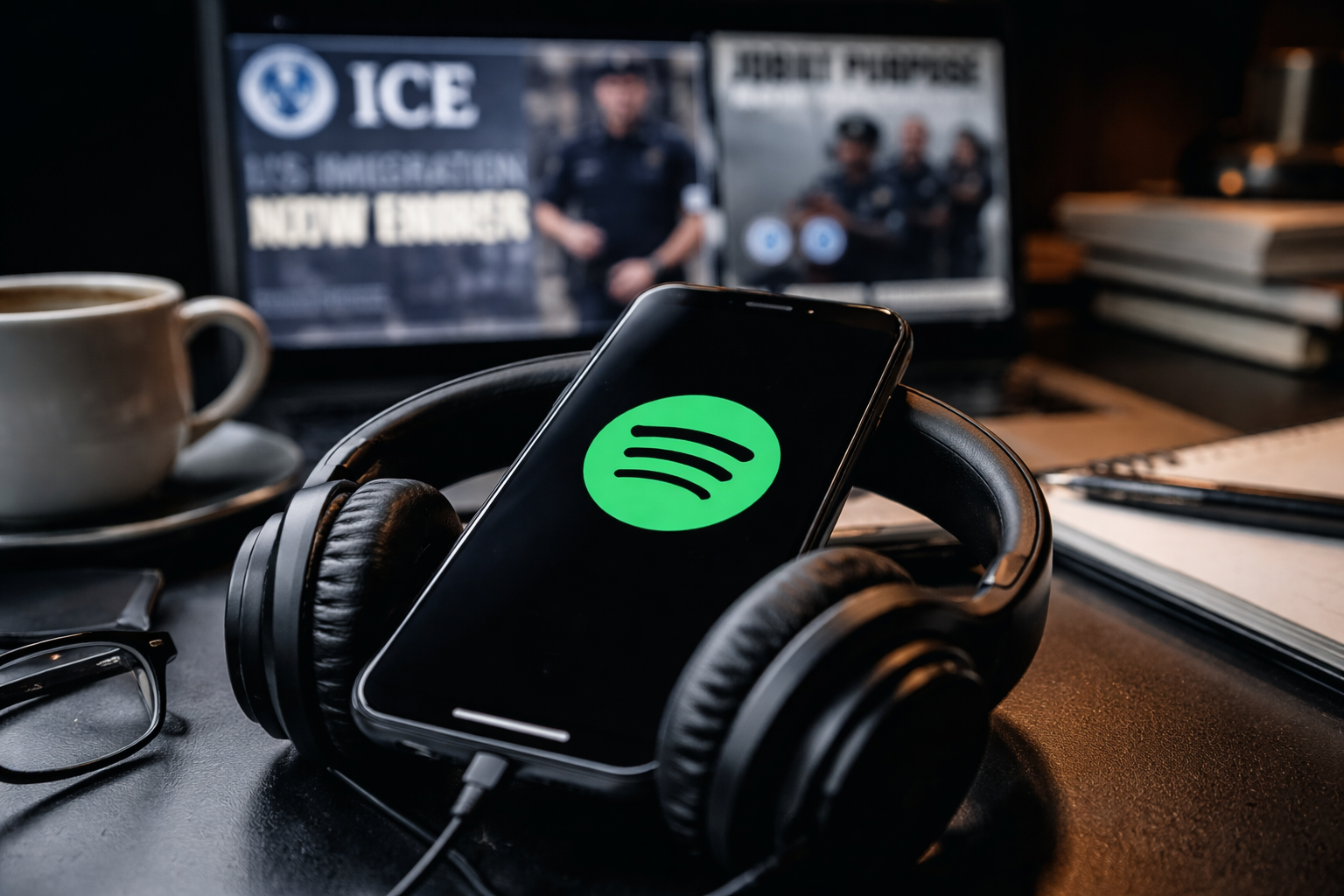

No press conference. No long manifesto. Just a confirmation: Spotify is no longer running recruitment ads for U.S. Immigration and Customs Enforcement (ICE).
Officially, the explanation is procedural. The government campaign ended. The ads stopped with it.
- Why This Didn’t Fade Away Like a Normal Ad Campaign
- Spotify’s Statement vs. Public Perception
- The Real Story Isn’t ICE — It’s Power
- Why This Hit Spotify Harder Than Traditional Media
- Artists Are Watching (Even If They’re Not Tweeting)
- For the Music Industry, This Is a Strategy Lesson
- What Happens Next Is the Real Test
- Final Take
Unofficially? The platform just stepped out of a cultural minefield—carefully, quietly, and without pretending the ground isn’t still shaking.
Why This Didn’t Fade Away Like a Normal Ad Campaign
Most ad campaigns end unnoticed. This one didn’t.
Because this wasn’t a sneaker drop or a streaming bundle. It was state recruitment messaging inserted into one of the most intimate media spaces that exists: music streaming. Headphones. Playlists. Focus sessions. Late-night loops.
That context changes everything.
When listeners hit play, they don’t expect to be addressed by authority. They expect mood, escape, identity. The backlash wasn’t about ad fatigue—it was about space violation.
Spotify’s Statement vs. Public Perception
Spotify’s position is clear and narrow:
The ads were part of a time-limited government buy. That buy ended. No ICE ads are running now.
What Spotify didn’t say is just as important as what it did.
There was no declaration of new standards.
No revision of political or government ad policy.
No commitment that similar campaigns won’t return.
To critics, that distinction reads less like closure and more like a pause button.
The Real Story Isn’t ICE — It’s Power
ICE is the symbol here, not the core issue.
The real tension is this: who gets to speak inside cultural platforms, and under what rules.
Streaming services like Spotify aren’t neutral pipes anymore. They’re environments. Curated, algorithmic, emotional environments. And once a platform monetizes attention at that level, it inherits responsibility—whether it wants it or not.
Listeners don’t separate “the ad team” from “the product.”
Artists don’t separate “policy compliance” from “brand values.”
Everything blends into one experience.
Why This Hit Spotify Harder Than Traditional Media
A government recruitment ad on TV feels expected. Almost retro.
The same message between two songs feels invasive.
That’s the difference.
- Audio is immersive, not skippable in the same way.
- Music platforms are identity-driven, not utility-driven.
- Spotify sells personalization, which raises expectations of alignment.
When a platform promises “your soundtrack,” users assume a degree of consent. Breaking that illusion is expensive—sometimes more expensive than the ad buy itself.
Artists Are Watching (Even If They’re Not Tweeting)
This kind of controversy rarely stays isolated.
Artists may not all speak publicly, but they notice patterns:
- What messages are allowed
- What values are enforced
- How quickly platforms react when pressure builds
History shows that once trust cracks, leverage appears. Catalog withdrawals, exclusivity threats, public letters—these tools don’t disappear. They wait.
For the Music Industry, This Is a Strategy Lesson
If you’re releasing music, building a label, or managing an artist brand in 2026, here’s the uncomfortable truth:
You don’t just choose platforms for reach anymore. You choose them for context.
Platform adjacency shapes perception.
Platform controversies bleed into artist ecosystems.
Platform silence can speak louder than policy.
That’s why smart strategies now include:
- Direct-to-fan channels
- Community ownership
- Multi-platform distribution that avoids total dependence
Not as rebellion. As risk management.
What Happens Next Is the Real Test
The ads are gone. The question isn’t.
Will Spotify formalize stricter guidelines on government recruitment advertising?
Will transparency around ad approvals increase?
Will competitors use this moment to position themselves as “listener-first” alternatives?
Those answers won’t come in statements. They’ll come in future buys—and future backlash.
Final Take
Spotify didn’t make a grand ethical pivot. It made a tactical exit.
But the episode leaves a mark: music streaming is no longer just about songs—it’s about space, values, and who gets invited into the listener’s head.
End the campaign, sure.
The debate? That playlist is still on repeat.