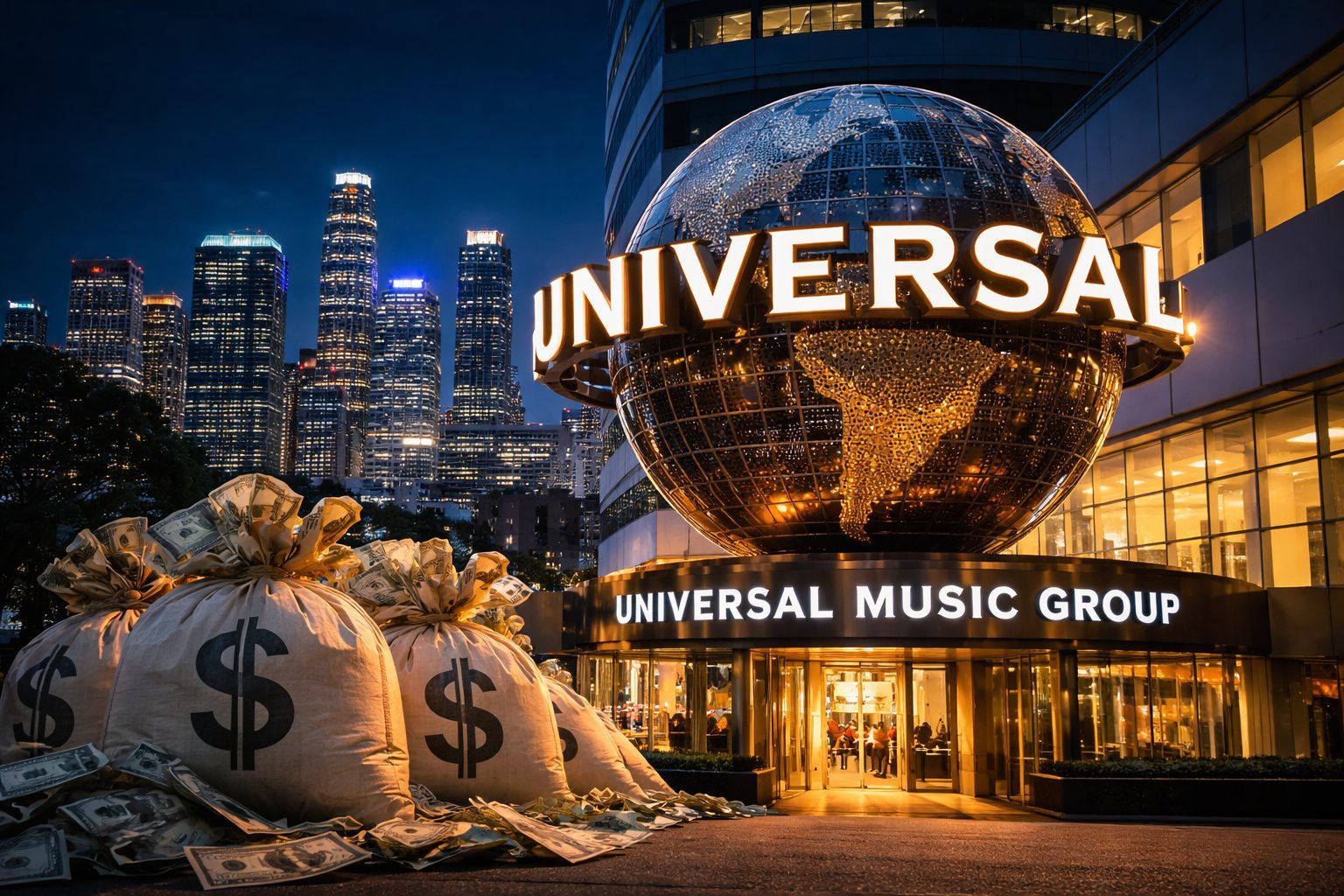

The biggest music company in the world is suddenly at the center of one of the most consequential deals the modern music business has seen in years. On April 7, 2026, Bill Ackman’s Pershing Square put forward a cash-and-stock proposal to acquire Universal Music Group in a deal valued at roughly $64 billion. On paper, it is a corporate story. In reality, it is much bigger than that.
If the proposal moves forward, it would not simply reshape the ownership of Universal Music Group. It could also alter the balance of power between record labels and streaming platforms, strengthen the hand of major rightsholders in future negotiations, and push the economics of music streaming into a more aggressive new phase. For Spotify, Apple Music, Deezer, Amazon Music, YouTube Music, and every platform built on licensed catalogs, this is not background noise. This is front-page business.
Universal Music Group is not just another entertainment company. It is the world’s largest music business, home to an enormous share of commercially essential repertoire and some of the biggest global artists in circulation. When a company of that scale becomes the target of a takeover bid, the consequences extend well beyond shareholders. They reach distribution, licensing, valuation, strategy, and ultimately the way music is packaged, priced, and delivered to audiences around the world.
A Deal That Goes Far Beyond Finance
Pershing Square’s proposal values Universal Music Group at around €30.40 per share, a sharp premium over the company’s recent market price. The structure combines approximately €9.4 billion in cash with shares in a newly configured entity that would be listed in New York. In practical terms, this is not only a bid for control. It is also a bid to reposition Universal Music Group inside a different financial ecosystem, with the United States presented as the market where the business could command a stronger valuation and broader investor appeal.
That detail matters. Universal has spent the last several years navigating questions around its listing strategy, its share-price performance, and the perception that public markets have not fully rewarded the long-term value of recorded music and publishing rights. Pershing Square’s argument is straightforward: Universal is worth more than the market has recently allowed it to show, and a move toward New York could unlock that value more effectively than the current arrangement.
But even that explanation only tells half the story. Music rights are no longer treated as a side category in global finance. They are now viewed as strategic assets with recurring revenue, defensible intellectual property, and long-tail cash generation. In other words, the deal is not simply about Universal being “undervalued.” It is about who gets to control one of the most powerful rights portfolios in the global entertainment economy.
Why Streaming Platforms Should Be Paying Very Close Attention
For streaming services, Universal Music Group is not just a supplier. It is one of the pillars that make the entire subscription model viable. The major platforms compete on interface, recommendation systems, bundled services, audio features, ecosystem strength, and user experience, but they all depend on licensing the catalogs that listeners actually want. Universal’s leverage begins there.
If control of UMG shifts into a more aggressive financial structure, the next round of negotiations with streaming platforms could become more assertive. That does not automatically mean immediate disruption, but it does raise the temperature. A rights holder under new ownership, or new strategic pressure, may pursue tougher economics, more ambitious licensing structures, or a broader set of demands tied to premium tiers, catalog prioritization, data access, promotional placement, or bundled monetization.
Streaming platforms have already spent years trying to prove that scale, recommendation technology, and platform stickiness can offset the structural power of labels. This deal is a reminder that the labels still own the assets that matter most. Algorithms can guide discovery. Interfaces can reduce friction. But when a company controls a vast share of the music consumers value, it enters every negotiation with gravity.
The New York Angle Is Not a Footnote
One of the most revealing parts of the proposal is the intention to move the center of gravity toward a New York listing. This is not cosmetic. It signals a belief that the American market may assign a different narrative to Universal Music Group than European markets have in recent years.
That narrative is built on scale, intellectual property, predictable licensing income, and the long-range monetization potential of music rights across streaming, sync, social media, short-form video, gaming, artificial intelligence licensing, and catalog exploitation. In other words, this is the argument that music is no longer merely a cyclical cultural business. It is an infrastructure business built on ownership.
If that framing gains traction, it could increase pressure on streaming platforms from two directions at once. First, labels would have stronger incentives to defend or improve the economics of licensing. Second, financial markets would be watching more closely, pushing management teams to justify growth and profitability with greater urgency. That can have a direct downstream effect on how aggressively a company negotiates with platforms that rely on its catalog.
Universal’s Catalog Is the Real Prize
The heart of the story is not the bid price alone. It is what Universal controls. UMG sits at the center of a vast commercial repertoire that gives it extraordinary bargaining power in a world increasingly defined by recurring subscription revenue and digital consumption. In the streaming era, ownership of hit catalogs is not just culturally powerful. It is economically strategic.
That is why this proposal lands with such force. The world’s biggest music company is not being targeted because music is suddenly fashionable again in boardrooms. It is being targeted because music rights, at scale, have become one of the most attractive long-duration asset classes in the entertainment sector. They generate ongoing revenue, travel across platforms, and extend far beyond the life cycle of a traditional release campaign.
For streaming platforms, that creates a familiar but uncomfortable reality. The services operate at consumer scale, but the labels control much of the premium inventory. When one of those labels becomes the object of an even larger strategic play, the services are reminded of a basic truth: distribution may be digital, but leverage still begins with ownership.
What This Could Mean for Spotify, Apple Music, and the Rest
Spotify remains the clearest example of a platform built on scale, personalization, and user behavior at global level. Apple Music leans on ecosystem strength, premium positioning, and broader device integration. YouTube Music benefits from Google’s infrastructure and its proximity to creator culture. Deezer continues to carve out relevance through product differentiation and regional positioning. Yet none of them can ignore a potential shake-up at Universal.
If Universal’s strategic direction changes, several questions become unavoidable. Will licensing become more expensive? Will majors push harder for differentiated payment structures? Will premium content, release-window strategy, or promotional access become more tightly contested? And will platforms have to offer more to hold the same catalog position they currently treat as baseline?
These are not abstract questions. The economics of streaming have always been defined by a difficult balance between user growth, subscription pricing, royalty obligations, and investor expectations. A more assertive UMG could disturb that balance, especially if broader market conditions make platforms less willing to absorb rising content costs without pushing changes back onto users, artists, or both.
The Independent Sector May Feel the Shock Too
Whenever the biggest companies in the music business reposition themselves, the independent sector feels the aftershocks. Not always immediately, and not always visibly, but the pressure spreads. If major labels strengthen their negotiating position with streaming services, independent artists and labels may face a tougher environment in subtle ways: less visibility, more competition for editorial placement, tighter economics, or a greater premium placed on direct audience ownership.
This is where the story becomes especially important for the broader music ecosystem. A more concentrated, more financially intensified top tier can make the market feel even more unequal. Streaming was once framed as a democratizing force. In many ways, it remains one. But ownership concentration has never disappeared. In fact, it may now be hardening into a more explicit competitive advantage.
For independent artists, the lesson is not panic. It is strategy. The more power accrues to major rightsholders and major platforms, the more essential it becomes for independent music professionals to build durable visibility outside the platform layer alone. Audience capture, brand identity, mailing lists, direct communities, editorial coverage, playlists, social presence, and owned traffic all become more important when the center of the industry grows more consolidated.
Can the Deal Actually Happen?
That remains the central open question. The proposal is non-binding, and any transaction of this size would need support from key shareholders as well as regulatory and corporate approval. Universal’s shareholder structure is not simple, and Pershing Square would need to navigate serious resistance, not just financial logic.
There is also the matter of timing. The proposal arrives after a period in which Universal’s valuation story has already been under debate, including discussions around listing strategy and the company’s market performance since its 2021 debut. Pershing Square has history with Universal, which adds a layer of continuity but also a layer of friction. This is not a clean outsider raid. It is an attempt shaped by years of prior involvement, public disagreement, and unresolved strategic questions.
That history makes the bid more credible in one sense and more complicated in another. Pershing Square knows the company well. But knowing a company well does not make a transaction easier when governance, influence, and control are on the line.
The Bigger Message for the Streaming Era
Whether or not the deal closes, the signal is already clear. Music is being treated as strategic infrastructure, and the ownership of rights is becoming even more central to how value is priced in the digital era. Streaming platforms changed consumption. They did not erase the underlying power of the companies that control the catalog.
That is the real takeaway from this moment. The next chapter of streaming may not be defined only by product innovation, AI playlists, superfans, audiobooks, podcast bundling, or premium audio formats. It may also be defined by a harder, more visible struggle over leverage between platforms and the owners of the music they distribute.
Universal Music Group now sits at the center of that tension. A $64 billion bid is dramatic enough on its own. But the deeper significance lies in what the bid reveals: the streaming economy is still built on a simple foundation. The pipes matter. The platforms matter. The recommendation engines matter. But the catalog still matters most.
A Turning Point for Music Business Power
This is why the proposed takeover of Universal Music Group deserves to be read as more than a financial headline. It is a snapshot of where the music business is heading. Capital wants rights. Rights want stronger valuation. Platforms want flexibility. Labels want leverage. Artists want fairness. Audiences want frictionless access. All of those interests now collide in the same ecosystem.
If Pershing Square succeeds, the streaming landscape could enter a more muscular phase, one where the largest rights owners push harder, negotiate tougher, and demand more visible recognition of the value they bring to the platform economy. If the deal fails, the message still lands: Universal Music Group is too strategically important to be treated as just another listed entertainment company.
Either way, the industry has been put on notice. The future of streaming will not be shaped by technology alone. It will also be shaped by who owns the songs, who controls the catalogs, and who has the power to turn access into influence.