
How to Choose Your First DAW for Beatmaking and Music Production
Choosing your first DAW can feel strangely dramatic. Spend one evening online and you will quickly meet a choir of strong opinions, workflow evangelists, interface loyalists, and producers who talk about software as if they are defending a family crest. One camp swears that one DAW is the only serious option for beatmaking. Another says a different platform is faster, deeper, cleaner, more creative, more professional, more intuitive, or somehow spiritually superior. For a beginner, it is enough to make the simple act of starting music production feel more complicated than it needs to be.
The good news is that most modern DAWs are more capable than beginners actually need. The bad news is that this makes the choice feel bigger than it is. Your first DAW does matter, but not because one platform is magical and the others are broken. It matters because the right one gets out of your way. It helps ideas move quickly, makes learning less frustrating, and gives you enough room to grow before your sessions become more advanced.
That means the real question is not, “Which DAW is best?” It is, “Which DAW fits the way I want to make music?” Beatmakers, vocal producers, electronic artists, songwriters, loop-based creators, and audio-first musicians do not all think in the same way. The smartest first choice is the one that matches your instincts, your budget, and your actual working habits—not the one that won the loudest argument on YouTube at three in the morning.
Choose for workflow
The best beginner DAW is the one that makes arranging, recording, and finishing music feel natural rather than technical.
Choose for momentum
A DAW that keeps you creating is always more valuable than one that impresses you but slows you down.
Choose for growth
Your first DAW should be simple enough to learn and deep enough to stay useful once your skills catch up.
First, Stop Looking for the “Perfect” DAW
One of the biggest beginner mistakes is trying to solve the DAW question as if there were a single correct answer hidden somewhere inside product pages and comment sections. There is not. Today’s major DAWs are all capable of producing professional music. Entire careers have been built in Ableton Live, FL Studio, Studio One, Logic Pro, GarageBand, REAPER, and several others. The quality of the music does not come from a logo in the top-left corner of the screen. It comes from taste, repetition, arrangement, sound choices, and the ability to finish what you start.
So the goal is not to identify the most powerful software in abstract terms. The goal is to find the environment where your ideas arrive with the least resistance. That may be a DAW built around loops and rapid pattern creation. It may be one that feels more like a recording studio. It may be something clean and flexible that rewards patience. The right answer depends less on prestige than on psychology.
If You Think in Loops and Patterns, Start There
For many beginners, beatmaking starts with rhythm, not arrangement. A kick appears, then a snare, then a bass idea, then a melody line, and before long the track is being built in layers rather than written from beginning to end. If that sounds like you, your first DAW should feel fast, immediate, and playful. You want something that helps you sketch ideas before self-doubt has time to join the session.
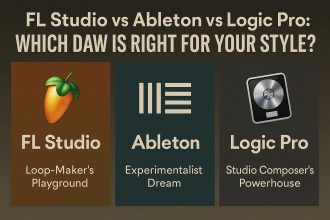
FL Studio has earned its place in that conversation for a reason. It is fast to open, strong for pattern-based production, and especially inviting for people who begin with drums, melodies, and loop construction. Its workflow can feel natural to beginners who want to build the track piece by piece, especially in hip-hop, trap, EDM, drill, pop production, and many forms of electronic beatmaking. It is the kind of DAW that often makes people productive before it makes them fully educated, which is not a flaw at all. In the beginning, momentum matters.
That does not mean FL Studio is only for beatmakers, but it does mean it often feels instantly approachable to people who think in short musical blocks and then expand outward. If you are the kind of beginner who wants the DAW to say “go on, build something” rather than “please configure your life first,” this kind of workflow can be a strong match.
If You Want to Perform, Experiment, and Build Ideas Visually
Some beginners are not really thinking in traditional song sections at first. They are thinking in energy, texture, movement, and experimentation. They want to trigger ideas, reshape audio, test combinations, and move between improvisation and arrangement without feeling boxed in. For that kind of mind, Ableton Live Lite or the wider Ableton Live ecosystem often makes immediate sense.
Ableton has long been attractive to electronic producers because it turns experimentation into part of the core workflow rather than a side activity. Clips, scenes, live-style launching, and rapid audio manipulation make it especially appealing for house, techno, ambient, experimental pop, sample-based production, and hybrid live setups. It is also a great environment for learning how arrangement and improvisation can feed each other instead of living in separate rooms.
For a beginner, what matters most is not the mythology around Ableton but its sense of movement. It invites trying, testing, and reshaping. If your best ideas arrive while playing with material rather than planning every step, that kind of design can be a real advantage.
If You Think Like a Songwriter or Recorder, Simplicity Matters
Not every beginner starts with beatmaking. Some start with chords, vocals, guitars, lyrics, and demos that need structure more than they need sound design fireworks. If your instinct is to record ideas, layer instruments, and shape songs in a more linear way, you may be happier in a DAW that feels organized, direct, and less dependent on loop culture.
Studio One Pro is often attractive here because its general workflow feels tidy, modern, and recording-friendly. It tends to appeal to musicians who want a DAW that can handle writing, recording, editing, mixing, and even mastering without feeling fragmented. For beginners who like structure and want the software to feel coherent from the first sketch to the final bounce, it can be an elegant entry point.
It is also a good reminder that beginner-friendly does not have to mean stripped-down. Sometimes the right DAW is the one that feels adult enough to grow into, but clear enough not to punish you for being new.
If You Are on Mac and Want the Easiest Entry Point
For Mac users, there is an obvious beginner path that should not be ignored simply because it is familiar: GarageBand. It is often underestimated precisely because it comes from Apple and is associated with starting out, but that is also its strength. It is one of the simplest ways to begin recording, arranging, learning signal flow, and building real songs without first climbing a wall of setup friction.
GarageBand is not the most glamorous answer, but it is often the smartest one for complete beginners on Mac. It teaches the fundamentals cleanly. It helps users understand tracks, instruments, effects, basic mixing, and song building without drowning them in options. For many new producers, that is exactly what a first DAW should do.
And when the time comes to go further, the transition to Logic Pro can feel natural. That makes GarageBand especially attractive for beginners who want a low-friction start without choosing software that feels like a dead end.
If Budget Matters More Than Branding
For some beginners, the question is not which DAW feels coolest. It is which one gives the most room to learn without forcing a big early investment. That is where REAPER becomes hard to ignore. It may not always be the first DAW that social media places in front of newcomers, but it remains one of the most flexible and affordable serious options in music production.
REAPER can feel less hand-holding than some of the more instantly seductive platforms, but for the beginner who is patient, curious, and comfortable learning through practice, it offers remarkable depth. It is the kind of DAW that rewards people who want control, customization, and long-term value rather than a heavily branded personality.
This is where beginner advice often goes wrong. It assumes every newcomer wants the same emotional experience from software. Some want inspiration. Some want order. Some want speed. Some want flexibility at the lowest possible cost. DAW choice makes more sense when you accept that these are different creative temperaments, not different levels of seriousness.
The Hidden Factor: What Kind of Frustration Can You Tolerate?
This may be the most useful question of all. Every DAW has a learning curve, but the type of friction varies. Some DAWs are easy to start and harder to master. Some feel confusing for two weeks and then suddenly become powerful. Some are visually inviting but conceptually strange. Others look plain but make more sense over time.
As a beginner, you should not ask whether a DAW has a learning curve. They all do. Ask whether the curve annoys you in a way you can live with. If a DAW’s interface makes you close the laptop after ten minutes, that matters. If another one makes you curious enough to keep going, that matters even more. Early consistency is worth more than theoretical superiority.
Do Not Choose Based on Features You Will Not Use for a Year
Another trap is shopping for your future self instead of your current one. Beginners often choose a DAW because it has advanced scoring, complex routing, surround options, deep scripting, or massive high-end features that sound impressive but will remain untouched while they are still learning how to make a clean eight-bar loop. That is like choosing a racing car because one day you might enjoy a specific kind of corner at 300 kilometers an hour.
Your first DAW should help you do the basics exceptionally well: create drums, record audio, write MIDI, arrange sections, use effects, export tracks, and stay engaged long enough to finish music. If it does that, it is already doing the most important work.
A Good First DAW Should Make You Want to Open It Again Tomorrow
That is the benchmark that matters most. Not whether strangers online say it is the “industry standard.” Not whether a famous producer uses it. Not whether it comes with enough branding to make your desk feel official. A good beginner DAW should make you want to come back the next day, and the day after that, with slightly better ears and slightly more confidence.
If you are drawn to fast pattern building and beat construction, FL Studio makes a lot of sense. If you want visual experimentation, live-style idea generation, and electronic flexibility, Ableton Live is a natural candidate. If you prefer recording, songwriting, and a tidy all-in-one production flow, Studio One is worth serious attention. If you are on Mac and want the easiest possible starting point, GarageBand is still one of the smartest beginner tools around. If budget and flexibility matter most, REAPER deserves far more respect than it sometimes gets in flashy beginner conversations.
Choose the One That Helps You Finish Music
Your first DAW is important, but it is not destiny. It is a working environment. Some producers stay with their first choice for years. Others change later when their needs become clearer. Both paths are fine. What matters at the beginning is not loyalty. It is movement.
So choose the DAW that feels least hostile to your creativity, most aligned with your habits, and most likely to keep you making music instead of researching it endlessly. In music production, finishing a rough first track in the right DAW will teach you more than reading fifty comparisons in the wrong mood. At some point, the real answer is simple: pick one, learn it deeply, and get to work.