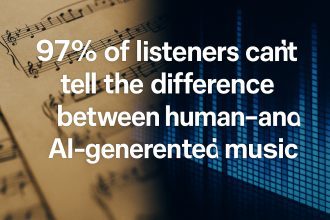

Deezer has made one of the strongest statements yet in the streaming era’s growing battle over AI-generated music. The platform says it is now receiving nearly 75,000 AI-made tracks every day, representing around 44% of its daily uploads. Those numbers are staggering on their own, but the real story is what comes next: Deezer is no longer treating synthetic music as a side issue. It is treating it as a platform-wide challenge that affects discovery, monetization, and the value of human-made music.
A Flood of Uploads Is Reshaping the Conversation
The rise of AI-generated music has moved from theory to volume. What was once a niche topic is now a daily operational reality for streaming services. Deezer’s figures show just how quickly the landscape is changing: synthetic tracks are arriving at industrial scale, turning the upload pipeline into a battleground. This is no longer only about experimentation or novelty. It is about how platforms deal with an overwhelming amount of content that can be produced faster than any listener could ever meaningfully engage with it.
At the same time, the platform’s data suggests a revealing disconnect. AI-generated songs may account for a huge slice of incoming releases, but they still represent only a small share of actual listening. That imbalance tells an important story. The problem is not simply that audiences are demanding more machine-made music. The bigger issue is that streaming services are being flooded with content before any real listener demand has been established.
Deezer’s Response Goes Beyond Symbolism
What makes this moment significant is the firmness of Deezer’s response. The company says AI-generated tracks detected on the service are tagged, kept out of recommendations, excluded from editorial support, and no longer stored in high-resolution format. It also says that a large share of streams linked to this content is being treated as fraudulent and demonetized. This is not a cosmetic gesture. It is a deliberate attempt to reduce the platform power of synthetic catalog spam before it starts distorting the wider music economy.
That matters because streaming platforms do more than host songs. They shape visibility. Recommendation systems, playlists, search ranking, and monetization rules all influence which music gets heard and which music gets buried. By removing AI-generated tracks from some of those discovery channels, Deezer is sending a clear message: scale alone should not automatically earn cultural or financial weight.

Why This Matters for Artists
For independent artists, producers, and songwriters, this is more than a policy update. It is a signal that at least one major platform understands the pressure that mass AI uploads can place on genuine music careers. When streaming ecosystems are overloaded with disposable content, the damage is not always dramatic at first. It is often subtle: less visibility, noisier search results, diluted recommendation quality, and a discovery environment that becomes harder to trust.
Deezer’s position is likely to resonate with musicians who feel that the current AI boom has created an uneven playing field. Human-made music takes time, skill, emotional perspective, and long-term artistic development. By contrast, machine-generated uploads can be produced in vast quantities with minimal friction. That difference is at the heart of the current debate, and Deezer appears determined to make it part of its platform policy rather than just its public messaging.
A Defining Moment for Streaming Platforms
The wider industry will now be watching closely. Deezer’s move raises a bigger question for every major streaming service: should AI-generated music be treated like any other upload, or should it be subject to stricter identification, visibility limits, and monetization controls? There is still no universal answer, but Deezer has made its position unusually clear. It is choosing curation over passivity and platform integrity over raw content volume.
That choice could prove influential. If more services begin tagging AI tracks, restricting their reach, or tightening revenue rules, the streaming sector may enter a new phase where upload quantity matters less than authenticity, trust, and audience value. In that sense, Deezer is not just reacting to a surge. It is trying to define the rules of what comes next.
The Bigger Picture
Deezer’s crackdown on AI-generated music is not just a headline about moderation. It is a statement about what kind of music ecosystem a streaming platform wants to build. By tagging synthetic tracks, removing them from recommendation pathways, limiting their technical treatment, and demonetizing suspicious activity, Deezer is positioning itself as one of the first major services willing to draw a hard line. In an industry increasingly crowded by automated output, that stance may become one of the most important streaming stories of the year.