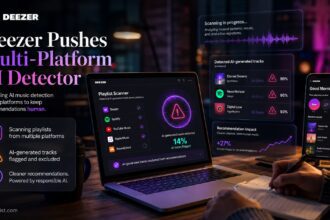

The French streaming platform has positioned itself as one of the most aggressive players in the fight against mass AI-generated music. According to Deezer, fully AI-generated tracks now represent roughly 44 percent of all new music uploaded to its platform every day. That means nearly 75,000 synthetic tracks arrive daily, more than two million per month, flooding the system at a scale that would have sounded absurd only a few years ago.
This is not a minor technical problem. It is a turning point for the entire streaming economy. Deezer is no longer treating AI-generated music as a niche experiment, a novelty or a futuristic side issue. It is treating it as an industrial-scale challenge that affects royalties, recommendation systems, catalog quality, listener trust and the visibility of human artists.
For independent musicians, producers, labels and curators, Deezer’s position matters. The platform is drawing a clear distinction between music created as part of a human artistic process and synthetic content delivered at massive volume by generative systems. In a market already overloaded with releases, that distinction may become one of the most important battles in modern music.
A Streaming Catalog Under Pressure
The streaming model was built on abundance. More music, more access, more choice, more discovery. For years, platforms presented the size of their catalog as a strength. Millions of tracks became a symbol of cultural openness, a promise that every listener could find something for every mood, scene and moment.
But abundance has a breaking point. When upload volume grows faster than listening demand, the catalog starts behaving less like a library and more like a storage problem. When a significant share of new uploads is generated automatically, the issue becomes even more serious. Platforms are no longer only managing songs. They are managing synthetic volume.
Deezer’s numbers reveal the scale of the shift. If nearly half of daily deliveries are fully AI-generated, the streaming industry is no longer dealing with a distant risk. It is already inside the system. The question is not whether AI music exists. The question is how platforms decide what deserves recommendation, monetization, storage and visibility.
That question cuts directly into the heart of the streaming economy. Every uploaded track takes up space, enters metadata systems, can be pushed through distributors, may appear in search, may generate royalties and may compete for listener attention. When that flow includes tens of thousands of synthetic tracks per day, platforms have to decide whether neutrality is still possible.
Deezer’s Strategy: Detect, Tag, Exclude and Limit
Deezer’s response is built around several layers. The company says it detects AI-generated music, tags it, removes it from algorithmic recommendations and no longer stores high-resolution versions of tracks identified as fully AI-generated. This is a strong statement because it goes beyond simple labeling.
Labeling is about transparency. Removing tracks from recommendations is about distribution power. Stopping hi-res storage is about resource allocation. Together, these measures suggest that Deezer is not only trying to inform listeners. It is actively reducing the weight of mass AI content inside its ecosystem.
That is a meaningful shift. Most platforms have historically been cautious about drawing hard lines between types of content. Streaming services often prefer scale, neutrality and automated processing. Deezer is taking a more editorial stance. It is saying that not all uploaded content should be treated equally once it enters the platform.
This does not mean Deezer is banning every use of technology in music. That distinction is important. Music production has relied on digital tools for decades. Sequencers, samplers, MIDI generators, pitch correction, drum machines, arpeggiators and assisted composition tools are part of modern production. The issue is not technology itself. The issue is fully synthetic mass output, delivered at industrial speed, often without a meaningful human artistic process behind it.
The Fraud Problem Behind AI Music
One of the most important details in Deezer’s position is the connection between AI-generated music and streaming fraud. The company says a large share of streams generated by fully AI-created tracks is detected as fraudulent and is therefore demonetized.
This matters because streaming revenue is not infinite. Royalties are distributed from a shared economic pool. When fraudulent plays enter that system, they do not simply create fake numbers. They can dilute value, distort data and redirect money away from legitimate artists.
In that sense, AI music is not only a cultural issue. It is also a financial and infrastructural one. A bad actor can generate large quantities of music, upload it through distribution channels, manipulate streams and attempt to extract revenue from the system. The music itself may have little cultural demand, but the fraud mechanism can still create pressure on the royalty pool.
Deezer’s decision to remove identified AI-generated tracks from recommendations is therefore not only about taste. It is also about protecting the recommendation engine from becoming a distribution machine for spam. If platforms allow synthetic mass content to benefit from the same algorithmic pathways as human-made music, the system can quickly become polluted by volume rather than value.
Why Recommendations Are the Real Battlefield
The most important space on a streaming platform is not the catalog. It is the recommendation layer. Search matters, playlists matter, editorial visibility matters, but recommendation systems are where listening habits are shaped every day.
When a platform recommends a track, it gives that track a form of institutional trust. The listener may not think about it, but the platform is saying, in effect, this belongs in your listening experience. That makes recommendations incredibly valuable. They can introduce new artists, revive older songs, reinforce trends and quietly shape culture.
Deezer’s decision to keep AI-generated tracks out of algorithmic recommendations is therefore one of its strongest measures. It does not necessarily remove the content from existence, but it prevents that content from being actively pushed into listening sessions.
For human artists, this is critical. The greatest threat is not simply that AI-generated tracks exist. The threat is that massive synthetic catalogs could occupy recommendation slots, playlist space and passive listening moments that would otherwise go to working musicians, producers, singers and composers.
Discovery is already difficult. Independent artists are competing against major labels, legacy catalogs, viral trends, short-form video culture and an overwhelming number of daily releases. Adding industrial AI output into the same recommendation pipeline would make the visibility problem even worse.
Transparency Is Becoming a Platform Value
Deezer’s tagging strategy also reflects a broader movement in streaming: transparency is becoming part of platform identity.
For years, listeners rarely needed to ask how a track was made. They cared about the song, the voice, the feeling, the performance, the production. AI-generated music changes that relationship. When a track can imitate style, voice, arrangement and emotional texture without a traditional creative process, listeners increasingly want to know what they are hearing.
Clear labeling matters because trust matters. A listener may still choose to listen to AI-generated music. That is their right. But the choice should be informed. A platform that hides or blurs the origin of synthetic content risks weakening the relationship between artists, fans and the service itself.
For artists, transparency is not just a moral issue. It is a market issue. If human-made music and fully synthetic music are presented in exactly the same way, the audience loses important context. The labor behind a song becomes invisible. The distinction between a vocalist recording a performance and a model generating a voice-like result becomes blurred. The cultural value of human craft becomes harder to defend.
The Hi-Res Decision Sends a Strong Signal
Deezer’s decision to stop storing high-resolution versions of AI-generated tracks may seem technical, but it carries symbolic weight.
High-resolution audio is usually associated with quality, fidelity and premium listening. By limiting hi-res storage for identified AI tracks, Deezer is sending a message about resource priority. Not every file delivered to a platform deserves the same technical treatment, especially when the content is being uploaded at massive scale and generates limited genuine listening demand.
This is also a practical move. Storage costs money. Infrastructure has limits. If platforms are forced to absorb endless synthetic output, those costs do not disappear. They become part of the operating burden of streaming. At some point, mass AI content can create pressure not only on discovery and royalties, but also on the economics of maintaining a platform.
That is why Deezer’s approach may interest the wider industry. It frames AI music not only as an artistic debate, but as a platform management problem. Streaming services cannot simply accept infinite content without consequences. Someone pays for the storage, moderation, detection, processing and distribution. Eventually, that cost reaches the ecosystem.
What This Means for Independent Artists
For independent artists, Deezer’s stance offers both reassurance and a warning.
The reassurance is clear: at least one major platform is publicly acknowledging that human music needs protection from synthetic mass production and fraudulent activity. Deezer is not pretending that every upload has the same value or the same intent. It is recognizing that fairness requires active decisions.
The warning is equally clear: the market is becoming more crowded, more technical and more dependent on platform-level trust systems. Artists can no longer think only about releasing music. They need to think about how their work is identified, credited, presented and protected.
Accurate metadata is essential. Real credits matter. A coherent artist profile matters. A clear visual identity matters. Authentic audience engagement matters. In a world flooded with synthetic content, human artists need to make their identity unmistakable.
This does not mean shouting “real artist” in every post like a desperate man holding a cardboard sign outside the algorithmic supermarket. It means building a body of work with consistency, intention and recognizable artistic direction. The more clearly an artist’s universe is defined, the easier it becomes for platforms, curators and listeners to understand its value.
The Difference Between Using Tools and Replacing the Artist
The debate around AI music often becomes messy because people confuse two very different realities.
On one side, there are musicians using technology as part of a creative process. A producer may use chord assistants, drum programming, sample manipulation, vocal editing, arrangement tools or generative sketches to develop ideas. In that case, technology supports human intention. The artist still makes decisions, shapes the identity, edits the material and takes creative responsibility.
On the other side, there is fully generated content produced at scale with minimal human involvement. This is where the streaming problem becomes serious. When thousands of tracks can be generated, uploaded and monetized with little artistic investment, the platform is no longer dealing with creativity in the traditional sense. It is dealing with volume production.
Deezer’s position is important because it focuses on fully AI-generated music, not on every digital tool used by musicians. That distinction protects modern production while challenging mass automation. It allows room for innovation without allowing the catalog to become a synthetic landfill with a distribution account.
Could Deezer Influence the Rest of the Industry?
Deezer may not be the largest streaming platform in the world, but its position could influence the wider market. Smaller or more focused platforms often move faster on issues that larger companies approach cautiously. If Deezer’s detection, tagging and recommendation policies prove effective, other services may face pressure to adopt similar standards.
The issue is especially urgent because AI music is not slowing down. Generative tools are becoming easier to use, faster and more accessible. The barrier to creating synthetic tracks is falling. The barrier to uploading them is already low. Without strong policies, the streaming catalog could become increasingly difficult to manage.
Major platforms will eventually have to make similar choices. Do they label AI-generated music clearly? Do they exclude it from recommendations? Do they demonetize fraudulent activity more aggressively? Do they limit storage quality for synthetic mass uploads? Do they require distributors to provide stronger declarations?
Deezer has made its answer visible. That visibility matters because it turns a hidden technical problem into a public industry debate.
The Future of Streaming May Depend on Trust
The next phase of streaming will not be defined only by catalog size, subscription price or user interface design. It will be defined by trust.
Can listeners trust that recommendations are not being polluted by mass-generated spam? Can artists trust that royalties are not being diluted by fraudulent streams? Can platforms trust distributors to deliver accurate information? Can the industry trust that human creativity will not be buried under automated volume?
These questions are no longer theoretical. Deezer’s numbers show that AI-generated music is already arriving at a scale large enough to force structural decisions. The platform’s response suggests that the future of streaming may require more filtering, more labeling and more responsibility than the old open-catalog model allowed.
That may disappoint those who believe platforms should remain neutral upload machines. But neutrality becomes difficult when the system is being manipulated. If a platform wants to protect listening quality, artist income and cultural value, it has to decide what it promotes, what it labels and what it refuses to amplify.
Conclusion: Deezer Is Defending the Value of Human Music
Deezer’s stance against mass AI-generated music is one of the clearest signals yet that streaming is entering a new era. The old question was simple: how much music can a platform offer? The new question is harder: what kind of music should a platform actively support?
By detecting, tagging and limiting the algorithmic reach of AI-generated tracks, Deezer is not just managing content. It is defending a principle. Music platforms cannot treat human creativity and industrial synthetic output as identical products without damaging the ecosystem they depend on.
For independent artists, this moment should be taken seriously. The flood of AI-generated music will not disappear. The tools will improve. The volume will grow. The pressure on platforms will increase. But that does not mean human music loses its value. It means human identity must become clearer, stronger and more visible.
Deezer’s message is direct: streaming cannot survive on endless uploads alone. It needs trust, context, fairness and real artistic value.
In a world where machines can generate thousands of tracks before lunch, the most powerful thing an artist can still offer is not volume. It is intention.