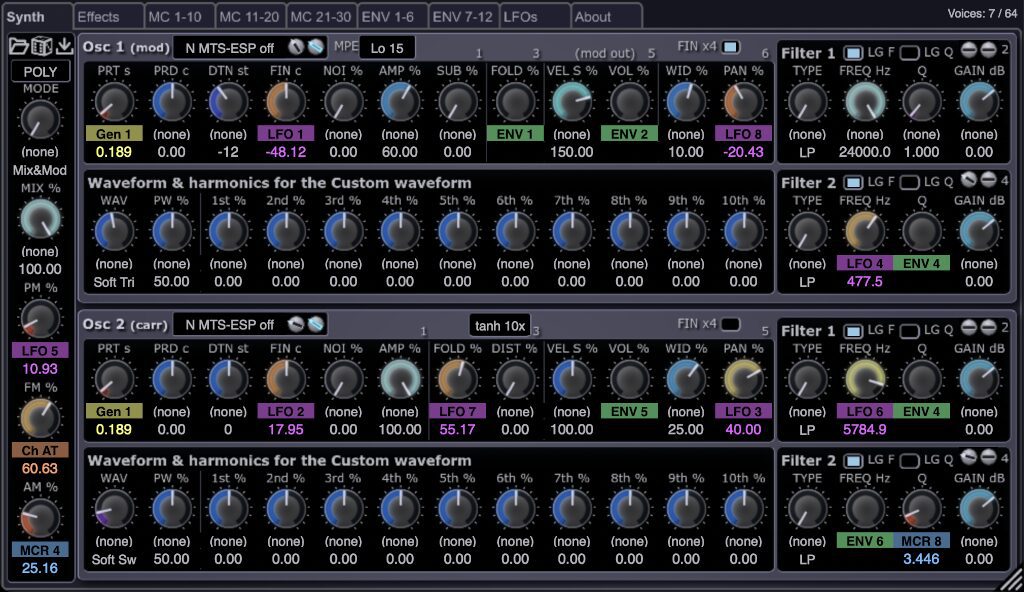

Free Synth Instrument
JS80P: A Free Expressive Synth for Deep Sound Design
Combine analog-style warmth, FM textures, PWM movement, expressive performance controls and built-in effects inside one open-source instrument.
JS80P is a free and open-source synthesizer developed by Attila M. Magyar. It is designed as a performance-oriented instrument capable of producing classic analog sounds, digital textures, evolving pads, expressive leads, basses, organs, bells and experimental effects.
The current version is 4.1.1. The major version 4 update expanded the oscillator waveforms, introduced pulse-width modulation options, added new distortion types and brought official macOS support alongside the existing Windows and Linux editions.
JS80P is distributed without a commercial license manager, account requirement or online activation. Producers can download the appropriate VST3 package and install it directly in a compatible DAW.
| Developer | Attila M. Magyar |
|---|---|
| Plugin type | Performance-oriented software synthesizer |
| Current version | 4.1.1 |
| Platforms | Windows, macOS and Linux |
| Plugin formats | VST3 and FST for VST 2.4-compatible hosts |
| Polyphony | Up to 64 notes |
| Synthesis types | Subtractive, additive, PWM, FM, PM and AM |
| Expression | MPE, aftertouch, macros, MIDI Learn and MTS-ESP |
| Price | Free and open source |
Two Flexible Oscillators and a Subharmonic Source
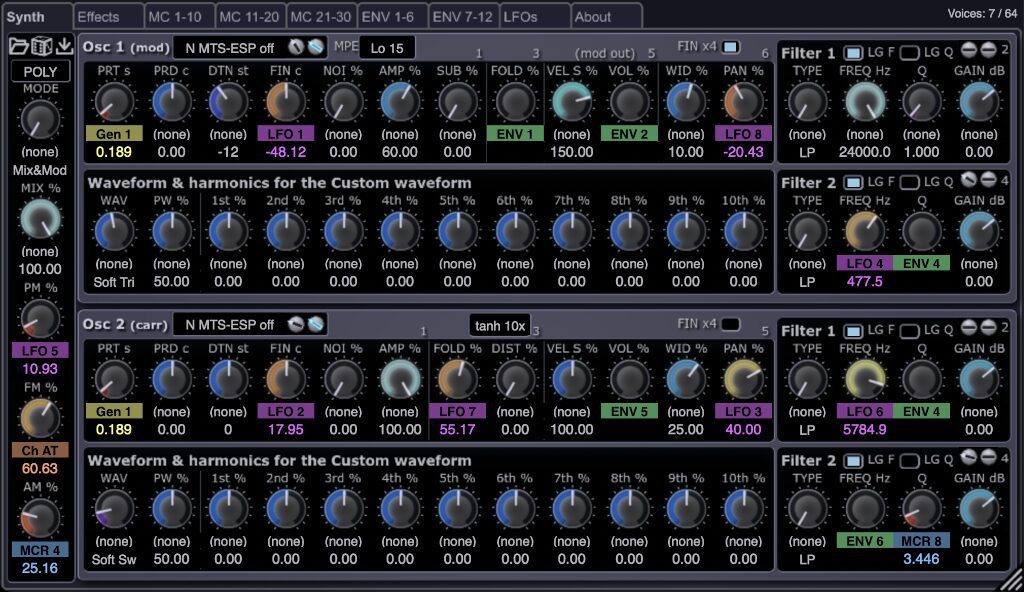
JS80P uses two main oscillators with 14 waveform options. These include sine, saw, triangle, square, pulse, bipolar pulse and softer variations designed to reduce the harshness of classic digital waveforms.
Both oscillators can generate noise and use custom harmonic waveforms. Oscillator pitch instability and tuning inaccuracy can be introduced to create the subtle movement associated with analog hardware.
A subharmonic sine source reinforces the lower frequencies, making the instrument useful for basses, cinematic drones and heavier electronic sounds.
The oscillators can interact through frequency modulation, phase modulation and amplitude modulation. A wavefolder adds further harmonic complexity before the signal reaches the effects section.
Filters and Detailed Tonal Control
Each oscillator has two filters with low-pass, high-pass, band-pass, notch, bell and shelving responses.
This structure allows different parts of the sound to be shaped independently. One oscillator can provide a darker foundation while the second contributes a brighter or more metallic layer.
Additional filters are included in the effects section. Producers can therefore perform corrective shaping, resonant sweeps and creative tonal processing without loading an external equalizer immediately.
Twelve Envelopes and Eight LFOs
JS80P includes 12 DAHDSR envelope generators. In addition to attack, decay, sustain and release, they provide delay and hold stages for more complex movement.
The envelopes can be assigned to oscillator, filter, volume and modulation parameters. Their curves are customizable, making them suitable for sharp plucks, slow pads, rhythmic movement and evolving cinematic textures.
Eight LFOs provide further modulation. Selected LFOs support variable pulse-width waveforms, while tempo synchronization keeps movement aligned with the project.
The LFOs can also use their own amplitude envelopes, allowing modulation to appear gradually, disappear after the attack or change throughout a sustained note.
MPE and Performance Controls
JS80P is designed for expressive playing. It supports MIDI Polyphonic Expression, channel pressure, conventional MIDI controllers and user-defined macros.
MPE allows compatible controllers to change pitch, pressure and other parameters independently for each note. This is useful for expressive leads, brass-style patches, evolving pads and sounds that react differently across a chord.
The synthesizer also provides polyphonic, monophonic and split-keyboard modes. Portamento can create smooth transitions between notes, while hold functions keep sounds active without a sustain pedal.
Built-In Effects
The internal effects section includes several distortion algorithms, tape-style processing, chorus, stereo echo and stereo reverb.
The tape module provides saturation, tonal coloration, noise, wow and flutter. It can also create slow-down and fast-forward effects for transitions and experimental sound design.
The echo and reverb sections include additional distortion and sidechain-style dynamics options. These tools can create rhythmic pumping, controlled ambience and more aggressive delay textures.
Because the effects are saved with each preset, complete sounds can be recalled without rebuilding an external processing chain.
Best Uses
- Expressive analog-style leads
- Warm basses and subharmonic sounds
- Ambient pads and cinematic textures
- FM bells and metallic instruments
- Synthwave, House, Techno and IDM
- MPE performance and automation
- Microtonal music with MTS-ESP
- Experimental effects and sound design
Presets and Random Sound Generation
JS80P includes presets covering organs, pads, bells, brass, basses, keys, effects and real-instrument-inspired sounds.
Version 4 introduced new patches including Ambient Pluck, Chiptune, Octave Bass and Tremolo PWM Bass. Version 4.1 added a random preset generator for discovering new combinations of synthesis and modulation settings.
The randomizer can provide unexpected starting points, but the complete parameters remain available for editing. Producers can keep the useful parts of a generated sound and correct the decisions made by the plugin after it becomes creatively overconfident.
Compatibility and Installation
Windows users can install JS80P on Windows 7 or newer. Separate AVX and SSE2 packages are provided for modern and older processors.
Linux packages are available for 64-bit and 32-bit x86 systems. VST3 bundle and single-file editions are offered alongside the FST format.
The macOS universal installer supports Apple Silicon computers running macOS 11 or newer and Intel Macs running macOS 10.12 or newer.
No account, serial number or online activation is required. Download the correct package, install or copy the plugin into the appropriate directory and rescan the DAW.
Main Limitations
- No official Audio Unit or AAX version
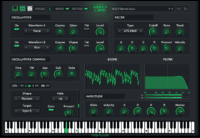
- The interface contains many controls and requires some learning
- Each instance can use approximately 300 to 400 MB of RAM
- AVX and SSE2 packages may initially confuse less experienced users
- MPE configuration depends on the DAW and MIDI controller
- Microtuning requires an MTS-ESP-compatible provider
Final Verdict
JS80P is an unusually deep free synthesizer for producers who value expressive control and detailed modulation.
Its combination of analog-style oscillators, FM and phase modulation, 12 envelopes, eight LFOs, MPE, microtuning and built-in effects provides enough flexibility for both traditional synth sounds and experimental design.
The interface is more technical than a simple preset instrument, but the factory sounds and random generator provide useful entry points.
For Windows, macOS and Linux producers seeking a modern free instrument with no activation system or reduced paid edition, JS80P is a powerful addition to the plugin library.