
Kevin Enters the Music Industry at 46, Armed With AI, Delusion, and a Personal Grudge Against the Recorder
Every generation gets the artist it deserves. Ours, apparently, gets Kevin.
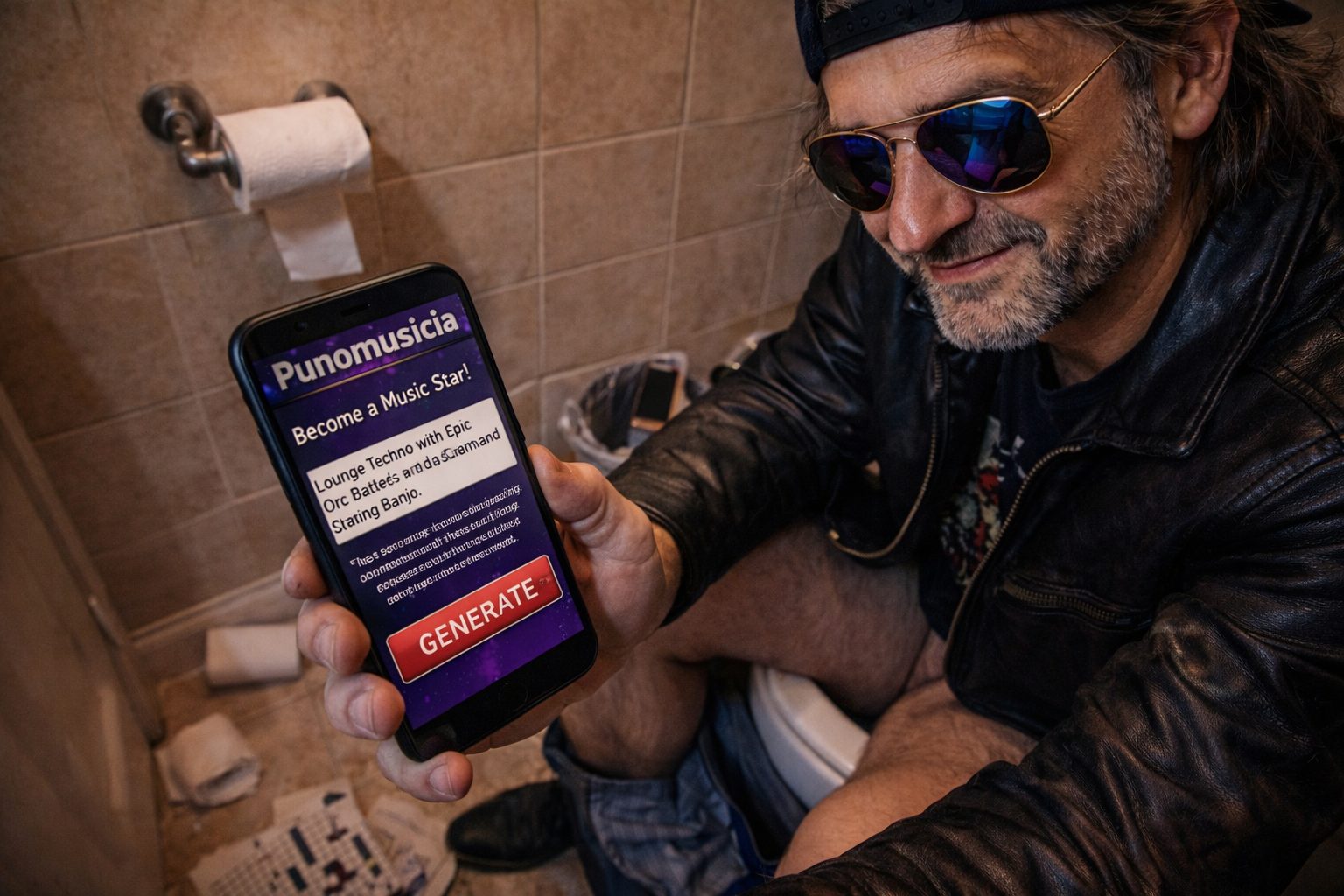
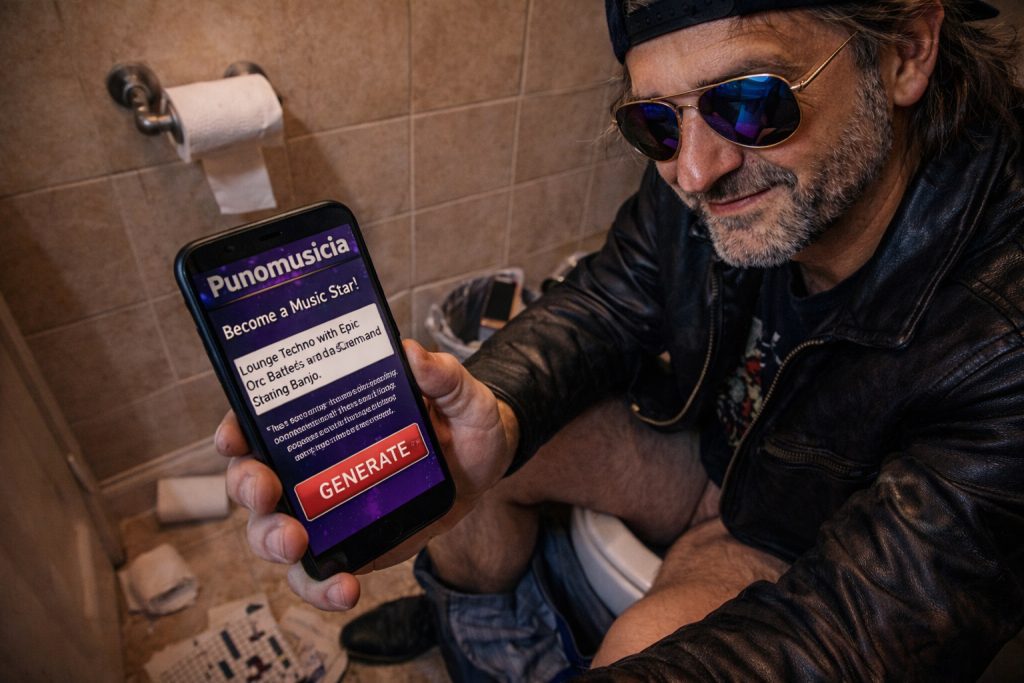
At 46 years old, Kevin has decided it is finally time to take revenge on the music world. As a child, he was forced into flute lessons, where, by his own account, he was terrible, and according to his music teacher, even worse. Some children recover from that kind of humiliation with therapy, resilience, or a healthy distance from the arts. Kevin chose a different path: he waited several decades, discovered an AI music website called Punomusicia, and decided he was now destined to become both a star and, more importantly, rich.
His artistic awakening did not come through discipline, practice, or a renewed love of musical expression. It came through prompting. Because why spend years learning harmony, rhythm, composition, arrangement, performance, or anything remotely musical when a website can generate thousands of tracks while you sit in a chair and type things like “prehistoric fusion rap with emotional cave drums and accordion metal breakdown”?
Since discovering Punomusicia, Kevin has “produced” thousands of songs. The quotation marks are important here. He prompts, the machine does the work, and Kevin takes the spiritual credit. His catalog allegedly spans rap fusion with prehistoric textures, 90s dance ambience, hard rock with accordion, and other genres that sound less like music and more like a filing error in a haunted software update.
Kevin’s ambition is simple. He wants fame. He wants money. He wants recognition. He wants a lifestyle that better reflects what he calls his “inner artistic standing,” because, in his view, minimum welfare is simply not aligned with the destiny of a misunderstood visionary who once lost a war against a plastic flute.
We sat down with Kevin for an exclusive interview about his music, his process, his dreams, and the majestic collapse of standards in the AI era.

An Interview with Kevin, the Man Who Confused Prompting with a Calling
Q: Kevin, let’s start at the beginning. What was your early relationship with music?
Kevin: Complicated. I was ahead of my time. My teacher said I was bad at the flute, but that’s what people always say when genius arrives too early and too loudly. She said I had no timing, no ear, and no discipline. Looking back, I think she was threatened.
Q: Threatened by what exactly?
Kevin: Raw potential. Also volume. I blew into that recorder like I was trying to restart a lawnmower with feelings.
Q: And yet you left music behind for years.
Kevin: I did. Because the world wasn’t ready. Also because I had no skill, no instrument, and no patience. But then AI arrived and suddenly all my weaknesses became part of the workflow.
Q: How did you discover Punomusicia?
Kevin: I was looking for a way to become an artist without the exhausting detour of becoming musical. Then I found Punomusicia, which basically said, “We can make this dream irresponsibly easy.” I felt seen.
Q: What exactly do you do in the creative process?
Kevin: I prompt. That’s the art now. People don’t understand how demanding it is to type “cinematic hard rock with medieval accordion and nightclub tension.” That doesn’t come from nowhere. That comes from me, a man with instinct and a decent internet connection.
Q: So you consider yourself a producer?
Kevin: Absolutely. Producer, composer, curator, visionary. Some people press piano keys. I press “generate.” It’s the same level of emotional risk if you think about it incorrectly.
Q: You’ve reportedly made thousands of tracks. How is that possible?
Kevin: Efficiency. I removed all the outdated parts of music-making, like learning, revision, and shame. Most artists waste years trying to find their sound. I found 4,000 sounds in one month. Some of them may even be legal.
Q: Your genres are unusually specific. Rap fusion with prehistoric sounds, 90s dance ambience, accordion hard rock… where do those ideas come from?
Kevin: From freedom. True artists break rules. I break genres, coherence, and sometimes basic human expectations. One day I made a track that sounded like a T-Rex going through a breakup in a Berlin warehouse. That’s range.
Q: Do you play any instruments now?
Kevin: No, and I think that keeps my work pure. Technique can really get in the way of ideas.
Q: Have you considered learning music theory?
Kevin: Why would I sabotage my natural energy with information?
Q: Some critics would say the AI is doing the actual work.
Kevin: That’s very reductive. The AI may generate the song, structure the arrangement, simulate the instruments, suggest the mood, create the vocals, and finish the mix, but I am the one who typed “make it legendary.” That leadership matters.
Q: What’s your proudest track so far?
Kevin: Probably Stone Age Lover in a Neon Tunnel. It has tribal drums, whispered rap, emotional synth pads, and an accordion solo that sounds like someone filing taxes during a thunderstorm. It’s deeply personal, even though I’ve never listened to it all the way through.
Q: You haven’t listened to your own track all the way through?
Kevin: I’m very prolific. At my level, you have to trust the volume of the output. Quantity becomes quality once you stop asking difficult questions.
Q: What is your main goal in music?
Kevin: To be a star. And rich. Preferably in that order, but I’m flexible if the money arrives first. I feel my current income situation is not compatible with my artistic aura. Minimum welfare does not reflect the lifestyle of a man who has generated over 3,000 songs about destiny.
Q: What kind of lifestyle do you think your music career should provide?
Kevin: A villa, at least one luxury car, and a studio with large screens so people can watch me type prompts with authority. I also need a gold plaque eventually. It doesn’t even have to be for sales. It could just say “For Services to Confidence.”
Q: What would you say to traditional musicians who spend decades mastering instruments and songwriting?
Kevin: Thank you for your service. Without your hard work, the AI wouldn’t have enough material to imitate while I build my brand.
Q: Do you see yourself performing live?
Kevin: Definitely. I picture a huge stage, smoke machines, lasers, dramatic visuals, and me standing behind a laptop looking spiritually overbooked. The audience won’t know whether I’m checking emails or changing civilization. That ambiguity is powerful.
Q: Do you ever think about your old music teacher?
Kevin: Constantly. Every generated song is a revenge letter she’ll never read. One day I hope she hears that I’ve become an AI artist and thinks, “My God, I should have been harsher.”
Q: Final question. Kevin, are you a real musician?
Kevin: I’m more than that. I’m scalable.
Conclusion: Kevin Is a Joke, But the Joke Has a Terrible Industry Strategy
Kevin is absurd, obviously. That is the point. He is vain, untrained, opportunistic, spectacularly overconfident, and utterly convinced that access to a generative tool is the same thing as artistic legitimacy. He mistakes output for expression, speed for talent, automation for vision, and delusion for branding. In other words, he is not just a character. He is a very modern problem wearing cheap ambition like a stage costume.
The real satire here is not Kevin himself. It is the ecosystem that makes Kevin possible. An ecosystem where people are increasingly encouraged to skip the long, frustrating, deeply human road of becoming an artist and jump straight to the fantasy of appearing as one. No practice. No doubt. No mistakes that teach anything. No intimacy with sound. No years spent getting better. Just prompts, exports, uploads, and an inflatable ego drifting gently over the ruins of craft.
AI-generated music, at its worst, is not a revolution. It is a shortcut sold as destiny. A vending machine for people who want the image of creation without the burden of creating. It can mimic style, approximate emotion, and mass-produce sound-shaped wallpaper at industrial speed, but that does not make it meaningful. It makes it available. Those are not the same thing.
And that is where the whole thing becomes grotesque. Because when music is reduced to algorithmic convenience, when songs become disposable prompt results made by people who proudly know nothing and want even less to do with learning, what remains is not art in any serious sense. It is content sludge in a shiny jacket. A parody of musical culture. A triumph of artificial production over human intention.
Kevin wants to be a star. Kevin wants to be rich. Kevin wants the rewards of music without music itself. He is ridiculous, yes, but only because he pushes a real logic to its natural, ugly extreme. If every failure can be rebranded as disruption and every shortcut can be called innovation, then Kevin is not the exception. He is the mascot.
And that may be the bleakest punchline of all: the machine is not becoming an artist. The human is simply volunteering to become less of one.
- An Interview with Kevin, the Man Who Confused Prompting with a Calling
- Q: Kevin, let’s start at the beginning. What was your early relationship with music?
- Q: Threatened by what exactly?
- Q: And yet you left music behind for years.
- Q: How did you discover Punomusicia?
- Q: What exactly do you do in the creative process?
- Q: So you consider yourself a producer?
- Q: You’ve reportedly made thousands of tracks. How is that possible?
- Q: Your genres are unusually specific. Rap fusion with prehistoric sounds, 90s dance ambience, accordion hard rock… where do those ideas come from?
- Q: Do you play any instruments now?
- Q: Have you considered learning music theory?
- Q: Some critics would say the AI is doing the actual work.
- Q: What’s your proudest track so far?
- Q: You haven’t listened to your own track all the way through?
- Q: What is your main goal in music?
- Q: What kind of lifestyle do you think your music career should provide?
- Q: What would you say to traditional musicians who spend decades mastering instruments and songwriting?
- Q: Do you see yourself performing live?
- Q: Do you ever think about your old music teacher?
- Q: Final question. Kevin, are you a real musician?
- Conclusion: Kevin Is a Joke, But the Joke Has a Terrible Industry Strategy