
For years, digital music promotion has carried a quiet threat beneath the surface. If organic reach declines, if platforms tighten visibility, if attention becomes harder to hold, then sooner or later the artist will have to pay. Pay to be seen. Pay to be clicked. Pay to be remembered. Pay, in short, for the privilege of standing in front of an audience that may or may not care once the money stops.
That pressure is real. By 2026, many artists feel it constantly. Paid promotion has become so normalized that organic strategy is often treated like a romantic leftover from an earlier internet, something people still mention at workshops before getting serious and opening the ad manager. The implication is clear enough: without ads, growth is limited, reach is unreliable, and promotion becomes a kind of noble struggle conducted mostly for moral satisfaction and screen fatigue.
That view is too simple. Organic music promotion is harder than it used to be, yes. It is slower in many cases, more demanding, less forgiving, and far less compatible with lazy habits. But it is not dead. In fact, in 2026, some of the most valuable forms of music growth still happen without paid amplification at all. They happen through identity, repetition, timing, trust, emotional precision, community behavior, catalog strategy, platform fluency, and content that gives people a reason to care before asking them to do anything.
The real shift is not that organic promotion stopped working. It is that generic organic promotion stopped working. There is a difference. The old playbook of posting a cover, dropping a link, writing “out now,” and hoping for kindness from the algorithm now fails so consistently it should probably be classified as a ritual rather than a strategy. What still works organically in 2026 is sharper than that. More intentional. More editorial. More human. And, unfortunately for anyone hoping to automate their way out of effort, more demanding of actual thought.
The fantasy of free reach is gone, but organic momentum is not
One of the most important mindset shifts for artists is accepting that organic promotion and effortless promotion are not the same thing. A lot of frustration in music marketing comes from confusing the two. Artists say organic no longer works when what they often mean is that low-effort posting no longer works. That is true. Platforms are crowded, audiences are selective, and attention has become brutally expensive in every sense except the literal one.
But organic momentum still exists when content travels because it deserves to, not because money forced it into view. It happens when people replay something, share it, comment on it, save it, send it to a friend, quote it, remember it, or return to the artist voluntarily. That kind of behavior cannot be bought in any deep sense. Ads can create exposure. They cannot manufacture real attachment on their own.
This is why organic promotion still matters so much. Not because it is pure, noble, or somehow morally superior, but because it remains one of the clearest tests of whether the music, the artist, and the surrounding identity are actually connecting. Organic traction may be slower, but it often reveals stronger truths.
Without ads, the content has to do more work
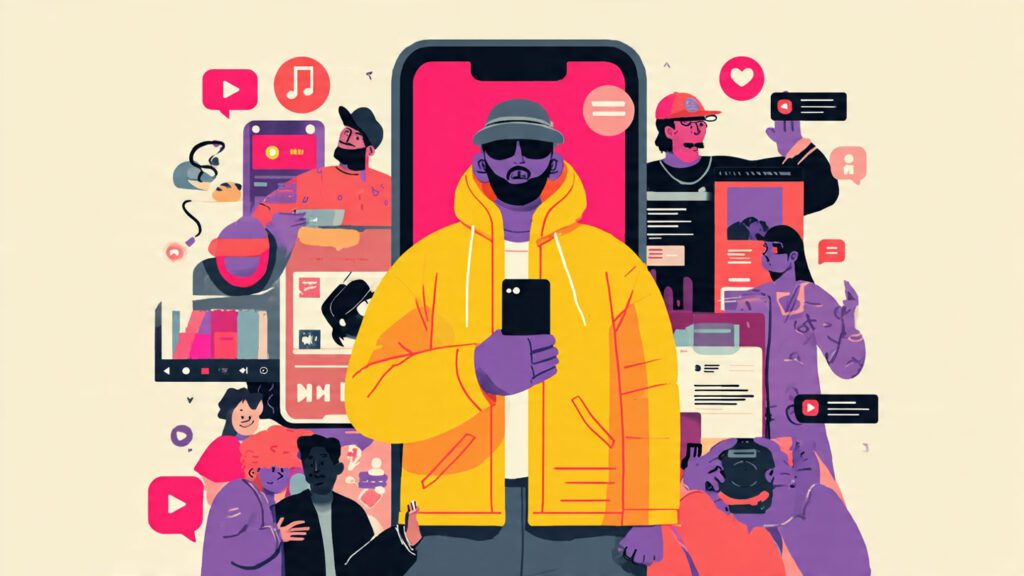
The first reality of organic promotion in 2026 is simple: the content must carry more of the campaign on its own back. There is no paid boost to rescue weak framing. No budget to compensate for vague identity. No media spend to hide the fact that the post says very little, means very little, and asks the audience to care anyway.
That is why organic promotion now rewards precision. The hook must be clearer. The emotional signal must be stronger. The tone must feel more intentional. The message must arrive faster. The audience has to understand, almost instantly, what kind of artist this is, what kind of world the song belongs to, and why this particular release deserves a few seconds of their life when the feed is offering a thousand competing reasons to move on.
Artists who promote organically without that clarity often mistake silence for unfairness. Sometimes unfairness is real. Platforms are inconsistent. Reach can be volatile. Timing matters. Luck matters. But a great deal of organic failure still comes from weak communication. The content does not create enough intrigue, enough recognition, enough identity, or enough emotional residue to survive beyond the scroll.
Consistency still works, but only when it means something
Consistency remains one of the most misunderstood ideas in music promotion. Many artists hear the word and imagine frequency alone. Post more. Show up daily. Feed the machine. Never let the audience forget you exist, even if the content itself increasingly suggests they probably should. That is not the kind of consistency that works.
What works organically is recognizable consistency. A recurring tone. A repeatable emotional world. A visual language that makes the artist identifiable. A posting rhythm that builds familiarity without becoming noise. A voice that sounds like the same person from one release phase to the next. The goal is not to be everywhere at all times. It is to become legible over time.
This matters because organic growth depends heavily on memory. Paid reach can force visibility in the short term. Organic promotion needs people to remember. To recognize. To say, knowingly or unconsciously, I have seen this artist before, and something about them stayed with me. That is where consistency becomes useful. Not as output volume, but as identity reinforcement.
Organic growth now rewards artists who understand platform behavior
One of the laziest mistakes in music promotion is treating every platform like a slightly different wall on which to staple the same announcement. That approach was weak years ago. In 2026, it is practically an act of self-sabotage. Organic growth depends on respecting how different environments create attention.
A post that works because it feels intimate on one platform may fall flat somewhere else if it lacks speed, tension, or visual clarity. A short-form clip that performs well in one feed may need a different framing, opening, or caption structure in another. A platform built around commentary rewards a different style of artist presence than one built around passive discovery. Organic strategy works best when the artist adapts the same release to multiple contexts without breaking the coherence of the campaign.
This is not about becoming a different person on every app. It is about understanding that audience behavior changes with environment. The artist who learns how to speak each platform’s native language without losing their identity has a far better chance of growing organically than the one who repeats the same post everywhere and calls it distribution.
Short-form video still works, but only when it carries identity
No conversation about organic music promotion in 2026 can ignore short-form video. It remains one of the most powerful discovery formats available to artists without ad spend. But its value has changed. The easy phase is over. The days when almost any passable snippet could generate surprising reach are largely behind us. Now the format rewards clarity, personality, and concept much more aggressively.
Short-form content still works when it does more than clip the song. A strong video gives the release a face, a feeling, a tension point, a story fragment, or a recognizable mood. It lets the audience experience the music in a context that creates memory rather than mere exposure. That is why the best organic short-form campaigns do not just recycle hooks. They build worlds around them.
For artists without ads, this is crucial. A good clip does not need paid support if it gives people a reason to stop, feel, and remember. A bad clip can waste a great song even with money behind it. Organic strategy depends on the former because it has no patience for the latter.
Community behavior matters more than raw reach
One of the most underestimated truths in organic promotion is that a small active audience is often more useful than a large passive one. Artists still spend too much time worrying about top-line visibility and too little building an environment where people respond, return, and participate. That is backward.
Community behavior creates organic lift in ways that metrics alone do not always capture cleanly. Comments make a post feel inhabited. Shares create personal endorsement. Saves suggest future value. Replies create warmth. Returning viewers increase recognition. These behaviors tell platforms that something meaningful is happening, but more importantly, they tell other humans that the release has social life.
This is why artists should think less in terms of broadcasting and more in terms of circulation. Organic promotion works best when the music begins moving through people, not just at them. The song does not need everyone. It needs enough listeners who care enough to carry it a little farther than the artist can alone.
Behind-the-scenes content remains powerful because it builds trust
One of the formats that still works remarkably well without ads is well-framed behind-the-scenes content. Not because audiences are endlessly fascinated by plugin windows and vocal takes in isolation, but because process content can reveal something harder to fake: care.
When an artist shows how a song evolved, what problem had to be solved, what lyric changed the track, what feeling they were chasing, or what detail almost broke the session, the audience gets more than access. It gets evidence. Evidence of effort. Evidence of craft. Evidence of personality. Evidence that the music has a life behind it.
Trust is one of the strongest organic growth drivers because it increases the likelihood of deeper behavior. A listener who trusts the artist’s process is more likely to stream, save, return, and follow. Behind-the-scenes content works when it stops functioning like documentation and starts functioning like narrative. It should not just show work. It should make the work matter.
Catalog promotion is an organic advantage too many artists ignore
Artists who rely entirely on new releases for visibility create a dangerous kind of pressure. Every new song has to win immediately. Every launch has to carry the whole momentum of the project. Every silence between releases becomes a problem. This is exhausting and unnecessary.
One of the smartest organic strategies in 2026 is reactivating the catalog. Older songs can still travel when reframed properly. A lyric can return through a new context. A track can resurface because its mood suddenly fits the season, the conversation, or the artist’s current phase. A live version can reopen a song. A behind-the-scenes story can make an overlooked release feel newly relevant. A clip can give an old track its first strong moment of discovery.
Catalog promotion works organically because audiences do not experience music according to the artist’s internal timeline. They experience it when it reaches them. If a strong song becomes visible in the right moment, it can feel brand new to the listener, even if the release date is buried in the past like an administrative detail no normal human cares about.
Artist identity is now one of the strongest organic growth engines
There is a reason some artists grow steadily without obvious ad pressure while others seem to post endlessly with little lasting effect. Identity. Not just branding in the shallow sense, but recognizable artistic identity. A voice. A tone. A visual discipline. A recurring emotional signal. A world people can identify quickly.
Organic growth rewards identity because identity improves recognition, and recognition improves return behavior. The audience does not need to rediscover the artist from zero every time. It begins to understand what kind of experience the artist offers. That creates trust, curiosity, and the possibility of real loyalty.
This is why vague artists struggle so much organically. If the music, the visuals, the captions, the persona, and the release framing all point in slightly different directions, the audience never builds a strong mental map. Without ads, there is rarely enough brute exposure to overcome that confusion. Identity has to do part of the lifting.
Organic promotion works better when the ask comes later
One of the quiet rules of effective organic strategy is that value should usually arrive before demand. Too many artists lead with the instruction. Stream this. Pre-save now. Go listen. New song out. Link in bio. These phrases are not useless, but on their own they are weak because they ask for effort before creating desire.
What still works organically is content that gives the audience something first. A feeling. A story. A tension point. A memorable visual. A line that lands. A glimpse of the process. A performance moment. A reason to care. Once that interest exists, the ask becomes far easier because the audience is already leaning in.
This is especially important when no ads are involved. Paid media can sometimes compensate for bad sequencing by creating enough repetition to force familiarity. Organic promotion cannot rely on that. It has to earn the impulse more honestly. Desire first, direction second.
Email, direct connection, and owned attention still matter more than people admit
Organic promotion is often discussed as if it begins and ends on public platforms. That is a mistake. Some of the strongest non-paid growth still happens through more direct channels: mailing lists, direct messages, private communities, fan groups, close followers, recurring listeners, and people who have already chosen to stay within reach of the artist.
These channels matter because they are less dependent on public feed volatility. They allow artists to reactivate listeners who have already shown belief. That is powerful. A warm audience is one of the most valuable assets an artist can build without spending money, because it reduces the dependence on constant public discovery.
Too many musicians chase strangers while underusing the people who already care. Organic strategy works much better when artists remember that retention is not the opposite of growth. It is one of the engines of growth.
Collaboration still works, but only when it feels natural
Another organic strategy that continues to matter is collaboration. Not the clumsy version where artists tag each other mechanically and call it community, but the real version where audiences, aesthetics, or creative worlds genuinely overlap. A well-matched collaboration can introduce music to a relevant new audience with far more trust than cold promotion ever could.
This is because collaboration carries social proof. It suggests a relationship, a shared standard, or a meaningful artistic connection. When it feels believable, it allows audiences to cross over more easily. The same principle applies to curators, creators, DJs, playlists, niche pages, visual collaborators, and other cultural intermediaries. Organic reach is often extended through association before it is extended through scale.
The key is fit. Forced collaborations create suspicion. Natural ones create movement.
What no longer works without ads
Generic announcement posts rarely work well on their own. Empty frequency does not work. Weak hooks do not work. Random content with no clear emotional signal does not work. Posting the same link repeatedly does not work. Treating the audience like a traffic source instead of a group of human beings with limited attention definitely does not work.
And perhaps most importantly, hoping that the music will “speak for itself” without any thought given to framing almost never works either. Great songs still matter most, but great songs do not arrive in a vacuum. Organic strategy in 2026 is not about manipulating attention so much as helping the right kind of attention find a reason to stay.
The artists who win without ads are rarely the laziest or the loudest
They are usually the clearest. They know what kind of world they are building. They understand how to repeat themselves without becoming repetitive. They know how to give the audience multiple ways into the same release. They use process, performance, identity, catalog, and community as connected tools rather than isolated tactics. They do not rely on one miracle post. They build enough coherent contact that memory has a chance to form.
This is the deeper truth about organic promotion in 2026. It is not a backup plan for artists without money. It is a distinct discipline. One that rewards artists who can create meaning before amplification, trust before demand, and identity before scale. It may not always be fast. It may not always be easy. It may occasionally make the ad dashboard look tempting in the same way a neon dessert cart tempts a tired person after midnight. But it still works when the work is good enough.
And that may be the most important point of all. Ads can help a campaign move. But organic strategy is what tells you whether the music, the artist, and the surrounding world can move people.