
Free VST Instrument
An original VST3 and AU instrument that simulates the movement of a plucked string in real time instead of relying on samples or conventional oscillators.
PartialString by Different Instruments is a free physical modelling synthesizer released in July 2026 for macOS, Windows and Linux. It creates plucked strings, soft keys, resonant tones, evolving pads and unusual experimental textures by numerically simulating the vibration of a string.
The current version, PartialString 1.1.1, is available as a free or pay-what-you-want download from the developer’s official website. It supports VST3 on all three operating systems, with an additional Audio Unit version for macOS.
PartialString at a Glance
Physical modelling synthesizer
VST3 and Audio Unit
Windows, macOS and Linux
Free or pay what you want
A Different Approach to String Synthesis
Most virtual instruments begin with recorded samples, traditional oscillators or wavetables. PartialString takes a more unusual route. It uses a finite-difference time-domain system, commonly abbreviated as FDTD, to solve the one-dimensional wave equation in real time.
In practical terms, the plugin creates a digital string and calculates how energy travels through it after the player triggers a note. A virtual pickup then measures the string’s movement and converts it into audio.
The result responds more like a simulated physical object than a static sample. Changes to the excitation point, pickup position, decay and simulation accuracy can produce major differences in tone and behaviour.
Shape the Excitation and Pickup Position
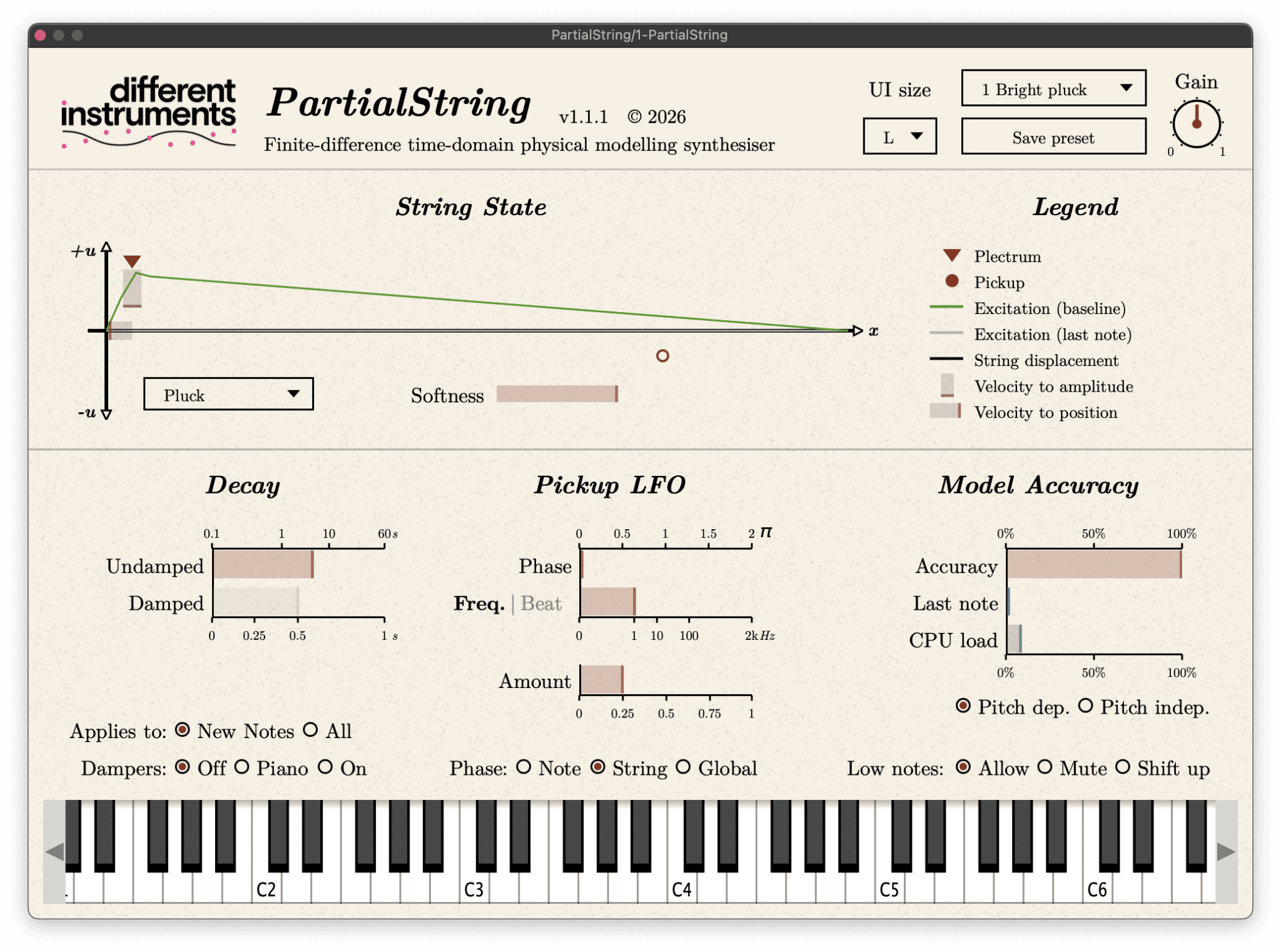
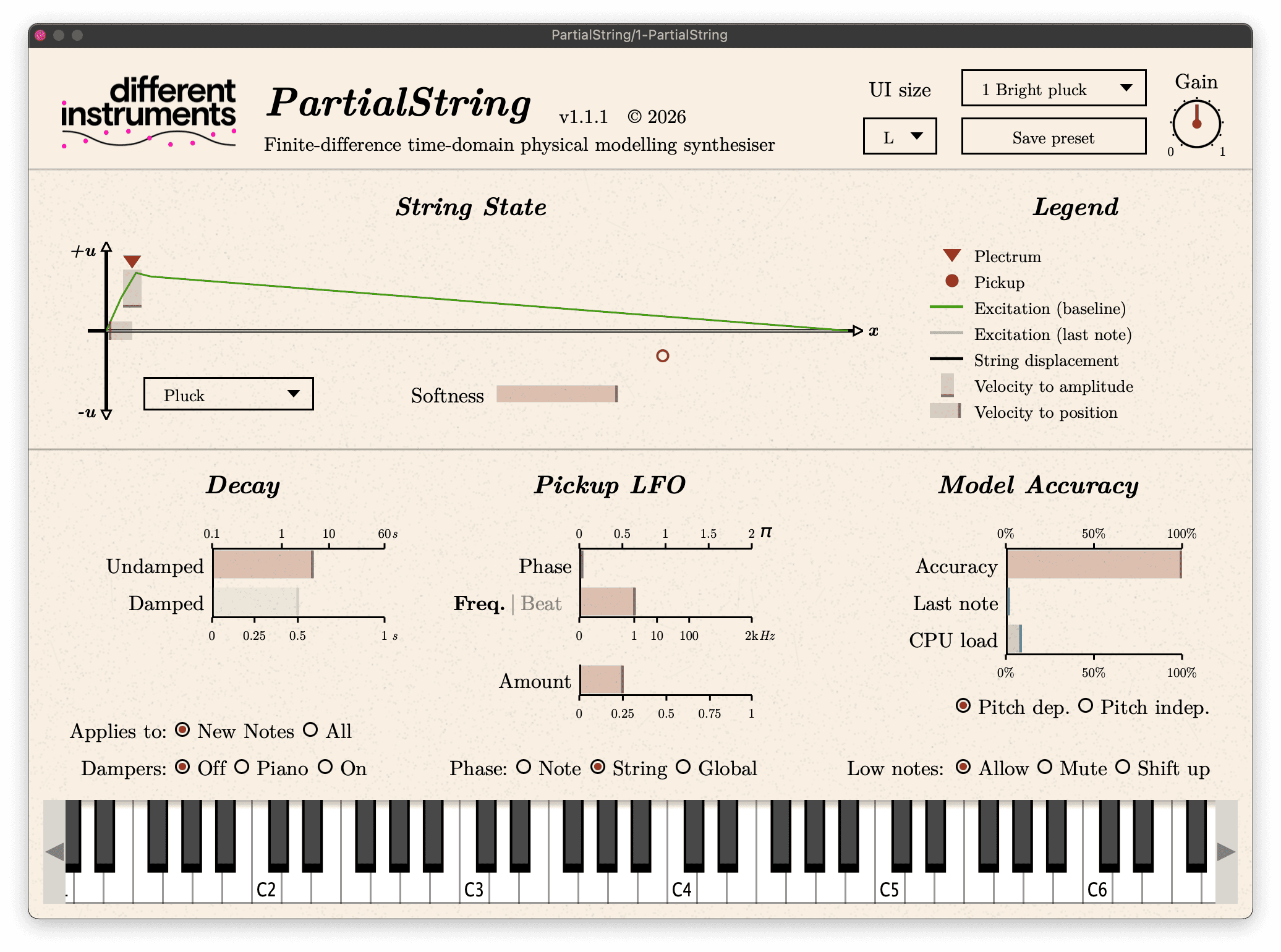
PartialString allows producers to adjust where the string is excited and how wide or soft that excitation becomes. Both parameters can respond to MIDI velocity, helping performances feel less mechanical.
Moving the excitation point changes the harmonic balance. Plucking closer to the end of the string creates a brighter and more complex tone, while moving toward the centre can produce a softer and rounder result.
The pickup position can also be moved across the simulated string. This changes which harmonics are captured, much like repositioning a pickup on a physical instrument.
Pickup Modulation and Experimental Tones
An integrated LFO can continuously move the pickup position. At slower rates, this introduces gentle tonal movement. Increasing the modulation frequency can generate more complex sidebands and amplitude-modulation-style textures.
This feature extends PartialString beyond realistic plucked instruments. It can create metallic keys, unstable drones, animated basses and strange digital tones suited to ambient music, cinematic scoring, IDM and experimental electronic production.
Decay, Dampers and Pad Creation
The decay section controls how long the virtual string continues vibrating. Separate damped and undamped settings make it possible to design short plucks, sustained resonances or long atmospheric notes.
Three damper modes are available. The damper can remain disabled, stay permanently active or behave more like a piano mechanism by closing when the MIDI note ends.
Using a long undamped decay can transform PartialString into an unusual pad instrument. Layering several notes creates evolving resonances that feel more organic than a conventional sustained oscillator.
Suitable Production Styles
PartialString is particularly relevant for ambient, cinematic music, experimental electronica, IDM, lo-fi, minimal composition, sound design and modern scoring. Its sharper plucked sounds can also be processed for melodic house, organic house and unusual pop textures.
Model Accuracy and Creative Imperfection
The Model Accuracy control changes the precision of the string simulation. Higher settings create a more accurate physical response but require additional processing power.
Reducing the accuracy produces softer, less realistic and increasingly inharmonic results. This makes the control useful as a creative sound-design parameter rather than simply a technical quality setting.
The accuracy can remain constant across the keyboard or change according to the simulated string length. This second option helps control CPU usage when playing lower notes.
Polyphony and CPU Performance
PartialString supports up to ten simultaneous voices. Because lower notes require longer simulated strings and more calculations, the actual polyphony can be reduced automatically when the processor approaches its limit.
The interface displays the current CPU load and available voice behaviour. An overload protection system can mute notes that are too demanding or shift them into a higher octave.
Producers using an Apple Silicon Mac should run a native or Universal version of their DAW. Using an Intel-only host through Rosetta may reduce the plugin’s performance.
Production Tips
- Use a short decay and a bright excitation position for detailed plucks and percussive melodies.
- Increase the undamped decay to create resonant pads and cinematic background layers.
- Automate the pickup position to introduce movement without adding chorus or phasing.
- Lower the model accuracy deliberately for softer, unstable and inharmonic textures.
- Resample long notes, then reverse or stretch them to create transitions and atmospheric effects.
Official PartialString Demo
The developer’s official demonstration provides a concise example of the instrument’s physical modelling character and tonal range.
Compatibility and Requirements
| macOS | macOS 10.13 or later, Intel and Apple Silicon, AU and VST3 |
| Windows | Windows 10 or later, 64-bit VST3 |
| Linux | 64-bit x86 Linux, VST3 |
| Copy protection | No activation system is mentioned on the official page |
Licensing
The developer distributes PartialString as a free or pay-what-you-want software download. The public product page does not provide detailed terms covering redistribution, modification or resale of the plugin files.
Music created with the synthesizer does not use bundled sample recordings, but users should still consult any licence documentation supplied with the download before redistributing the software or including it inside another product.
Final Verdict
PartialString is not another virtual analog synth wearing a slightly different jacket. Its real-time string simulation gives producers an original source of plucks, resonances, pads and unstable experimental sounds.
The interface remains approachable, but controls such as pickup modulation, damper behaviour and model accuracy offer considerable depth. CPU consumption can become noticeable with long low notes, although the automatic protection system helps keep sessions usable.
For composers and sound designers who want a free instrument with a genuine technical identity, PartialString is a fascinating download. It may occasionally ask more from the processor than a basic synth, but solving the wave equation in real time was never going to run on good intentions alone.
Download PartialString from the official website:
Technical information, official image and video supplied by Different Instruments.