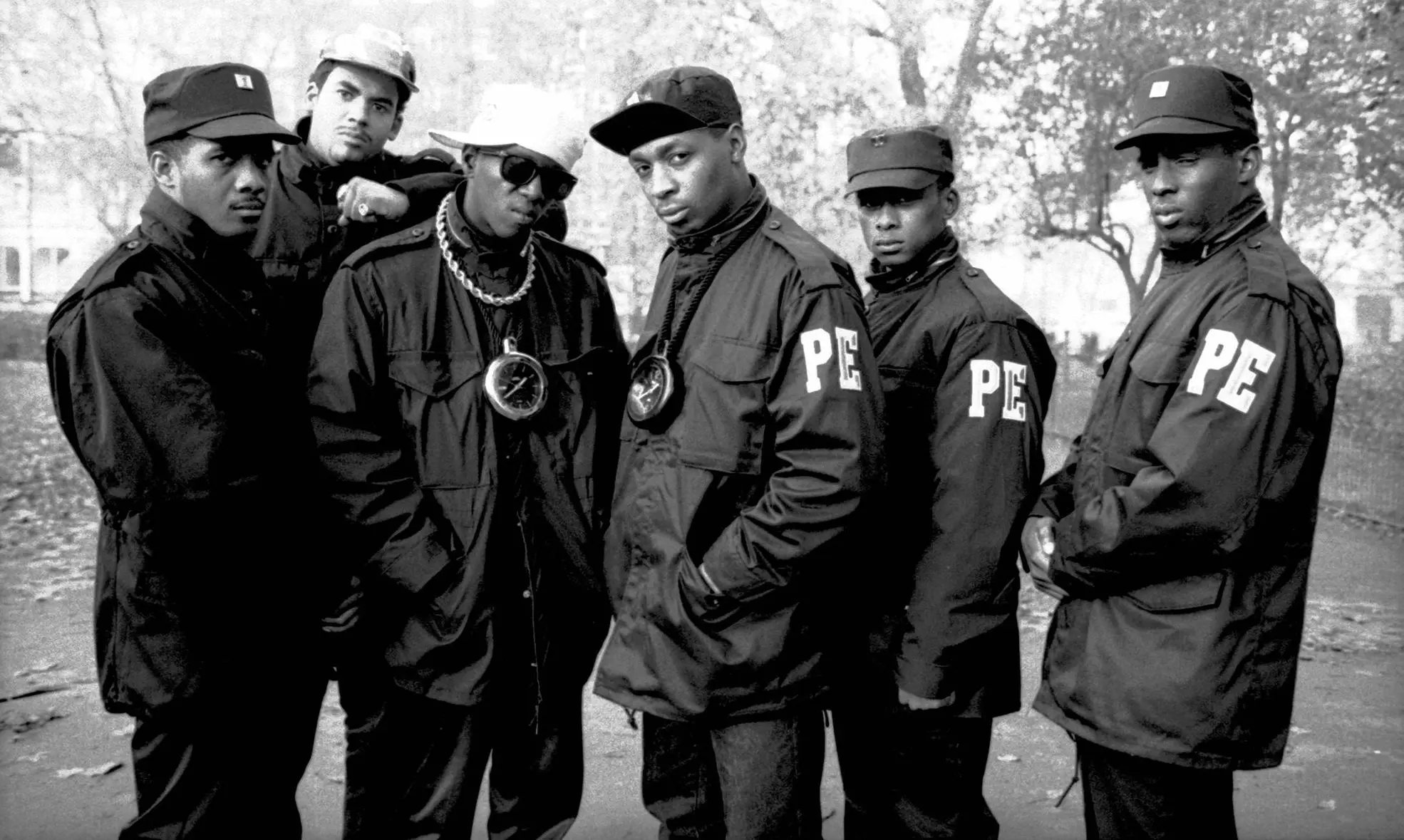

Public Enemy: The Sound of Hip-Hop as Resistance, Noise and Truth
At a time when hip-hop was still fighting for recognition as a serious art form, Public Enemy refused to ask politely for space. They took it. Their records sounded like cities under pressure: sirens, scratches, speeches, funk fragments, distorted drums and voices colliding in every direction. Behind that chaos was precision. Behind the volume was a message. Public Enemy made music that did not simply entertain, it challenged the listener to wake up.
Few tracks introduce the force of Public Enemy better than “Fight the Power,” a song that became more than a single. It became a cultural signal.
Public Enemy Biography: From Long Island Radio Culture to Global Hip-Hop History
Public Enemy’s story begins not in a corporate boardroom, but in the charged atmosphere of student radio, local scenes and Black political consciousness. Chuck D, born Carlton Ridenhour, understood the power of the voice before he became one of rap’s most authoritative MCs. His delivery had the weight of a news anchor, the force of a preacher and the discipline of a strategist. Flavor Flav, born William Drayton, brought contrast: comic timing, raw electricity, ad-libs, chaos and instinct. Together, they formed one of the most recognizable vocal dynamics in hip-hop history.
The group’s early world also included Terminator X, Professor Griff, the S1W presence and, crucially, The Bomb Squad. The production team, built around Hank Shocklee, Keith Shocklee and Eric “Vietnam” Sadler, created the dense sonic architecture that made Public Enemy sound unlike anything else in rap. Their beats did not simply loop funk breaks. They detonated them, layering samples, scratches, alarms and fragments into a wall of sound that felt political even before Chuck D started rhyming.
“Don’t Believe the Hype” remains one of the clearest examples of Public Enemy’s early authority, turning media criticism into a hard, fast, unforgettable statement.
Public Enemy released Yo! Bum Rush the Show in 1987, but their real earthquake came one year later with It Takes a Nation of Millions to Hold Us Back. That album did not feel like a normal rap release. It felt like a manifesto pressed onto vinyl. The group spoke about race, surveillance, media distortion, state violence, Black identity and cultural power with a directness that forced critics, fans and institutions to take hip-hop seriously as political art.
A Sound Built Like a Riot: The Public Enemy Musical Universe
Public Enemy’s sound is impossible to separate from their message. The music was aggressive because the subjects were urgent. The production was crowded because the world it described was crowded with pressure, misinformation, violence and resistance. The Bomb Squad created tracks that felt like information overload before the internet made that sensation normal. Their records were noisy in the best possible way, not messy, but militant.
Chuck D’s voice cut through that storm with unusual clarity. He did not rap like someone chasing fashion. He sounded like someone reading history in real time while the building was on fire. Flavor Flav, meanwhile, disrupted the seriousness without weakening it. His presence gave the group movement, unpredictability and street-theater energy. That tension between discipline and disruption became essential to the Public Enemy identity.
“Bring the Noise” captures the group’s sound at full impact, a track where rap, rock energy and sonic pressure collide with almost industrial force.
Public Enemy also changed the way hip-hop could use sampling. Their records treated samples not just as grooves, but as arguments. A horn stab could become a headline. A siren could become a thesis. A scratch could interrupt the listener like breaking news. In their hands, production became editorial language.
The Albums That Made Public Enemy Untouchable
Yo! Bum Rush the Show introduced Public Enemy as a group with force, but It Takes a Nation of Millions to Hold Us Back made them historic. Released in 1988, it remains one of the most important hip-hop albums ever made, a record that pushed rap into a new level of density, intelligence and confrontation. It was not background music. It demanded full attention.
Then came Fear of a Black Planet in 1990, a record that expanded their vision while sharpening their cultural impact. With “Fight the Power,” “Welcome to the Terrordome,” “911 Is a Joke” and “Burn Hollywood Burn,” Public Enemy turned the album into a panoramic statement about race, media, Hollywood, policing and America’s nervous relationship with Black power.
“911 Is a Joke” gave Flavor Flav one of his most memorable spotlights, turning anger at institutional neglect into a track with bite, rhythm and dark humor.
Apocalypse 91… The Enemy Strikes Black continued the mission with a heavier, more direct sound, including “Can’t Truss It” and the famous collaboration with Anthrax on “Bring tha Noize.” That crossover moment did not feel like a gimmick. It made sense because Public Enemy had always carried rock-level aggression. They were already a band of impact, even when working through samplers, turntables and microphones.
Later releases such as Muse Sick-n-Hour Mess Age, He Got Game, There’s a Poison Goin’ On, How You Sell Soul to a Soulless People Who Sold Their Soul??? and What You Gonna Do When the Grid Goes Down? showed a group that refused to become a museum piece. Public Enemy’s catalog is not only about their golden era. It is about persistence, adaptation and the belief that protest music has no expiration date.
When Hip-Hop Crossed the Barricade: Public Enemy and Rock Energy
Public Enemy’s relationship with rock was never decorative. Their records had the compression, attack and confrontation of great rock music long before guitars entered the frame. That is why their collaboration with Anthrax worked so naturally. It did not force rap into rock clothing. It revealed what was already there: distortion, rebellion, volume and crowd command.
The Anthrax version of “Bring tha Noize” became a landmark rap-rock moment, but more importantly, it showed how far Public Enemy’s language could travel without losing its identity.
This crossover energy helped position Public Enemy as one of the rare hip-hop groups whose influence moved across genres. They mattered to rappers, rock bands, producers, activists, journalists and visual artists. Their music was not confined to one scene because the questions they raised were bigger than scene politics.
What Public Enemy Brought to Music
Public Enemy brought urgency back to popular music at a time when much of the industry preferred safer messages. They made hip-hop sound like a public address system for communities that had been misrepresented, ignored or attacked. They treated rap as journalism, protest, memory, satire and strategy.
Their influence is enormous. Without Public Enemy, politically charged hip-hop would still exist, but it would not have the same vocabulary of scale. They showed that a rap group could operate with the conceptual weight of a revolutionary newspaper, the sound pressure of a punk band and the discipline of a cultural movement. They also proved that Black anger, intelligence and humor could sit at the center of mainstream music without being softened for comfort.
“He Got Game,” built around a powerful Stephen Stills connection, shows another side of Public Enemy: reflective, cinematic and still deeply engaged with the moral questions running through American culture.
Public Enemy’s greatness also lies in their refusal to separate music from responsibility. They did not treat consciousness as a marketing angle. It was the engine of the project. Their work gave hip-hop a larger frame, one where the MC could be artist, critic, historian and agitator at the same time.
Why Public Enemy Still Matters Today
Public Enemy still matters because the world they described has not disappeared. Media distortion, racial injustice, political manipulation, institutional violence and cultural amnesia remain painfully relevant. That is why their music does not feel frozen in the late 1980s or early 1990s. It still sounds like a broadcast from the present.
The group’s later work also proves that their mission did not end with nostalgia. Tracks like “Harder Than You Think” reintroduced Public Enemy to new audiences while keeping the same essential DNA: strength, defiance, rhythm and public purpose.
For new listeners, Public Enemy is essential because they explain what hip-hop can be when it refuses to shrink itself. Their music is not always comfortable, and that is precisely the point. Great protest music is not made to decorate the room. It is made to change the temperature.
Conclusion: Public Enemy Never Asked Permission
Public Enemy changed hip-hop by making it louder, sharper and more intellectually dangerous. They turned the studio into a newsroom, the stage into a platform and the rap group into a cultural force capable of challenging power directly. Their best records still feel alive because they were built from pressure, not trend.
In the end, Public Enemy’s legacy is not just a discography of classic albums and landmark singles. It is a method. Speak clearly. Sound fearless. Question everything. Build noise into meaning. More than three decades after their most famous records, that method still hits with force. Public Enemy did not simply fight the power. They gave the fight a sound.