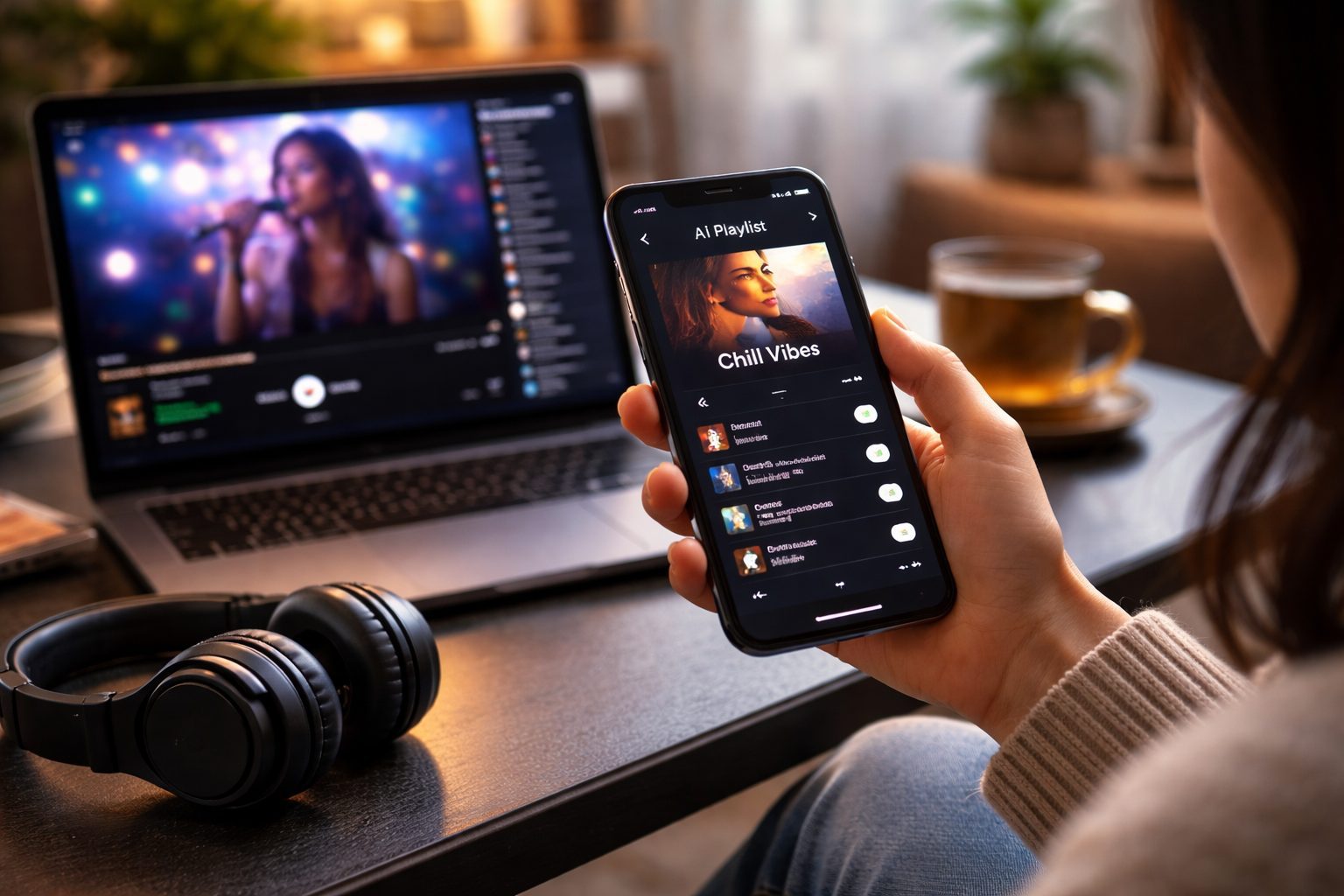

Spotify is no longer just a music streaming service — it is rapidly evolving into a multimedia entertainment hub where audio, video, and AI-driven personalization converge. As competition intensifies across the streaming landscape, the platform is embracing artificial intelligence, integrated video content, and cross-service interoperability to redefine how audiences discover and engage with music.
- AI-Powered Playlists Redefine Discovery
- Integrated Music Videos: Spotify Challenges YouTube
- Seamless Playlist Import Lowers Barriers to Entry
- The Vision: A Unified Audio-Video-Social Ecosystem
- The Risk: Feature Overload and User Fatigue
- What This Means for Artists and the Industry
- A Platform at a Crossroads
This transformation signals a decisive shift: Spotify is positioning itself not merely as a listening platform, but as a comprehensive ecosystem designed to capture attention in an increasingly fragmented digital environment.
AI-Powered Playlists Redefine Discovery
Artificial intelligence now sits at the core of Spotify’s discovery engine. The platform has expanded its AI-assisted playlist creation tools, allowing users to generate tailored playlists through prompts, mood descriptions, or listening history.
Rather than relying solely on past behavior, Spotify’s AI can interpret intent — whether a listener wants “late-night focus beats,” “sunset drive vibes,” or “underground house discoveries.” This contextual understanding marks a significant leap from traditional recommendation models, transforming playlist creation into an interactive experience.
For users, the benefit is immediacy and precision. For artists, it introduces a new discovery pathway where niche sounds can surface through descriptive prompts rather than algorithmic popularity alone.
Integrated Music Videos: Spotify Challenges YouTube
Spotify’s rollout of integrated music videos represents one of its boldest strategic moves in years. By embedding official clips directly within the app, the platform is bridging the gap between audio streaming and visual storytelling.
This feature responds to a clear behavioral trend: younger audiences increasingly expect music to be a visual experience. From vertical video snippets to full-length clips, Spotify is expanding the ways fans connect with artists beyond sound alone.
The implications are significant. Video integration keeps users inside the Spotify ecosystem longer, reduces reliance on external platforms, and opens new creative formats for artists — including visual albums, live sessions, and short-form performance content.
Seamless Playlist Import Lowers Barriers to Entry
In a move aimed at user acquisition and retention, Spotify now enables direct playlist imports from competing services. This functionality eliminates one of the biggest friction points in switching platforms: rebuilding years of curated music.
By simplifying migration, Spotify strengthens its competitive edge while reinforcing its role as a central hub for personal music libraries. For users, the transition becomes nearly frictionless; for the platform, it represents a strategic expansion tactic in saturated markets.
This interoperability also reflects a broader industry trend toward portability and user ownership of listening data.
The Vision: A Unified Audio-Video-Social Ecosystem
Spotify’s recent innovations reveal a clear ambition — to become a unified destination where music, video, podcasts, and social interaction coexist. The platform is steadily layering features that encourage deeper engagement, from collaborative playlists and AI curation to visual content and creator tools.
This convergence mirrors the evolution of digital media consumption, where audiences seek immersive environments rather than isolated services. By integrating multiple formats, Spotify aims to maximize user time within its ecosystem while offering creators diversified avenues for expression.
The Risk: Feature Overload and User Fatigue
Yet this expansion carries inherent risks. As Spotify accumulates features, some users express nostalgia for the platform’s earlier simplicity — a streamlined interface centered purely on music.
Increased complexity can dilute usability, particularly for listeners who value frictionless playback over interactive tools. Balancing innovation with clarity will be critical to maintaining user satisfaction.
Spotify’s challenge lies in ensuring that new capabilities enhance, rather than overwhelm, the listening experience.
What This Means for Artists and the Industry
For artists, Spotify’s transformation opens new strategic opportunities. AI-driven discovery allows for more nuanced audience targeting, while integrated video introduces fresh storytelling formats that can deepen fan engagement.
However, success in this evolving ecosystem will require adaptability. Visual identity, short-form content, and metadata optimization are becoming as important as audio production itself.
On an industry level, Spotify’s shift underscores a broader trend: streaming platforms are no longer competing solely on catalog size, but on experience design and ecosystem depth.
A Platform at a Crossroads
Spotify’s evolution into an AI-powered, immersive media hub marks a defining moment in the streaming era. By merging audio, video, and intelligent personalization, the platform is betting on a future where music consumption is interactive, visual, and deeply personalized.
Whether this strategy strengthens user loyalty or introduces friction will depend on execution. What is certain, however, is that Spotify is no longer content to be just a music app — it is building a digital stage where sound, image, and algorithm converge.
In the race to define the next generation of streaming, Spotify has made its position clear: the future of music is immersive, intelligent, and interconnected.