
For artists, labels, distributors and independent curators, this is not background noise. These platform decisions shape how music is discovered, how royalties move, how listeners trust what they hear and how human creativity survives in a catalog increasingly flooded by automated content. The streaming economy is no longer just a race for subscribers. It is becoming a test of credibility.
Spotify Tests the Limits of Price Strategy
Spotify’s latest pricing shift is one of the clearest signs that the platform is still searching for the right balance between growth, value and user psychology. The company has discontinued its Premium Lite tier in India, Indonesia, Saudi Arabia, South Africa and the United Arab Emirates, only months after launching the lower-cost plan in those markets.
Premium Lite was designed as a more affordable paid option, offering an ad-free experience and on-demand playback, but without key Premium benefits such as offline downloads and higher audio quality. On paper, the idea made sense: give price-sensitive markets a softer entry point into paid streaming. In practice, Spotify appears to have discovered a hard truth about music subscribers. People may want cheaper access, but they do not necessarily want to feel like they are paying for a reduced version of the service.
The company has also lowered the price of its standard Premium plan in some of those markets, including India, where the adjustment is particularly significant. It is a sharp strategic reversal. Instead of pushing listeners into a smaller tier, Spotify is making the full Premium experience more competitive. That tells us something important: in emerging streaming markets, price matters, but perceived value matters even more.
Canada Moves in the Opposite Direction
While Spotify is cutting prices in selected growth markets, it is raising Premium prices in Canada, with increases depending on the subscription plan. This split strategy says a lot about the current streaming economy. Mature markets are being asked to carry more revenue per user, while developing markets are still treated as long-term acquisition territory.
For the music industry, this creates a complicated picture. Higher subscription prices can support better revenue growth, but they also increase pressure on platforms to prove that the monthly fee still feels justified. Listeners now compare music streaming not only with other music services, but with video, gaming, cloud storage, audiobooks and social subscriptions. The question is no longer “Is Spotify cheaper than buying albums?” It is “Does this service still feel essential every month?”
Spotify Turns Listening History Into Social Currency
Spotify is also leaning heavily into personal data as a cultural product. Its 20th anniversary experience, “Spotify 20: Your Party of the Year(s),” transforms user listening history into a personalized retrospective. It highlights early listening behavior, favorite artists, total songs streamed and a playlist built around the user’s most-played tracks.
This is more than a birthday feature. Spotify has become exceptionally good at turning private listening habits into shareable identity. Wrapped proved the model. The anniversary experience extends it. The user is no longer just listening to music, the user is performing taste, nostalgia and personal history through the platform.
That matters for artists because the emotional bond between listener and platform is increasingly built around memory. Discovery is important, but retention is often driven by habit, ritual and self-recognition. Spotify understands that the strongest streaming product is not always the newest feature. Sometimes it is the feeling that the service knows your life better than your old hard drive ever did.
Family Accounts Become a New Trust Frontier
Spotify’s expansion of managed accounts for younger listeners also shows how streaming platforms are moving deeper into family infrastructure. The feature gives parents more control over content exposure, explicit tracks, artist blocking and certain social functions. It also helps separate children’s listening activity from the parent’s own recommendation profile.
That detail may sound small, but it is actually very smart. Anyone who has seen their recommendation feed hijacked by children’s music understands the danger. One week of cartoon songs, and suddenly the algorithm thinks you are preparing a nursery rave. Spotify is trying to protect both safety and personalization, two subjects that will only become more important as platforms compete for household subscriptions.
Deezer Makes the Strongest Move Against AI Music Flooding
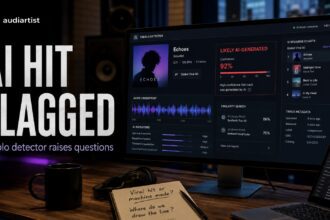
The most serious issue in streaming right now is not price. It is the explosion of AI-generated uploads. Deezer has become the most aggressive major platform on this front, stating that around 75,000 AI-generated tracks are now delivered to the platform every day, representing roughly 44% of daily uploads.
That number should make the entire industry stop pretending this is a niche debate. AI music is not arriving slowly. It is arriving industrially. The issue is not whether a producer uses an intelligent tool for harmony, arrangement or workflow assistance. The issue is the mass production of fully generated tracks designed to occupy catalog space, manipulate discovery systems and potentially divert royalties away from human creators.
Deezer’s response is more concrete than most. The platform detects and tags AI-generated music, removes it from algorithmic recommendations and editorial playlists, and has stopped storing high-resolution versions of identified AI tracks. It has also said that a large share of streams linked to AI-generated music shows signs of fraud and is therefore demonetized.
Why Deezer’s Position Matters
Deezer is not the biggest streaming platform in the world, but its AI policy has given it a rare leadership position. While some competitors focus on metadata disclosure, Deezer is building the argument around detection, demotion and royalty protection. That distinction matters.
A self-declaration system depends on honesty. A detection system depends on enforcement. Neither is perfect, but they do not carry the same weight. In a world where thousands of tracks can be generated, uploaded and distributed at scale, asking bad actors to politely label themselves is not exactly a fortress strategy. It is more like putting a “please do not steal the royalties” sign on the door.
For independent artists, Deezer’s position is important because it addresses visibility as much as fraud. If platforms allow automated music to flood recommendation systems, the damage goes beyond royalty leakage. Human artists lose space, listeners lose trust and curators are forced to filter through more noise than ever before.
Apple Music and Spotify Choose Transparency, but the System Still Depends on Disclosure
Apple Music has introduced AI Transparency Tags designed to identify where artificial intelligence has been used in music-related content. The system covers several areas, including recordings, composition, artwork and music videos. Spotify is also moving toward AI credits in song information, with early rollout connected to distributor-side declarations.
These are important steps, but they reveal the central weakness of the current platform response. Much of the system still depends on labels, artists or distributors declaring the use of AI correctly. That may work for responsible professionals. It will not necessarily stop the flood of opportunistic uploads coming from anonymous catalog factories.
Transparency is useful only when it is visible, consistent and enforced. A tag hidden in credits is better than silence, but it is not the same as a platform-wide policy that shapes recommendation, monetization and discovery. The streaming industry is now entering a phase where metadata will become a battleground. Credits, rights information, AI involvement and fraud signals will matter almost as much as the audio file itself.
Qobuz Strengthens the Human-Creativity Argument
Qobuz has also moved into the AI-detection conversation, positioning itself around artist protection, editorial quality and listener trust. This fits naturally with its identity as a high-quality music service aimed at serious listeners. For a platform built around sound quality and music culture, uncontrolled AI flooding would be especially damaging.
The Qobuz approach reinforces a broader trend: smaller or more specialized platforms can differentiate by taking stronger ethical and editorial positions. They may not have Spotify’s scale or YouTube’s ecosystem power, but they can compete on trust. In a market where catalog quantity is becoming less impressive by the day, curation and credibility are becoming valuable again.
YouTube Music Keeps Growing Through Ecosystem Power
YouTube Music and YouTube Premium continue to benefit from one of the strongest ecosystems in entertainment. Alphabet has reported record non-trial subscriber growth for YouTube Music and Premium during the first quarter of 2026, even as other platforms face slower growth in mature markets.
The reason is simple: YouTube is not just a music platform. It is video, creators, podcasts, Shorts, tutorials, fan culture, live performances and music discovery in one environment. For younger listeners especially, the boundary between watching music and listening to music has already collapsed.
This gives YouTube Music a structural advantage. Spotify is powerful because it owns listening habits. YouTube is powerful because it owns attention. In 2026, attention may be the more dangerous asset.
TIDAL Tries to Rebuild Value Around Direct Fan Support
TIDAL’s direct-to-fan album download model is another important signal. By allowing artists to sell directly through the platform with a 90/10 artist-platform split, TIDAL is positioning itself closer to the Bandcamp-style economy while keeping the streaming experience at the center.
This is a smart strategic lane. TIDAL is unlikely to beat Spotify on total user scale, but it can compete by offering artists better tools for fan monetization. For independent musicians, direct sales matter because they create a different relationship with value. A stream is passive. A purchase is intentional. One pays fractions. The other says, “I want to own this.”
The future of artist income will not come from streaming alone. It will come from a stack of revenue sources: streaming, direct sales, merch, live shows, sync, fan subscriptions, editorial exposure and community building. TIDAL’s move recognizes that reality.
Tencent Music Shows the Power of the Superfan Economy
Tencent Music is moving in a similar direction, but at a much larger ecosystem level. Its recent growth has been supported not only by streaming subscriptions, but by concerts, merchandise and superfan-driven services. The company’s live and non-subscription music activities are becoming a serious part of its business.
This matters because it points toward the next stage of streaming competition. Platforms no longer want to be simple access providers. They want to control more of the music value chain: discovery, listening, ticketing, fan engagement, merchandise and premium experiences.
That model could benefit artists if it creates more revenue opportunities. It could also create new dependencies if platforms become too powerful across every layer of the fan relationship. The same platform that recommends the song may also sell the ticket, host the fan club and control the data. That is convenient, but it is also a lot of power in one place.
The Streaming Market Is Becoming Less Neutral
For years, platforms tried to present themselves as neutral libraries. Upload the music, let the system work, trust the algorithm. That era is fading. Every major platform is now making editorial, economic and ethical choices that shape what listeners hear and what artists earn.
Spotify is adjusting price architecture. Deezer is actively filtering AI content from recommendations. Apple Music is building transparency metadata. Qobuz is protecting its editorial identity. TIDAL is creating direct sales options. YouTube Music is expanding through ecosystem dominance. Tencent Music is turning streaming into a broader fan economy.
These are not isolated updates. They are signs of a market entering a more selective phase. The streaming catalog is too large, the fraud risk is too high and the listener’s attention is too valuable for platforms to remain passive.
What This Means for Independent Artists
Independent artists should read these developments carefully. The old strategy of simply distributing a track everywhere and waiting for the algorithm to notice is weaker than ever. Visibility now depends on trust signals, platform behavior, fan activity, editorial positioning and consistent audience engagement.
Artists need clean metadata, strong visuals, credible release strategies, social proof and active fan communication. They also need to think beyond one platform. Spotify can deliver reach, YouTube can deliver attention, TIDAL can support direct value, Deezer and Qobuz can support credibility, and editorial websites can provide context that algorithms cannot.
The most resilient artists in this new environment will not be the ones who chase every trend. They will be the ones who build recognizable identity, protect their catalog quality and understand that streaming is only one part of a larger music ecosystem.
The Real Story: Streaming Is Fighting for Trust
The biggest streaming story of the day is not one single feature, price change or product launch. It is the trust crisis underneath all of them.
Listeners need to trust that what they hear is worth their time. Artists need to trust that platforms will not bury them under automated noise. Labels need to trust that royalties are not being siphoned by fraud. Platforms need users to trust that subscription prices still make sense. Everyone is asking the same question from a different angle: what is real value in a market where music is infinite?
That is why the current moment feels important. Streaming is not collapsing. It is maturing, and maturity is rarely comfortable. The easy-growth era is over. The catalog race is over. The next phase belongs to platforms that can prove they are not just delivering music, but protecting its meaning.
For human artists, that should be both a warning and an opportunity. The flood of automated content is real, but so is the hunger for authenticity. The platforms that understand this will define the next decade of streaming. The artists who understand it first will have the strongest chance of being heard.