
A Strategic Shift Toward Conversational Discovery
In the increasingly competitive streaming landscape, incremental updates rarely move the needle. But YouTube Music’s latest AI-powered playlist feature signals something more strategic than a simple UI tweak. It represents a deliberate push toward conversational music discovery — and a redefinition of how users interact with streaming platforms.
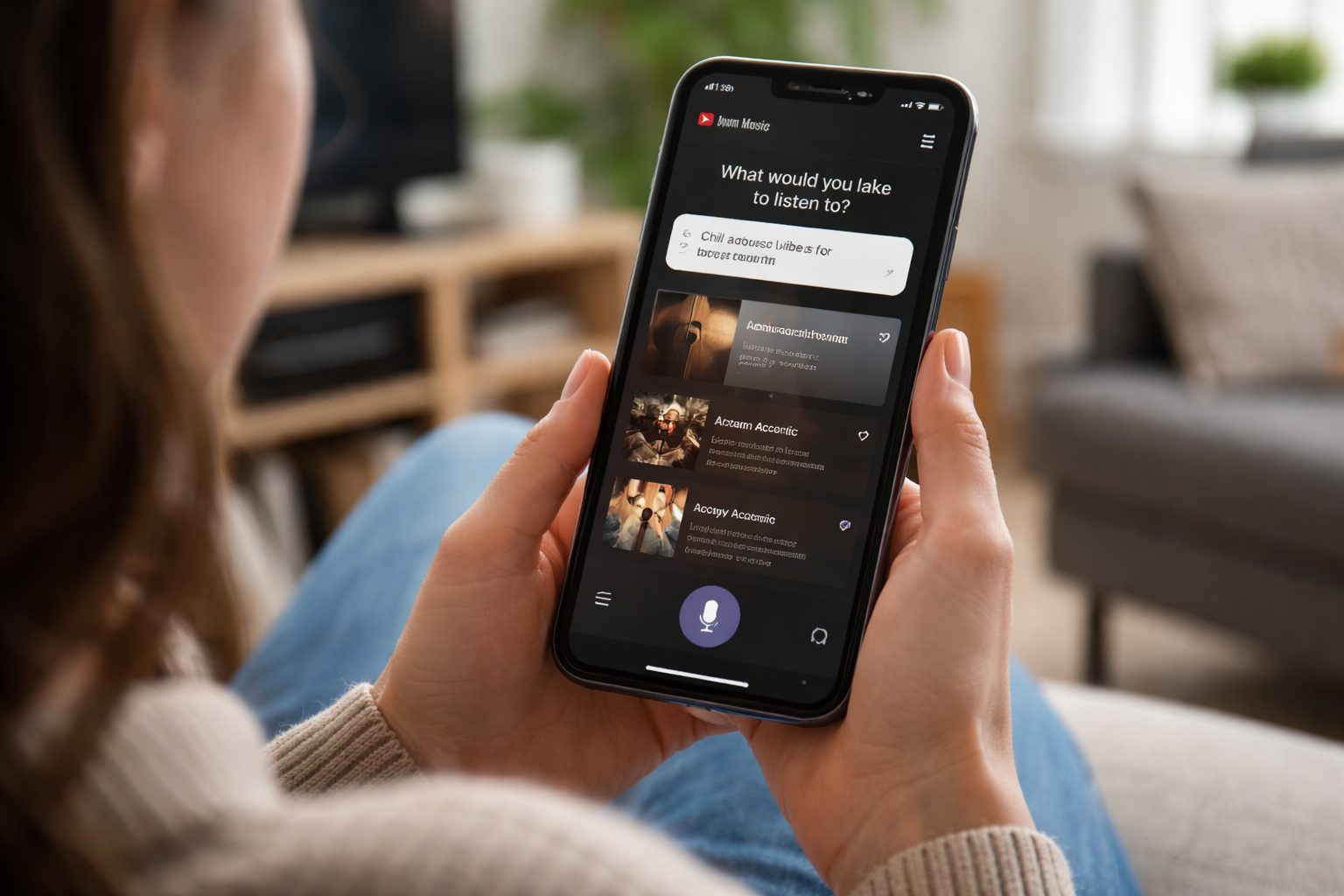
For Premium subscribers, the rollout introduces intelligent playlist generation driven by natural language prompts. Instead of manually curating tracks or browsing algorithmic suggestions, users can now describe a mood, scenario, or activity — even through voice input — and receive a dynamically generated playlist tailored in seconds.
This is not just convenience. It is positioning.

From Algorithmic Suggestion to Conversational Curation
For years, streaming platforms have relied on predictive algorithms based on listening history, skips, saves, and engagement metrics. While effective, these systems are fundamentally reactive. They analyze what users did, not necessarily what they want right now.
The new AI playlist feature changes that equation.
By allowing subscribers to type or speak contextual prompts such as “late-night deep focus,” “sunset rooftop house vibes,” or “melancholic piano with cinematic tension,” YouTube Music shifts toward intent-based discovery. The AI interprets semantic nuance, emotional tone, and situational context — creating playlists that feel more curated than computed.
This move places YouTube Music at the crossroads of generative AI and streaming personalization — an arena that is quickly becoming the industry’s next battlefield.
Why This Matters for the Premium Strategy
The feature is currently being deployed for Premium users, reinforcing a broader monetization strategy. In a market where subscriber growth is increasingly challenging, platforms are leaning on differentiated tools to justify paid tiers.
AI-assisted playlist generation becomes more than a novelty feature; it becomes a conversion lever.
Premium already offers ad-free listening and background play. Now it adds creative control. Users aren’t just consuming playlists — they’re co-creating them with AI.
In practical terms, this enhances perceived value. In strategic terms, it deepens lock-in.
Competing in an AI-Driven Streaming Era
Streaming services are no longer competing solely on catalog size or audio quality. The battleground has shifted to discovery intelligence.
With millions of tracks added each year, the problem is no longer access — it’s navigation. AI playlist tools aim to solve discovery fatigue by compressing search time into conversational prompts.
This aligns with broader industry trends:
- The rise of generative interfaces across tech platforms
- Voice-driven interaction replacing manual browsing
- Context-aware recommendations instead of passive algorithm feeds
YouTube Music’s advantage lies in its integration with YouTube’s broader ecosystem. Data signals from video consumption, Shorts engagement, and cultural trends can feed into more adaptive recommendation layers, potentially making its AI playlists more responsive to real-time cultural momentum.
A Subtle but Significant UX Shift
What makes this rollout particularly interesting is its psychological impact.
Traditional playlists imply editorial authority — curated by humans or platform algorithms. AI-generated playlists, built from user prompts, imply personalization and agency. The user becomes part of the creative loop.
That subtle shift changes perception:
The platform no longer “knows best.”
The platform collaborates.
If executed well, this reduces friction between inspiration and playback. A mood becomes music almost instantly.
Implications for Artists and Discovery
For artists, especially independent musicians, the stakes are high.
If AI-generated playlists rely heavily on contextual tagging, metadata precision, and semantic analysis, discoverability could increasingly depend on how well a track is described and categorized — not just how often it is streamed.
In other words, metadata may become as strategic as marketing.
Producers and labels who understand contextual positioning — mood, use-case, emotional descriptors — could see stronger placement within AI-generated listening sessions.
The Bigger Picture
This feature rollout is not just about making playlists easier to create. It signals the next phase of streaming evolution: conversational music ecosystems.
The future of discovery may look less like scrolling through curated categories and more like speaking to a music companion that understands nuance, timing, and emotion.
If YouTube Music refines this capability — and integrates it seamlessly with its broader video and Shorts infrastructure — it could redefine how users discover music in 2026 and beyond.
Streaming is no longer about access.
It’s about interpretation.
And AI is quickly becoming the interpreter.