
How Artists Win Without Sending Fans Anywhere
For years, music promotion followed a familiar ritual. Post the artwork. Add a link. Ask people to stream the track, pre-save the release, watch the video, join the newsletter, follow the profile, maybe buy the merch if the moon was in a generous mood. The entire strategy depended on one fragile action: the click.
That model has not disappeared, but it has lost its throne. In 2026, the click is no longer the center of gravity. Attention is. Platforms want users to stay where they are. Audiences have become faster, more selective, and more allergic to friction. The result is a quiet but decisive shift in how music spreads online. More and more often, the artist who wins is not the one who sends fans elsewhere. It is the one who creates enough intrigue, emotion, and trust before anyone has to leave the feed.
This is the zero-click era of music promotion. It does not mean links are useless. It means links now come later, and sometimes they barely matter at all. The real conversion begins inside the post, inside the video, inside the caption, inside the comments, inside the first five seconds where a listener decides whether this artist feels worth caring about.
For independent musicians, this is both frustrating and liberating. Frustrating because lazy promotion has become even easier to ignore. Liberating because artists with strong storytelling, personality, consistency, and emotional precision can now outperform bigger players who still behave like every post is a traffic sign pointing somewhere else.
The end of the “link in bio” fantasy
There was a time when “link in bio” felt like a strategy. In reality, it was often just a polite form of begging the audience to do extra work. Click the profile. Find the link hub. Choose the right destination. Wait for the page to load. Decide again. Maybe listen. Maybe not. At every step, a few people vanished.
Most artists underestimated how much energy they were asking from casual listeners. Fans do not move through digital spaces like disciplined interns completing a checklist. They move like everyone else on the internet: impulsively, emotionally, distracted by twenty other stimuli. The less momentum you preserve, the more attention you lose.
That is why zero-click promotion matters. It accepts the reality of platform behavior instead of fighting it. Instead of treating the post as a doorway to the “real” experience, it makes the post part of the experience itself. The teaser is no longer bait. It is content. The caption is no longer admin. It is narrative. The comment section is no longer an afterthought. It is social proof in motion.
In this environment, the strongest music campaigns do not begin with “go listen.” They begin with “feel this.”
What zero-click promotion actually looks like
Zero-click promotion is often misunderstood as anti-marketing minimalism, as if the answer were simply to post more clips and ask for nothing. That misses the point. The approach is not passive. It is highly intentional. It is about designing content that creates desire before the link appears, and sometimes without needing the link to do the heavy lifting at all.
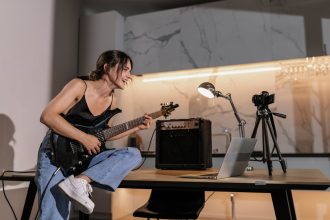
A zero-click post can take many forms. It might be a vertical video built around the most emotionally charged ten seconds of a song. It might be a studio moment where the artist explains the line that changed the whole track. It might be a raw voice note about why this release almost never came out. It might be an on-camera performance with a direct look into the lens, no glossy distraction, no fake urgency, just presence.
What all these formats share is simple: they deliver value before asking for action. That value can be emotional, aesthetic, entertaining, surprising, revealing, or even controversial. But it must be immediate. A post that merely announces a release is usually weak. A post that makes the audience feel like they already stepped into the world of the song is much stronger.
Why platforms now reward native attention
The structure of digital promotion has changed because platform incentives have changed. Social apps want retention. Streaming platforms want deeper fan engagement. Video ecosystems want repeat viewing and platform-native behavior. Nobody is handing out medals for successfully pushing users away in the first few seconds.
That does not mean external destinations have vanished from music marketing. Artists still need streaming links, stores, ticket pages, newsletters, and websites. But those destinations work best when they are reached by momentum, not by command. The difference is subtle and enormous.
When a user sees a generic post that says “new song out now, listen here,” the request arrives before the emotional investment. When a user sees a clip that triggers curiosity, recognition, nostalgia, tension, or admiration, the decision begins internally. The platform did not block the conversion. The content either built enough energy to make the next step feel natural, or it did not.
This is why native tools across platforms have become more important than many artists realized. Countdown features, short vertical clips, previews, in-app reminders, artist profile upgrades, visual loops, pinned posts, story stickers, and comment-led interaction all serve one purpose: reducing friction between discovery and action. The best promotional systems in 2026 are not louder. They are smoother.
The first job of promotion is no longer traffic. It is belief.
In the old mindset, promotional success was often framed as reach plus clicks. In the new one, the first metric that matters is belief. Did the audience believe this release was worth noticing? Did they believe the artist was real, intentional, and emotionally legible? Did they believe there was a story here, not just another demand for attention?
This is where many campaigns collapse. Not because the song is weak, but because the surrounding content gives the audience nothing to hold onto. People do not support music in a vacuum. They support signals. A face. A tone. A point of view. A recurring atmosphere. A sentence that feels true. A clip that lingers in the mind after the scroll has moved on.
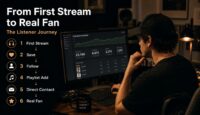
Belief is what turns passive exposure into memory. Memory is what turns familiarity into intent. Intent is what makes the eventual stream, save, follow, or share much more likely. Zero-click promotion understands this chain. It stops treating audience behavior like a mechanical funnel and starts respecting the fact that people first need a reason to care.
How artists lose momentum before the song even starts
Most failed music promotion is not aggressive enough in the wrong places and not generous enough in the right ones. Artists often overinvest in distribution mechanics and underinvest in content architecture. They polish the release day assets, generate smart links, schedule announcements, and still wonder why the response feels soft.
The answer is often painful: the campaign never created tension. It informed, but it did not seduce. It posted, but it did not frame. It announced, but it did not reveal.
A listener does not owe a new artist curiosity. Curiosity has to be earned. If the first touchpoint is generic, the audience assumes the song might be generic too. If the visual is forgettable, the release feels forgettable. If the caption reads like a template, the music inherits the same energy.
That is why zero-click strategy begins well before release day. It builds atmosphere in advance. It gives the audience fragments to decode. It lets a song arrive with context, not just availability.
The new anatomy of a high-performing music post
A hook that belongs to the platform
The most effective hooks are not always the loudest or most dramatic. They are the ones that feel native to the space while still carrying a pulse of difference. On short-form video, that can mean opening with a line people instantly relate to, a visual tension point, a performance moment, or a sentence that re-frames the song in human terms. On other platforms, it may mean leading with one striking image and a caption that invites reading rather than begging for engagement.
The mistake many artists make is treating the hook like a trailer. Better to treat it like a tiny confession, a fragment of a scene, or a live wire from the track’s emotional core.
Proof of humanity
The internet is crowded with polished surfaces. What cuts through is often not perfection but recognizability. A voice speaking naturally. A room that looks lived in. A rehearsal take with tension still inside it. A musician explaining why a chorus had to be rewritten three times. These details do not weaken a campaign. They humanize it.
In an era where audiences are increasingly suspicious of formula, synthetic polish, and generic volume, proof of humanity is promotional gold. It signals craft. It signals intention. It signals that there is someone behind the release who is not just uploading content into the void and hoping an algorithm takes pity.
A clear emotional takeaway
Good promotional content leaves the audience with a feeling, not just information. The post should answer, without sounding like a press release, one essential question: why this song, why now, why should anyone care? The answer may be joy, tension, grief, freedom, obsession, nostalgia, irony, tenderness, rage, or release. But it has to be legible.
People rarely remember a post because it was efficient. They remember it because it created a mood they wanted to revisit.
Captions are no longer support text
Many artists still write captions as if nobody reads them. That assumption is expensive. In zero-click promotion, the caption can carry as much persuasive weight as the media itself. It is where context deepens. It is where tone sharpens. It is where the artist either sounds alive or sounds interchangeable.
A strong caption does not summarize the obvious. It expands the moment. It adds a layer the video alone cannot hold. It can reveal the line that broke the song open, explain the scene behind the lyric, or frame the release with a sentence that immediately invites emotional recognition.
The best captions are not overloaded with hashtags, desperate instructions, or obvious sales language. They sound like the artist is speaking to a room full of intelligent humans, not shaking a digital cup and hoping for a few clicks to fall in.
This does not mean every caption must become a miniature essay. Some of the best ones are brutally short. But they should always carry intention. Every post needs a center of gravity, and very often the caption is where that center quietly forms.
The comments section is part of the campaign
Too many artists still treat comments as something that happens after promotion. In reality, comments are promotion. They shape perception in real time. They show whether a release feels alive. They turn a post from a monologue into a social object.
When listeners react publicly, they create proof that other listeners can trust. When the artist responds with warmth, clarity, humor, or insight, the campaign gains density. It feels inhabited. That matters more than many vanity metrics. A post with a moderate number of views and a strong comment culture often carries more long-term value than a large but empty spike.
Comment-led promotion is one of the hidden strengths of the zero-click era. It gives artists a way to deepen engagement without immediately redirecting people elsewhere. It allows relationships to begin in public, where other potential listeners can watch belief being built.
There is also a subtle credibility effect at work. Dead comment sections make a release feel cold. Lived-in ones make it feel relevant. The difference is not trivial. Music discovery has always been social, even when the tools change.
Short-form video changed promotion, but not in the way many artists think
The rise of vertical video pushed the industry into a familiar panic. Some artists embraced it, others resisted it, and many tried to imitate trends with the grim facial expression of someone assembling flat-pack furniture without the manual. The problem was never video itself. The problem was misunderstanding what video could actually do.
Short-form content is not just a place to advertise the song. It is a place to let the song behave like culture. That means the clip should not always function like a commercial. Sometimes it should feel like a performance. Sometimes like a thought. Sometimes like a cinematic fragment. Sometimes like a direct conversation.
Artists who only use video to point outward tend to underperform. Artists who use video to make the song emotionally available inside the platform tend to build stronger momentum. The best clips do not say, “Please go stream this.” They make the audience think, “I need to hear more.”
That is the distinction that defines the zero-click era. Desire comes first. Navigation comes second.
How to turn a release into an in-platform event
One of the smartest adaptations artists can make is to stop thinking of a release as a single announcement. A release is an unfolding event. It has phases, temperature changes, narrative beats, and social cues. If it only appears as one isolated post on release day, it arrives too flat.
In-platform events work because they build anticipation without exhausting the audience. A song can be introduced through several angles: a lyrical reveal, a performance excerpt, a production detail, a personal backstory, a visual motif, a countdown moment, or a listener reaction. Each post should feel distinct, but all should belong to the same emotional world.
This is where native tools become especially powerful. On platforms such as Spotify for Artists, artists can strengthen release framing through visual and release-related assets that help anticipation feel organized rather than improvised. On TikTok and YouTube, recurring vertical content can create the impression that a release is happening in public, not merely being uploaded in silence.
The key is not quantity for its own sake. It is coherence. Every touchpoint should answer the same silent question in a different way: why does this song matter enough to interrupt the feed?
The artists who thrive in zero-click promotion think like media brands
This is where the conversation becomes uncomfortable for some musicians. Great songs still matter most, but songs alone are no longer enough to structure visibility. Artists who thrive in 2026 increasingly understand that they are not simply releasing tracks. They are building an editorial presence around their work.
That does not mean becoming fake, overexposed, or terminally online. It means recognizing that every artist now operates, at least in part, like a micro-media brand. There is a recognizable tone. A visual language. A rhythm of publication. A way of speaking. A world that fans learn to identify before they fully understand why.
Some artists do this through intimacy. Others through humor, aesthetics, mystery, education, performance, or consistency of mood. The method can vary wildly. What matters is that the audience begins to associate the artist with an experience, not just a catalog.
Once that happens, promotion becomes far less dependent on constant link pushing. People return because the artist has become a destination in the feed itself. The content is no longer just a delivery mechanism for the song. It is part of the artist’s cultural footprint.
Why authenticity now has promotional value
Authenticity has become one of the most abused words in modern music discourse, partly because it is often used as decorative branding rather than something observable. But in the zero-click era, authenticity is not an abstract virtue. It is a practical advantage.
Audiences have become better at detecting when something feels hollow. That intuition may not always be precise, but it shapes behavior. Content that looks engineered without soul tends to die quickly unless it is carried by enormous paid support or sheer novelty. Content that feels personal, coherent, and grounded creates a different kind of retention.
This is especially relevant for independent artists competing in an environment saturated with content designed to mimic emotional immediacy without actually containing much of it. When everything is optimized, humanity becomes a differentiator. The artist who can communicate intention without theatrical self-mythology often comes across as more compelling than the one who tries to appear flawless.
Promotional authenticity is not oversharing. It is clarity. It is the ability to make people feel there is a real person, a real ear, and a real stake behind the release.
The most common zero-click mistakes
The first mistake is confusing visibility with memorability. A post can be seen and forgotten in the same motion. Artists who chase volume without identity often end up producing a lot of content that leaves no residue.
The second is announcing too much and revealing too little. A release campaign cannot survive on logistics alone. Dates, links, and assets matter, but they do not replace narrative energy.
The third is using every platform exactly the same way. Zero-click promotion does not mean copy-pasting one message across five apps and calling it omnichannel. It means understanding that each space has its own social tempo, its own tolerance for polish, and its own expectations around intimacy, immediacy, and repetition.
The fourth is sounding like a campaign manager instead of an artist. Audiences can smell generic promotional language from several screens away. The safest wording is often the weakest. If the tone could belong to anyone, the impact usually does too.
The fifth is forgetting that the song still has to deliver. Zero-click strategy can win the first battle, but not the war. If the music does not reward the curiosity your content creates, the whole system starts to feel like a beautifully wrapped empty box.
What artists should build instead of obsessing over clicks
The better question in 2026 is not “How do I get more clicks?” It is “How do I reduce resistance?” How do I make discovery feel natural, not forced? How do I create enough intrigue that people want more before I ask for anything? How do I make every touchpoint deepen recognition instead of merely repeating information?
Artists should build a visible world around the release. They should build recurring formats that fans can recognize. They should build captions worth reading, comments worth entering, visuals worth stopping for, and a tone that feels unmistakably theirs. They should build momentum before the link appears and trust after it does.
In practical terms, that may mean fewer generic announcements and more focused narrative fragments. Fewer begging posts, more revealing ones. Fewer broad calls to action, more emotionally specific invitations. Fewer attempts to drag the audience across the internet, more effort spent making each platform-native touchpoint strong enough to stand on its own.
The future of music promotion is not less direct. It is less clumsy.
There is a temptation to read the zero-click era as a kind of defeat, as if artists have been trapped inside platforms and stripped of their ability to guide listeners elsewhere. That interpretation misses the more interesting truth. What is really happening is a correction. Promotion is becoming less mechanical and more human.
The strongest artists are not giving up on conversion. They are becoming smarter about where conversion begins. It begins in attention, in trust, in atmosphere, in social proof, in identity, in the quiet accumulation of signals that make a release feel worth entering. By the time the listener reaches the song, the decision has often already been made.
That is why the old promotional reflexes now feel so blunt. “Out now, link in bio” is not dead because links no longer matter. It is fading because it asks for movement before meaning. In 2026, meaning must come first.
The artists who understand that will not merely survive the zero-click era. They will shape it. They will know how to turn a post into a scene, a caption into context, a clip into desire, and a release into something that feels alive before anyone ever leaves the app.
And that, at last, is the real promotional advantage: not sending fans somewhere else, but making them care enough to follow when they do.