AI music is not simply a technological debate. It is becoming a cultural mirror, and what it reflects is not always flattering. It shows us an industry already addicted to speed, volume, metrics, shortcuts, fake visibility, algorithmic ambition and the eternal fantasy of becoming somebody without first becoming good at anything. In that sense, AI music may not be the future of creativity. It may be the revenge of those who always wanted the reward without the work.
The uncomfortable question is no longer whether AI can make listenable music. It can. The question is what happens when listenable becomes enough.
The New Gold Rush: Prompt, Generate, Upload, Repeat
Every creative revolution attracts pioneers. It also attracts opportunists wearing the costume of pioneers because it photographs better.
The rise of AI-generated music has opened a door to people who were never stopped by lack of distribution, lack of tools, or lack of access. They were stopped by the harder problem: lack of musical identity. Until recently, that problem required time. You had to learn arrangement, rhythm, harmony, sound design, performance, production, mixing, or at least taste. You had to fail privately before daring to publish publicly. The process was not glamorous, but it had one useful function: it filtered out impatience.
AI removes that filter.
Today, the entry ticket is not musicianship but persistence in prompting. The new bedroom producer does not necessarily need a keyboard, a microphone, a DAW, or even a basic understanding of why a kick and a bassline should not fight like two drunk uncles at a wedding. He needs a subscription, a few genre keywords, and the confidence of someone who has never been humbled by a bad mix.
That is why AI music has become so seductive. It gives the sensation of creation without the friction of craft. It offers instant polish, instant vocals, instant drums, instant atmosphere, instant “professional sound.” The machine supplies the illusion of competence. The user supplies the illusion of intention.
The result is a flood of music that often feels finished but not lived. Clean but not necessary. Structured but not inhabited. Music with the emotional temperature of a hotel lobby candle.
The Three Tribes of AI Music
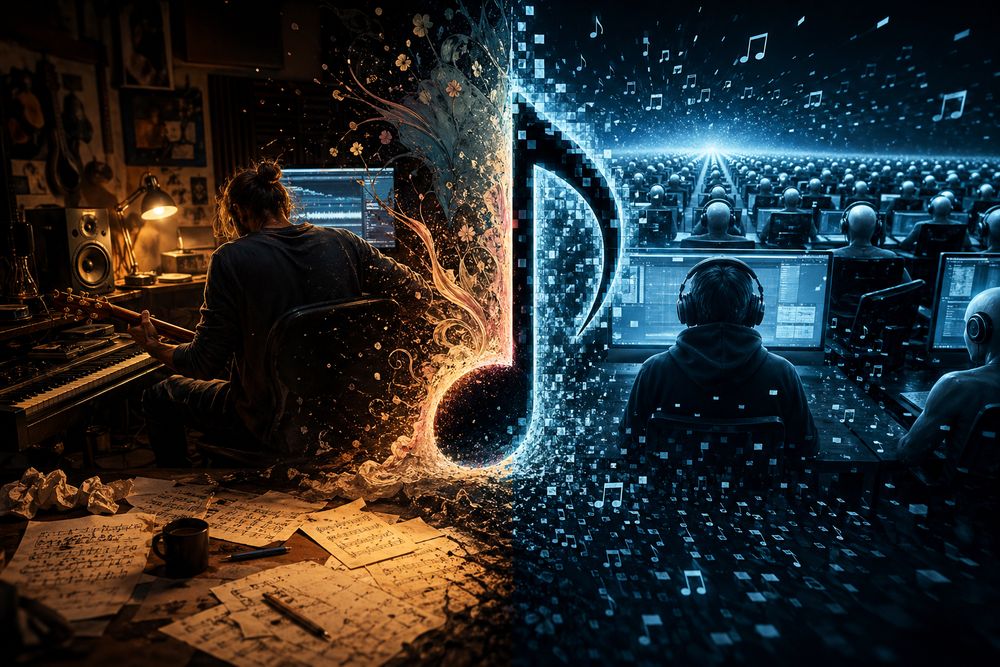
Not everyone using AI music tools belongs in the same box. That would be too easy, and frankly, too lazy — which would be ironic in an article about laziness. The AI music world is divided into three broad tribes, and only one of them is truly interesting.
1. The Prompters: Fame Without Formation
The first group is the loudest: the prompters.
They do not know much about music, and many do not particularly want to. Their relationship with creativity is mostly administrative. They enter commands, collect outputs, rename files, upload tracks, and talk about “their new single” with the solemn pride of someone who has just microwaved a frozen lasagna and called it Italian heritage.
Some want attention. Some want money. Some want both, because modesty also seems to have been automated out of the process.
This group is not fascinated by music as a language. It is fascinated by music as a loophole. They see streaming platforms as a casino, social networks as a lottery, and AI as the machine that prints endless tickets. The dream is simple: generate enough tracks, flood enough platforms, trigger enough algorithmic accidents, and maybe one day the system will mistake quantity for relevance.
This is not artistic ambition. It is content farming with a melody.
The tragedy is not that these people exist. Every era has its shortcut merchants. The problem is scale. In the past, lack of skill limited the damage. Now the machine removes the natural ceiling. Someone with no musical ear can produce hundreds of tracks with a level of surface polish that once required real labor. Bad taste has always existed. Now it has batch export.
2. The Failed Musicians: The Machine as Cosmetic Surgery
The second group is more delicate, because it sits closer to the real music world: musicians who never quite crossed the line from competent to compelling.
They can make songs. They may know chords, structure, software, perhaps even performance. Their music is not necessarily terrible. That is almost the problem. It is listenable. It is clean. It is fine. And “fine” is one of the most dangerous words in music.
These are the artists who have spent years making tracks that function but do not move. The melodies behave. The drums arrive on time. The vocals sit politely. Everything is technically present, yet nothing burns.
For them, AI becomes a temptation: a way to decorate weakness. Need a better singer? Generate one. Need a stronger hook? Ask the machine. Need richer drums, cinematic strings, a more expensive atmosphere? Prompt until the mediocrity wears a nicer jacket.
But technology can only enhance a vision if there is a vision to enhance. Without one, AI becomes musical makeup: smoother skin, brighter eyes, better lighting — same empty stare.
This is where the conversation becomes uncomfortable. AI can help a weak track sound more impressive. It cannot make it matter. It can inflate production value, but not emotional necessity. It can imitate tension, but not risk. It can create drama, but not biography.
A bad idea with premium mastering is still a bad idea. It just enters the room wearing perfume.
3. The Real Musicians: AI as Assistant, Not Substitute
The third group is smaller, quieter, and far more legitimate: musicians who use AI as a tool rather than a replacement for talent.
For them, AI is not the author. It is an assistant. A sketchpad. A session player. A temporary vocalist when no singer is available. A drum idea generator. A harmonic assistant. A way to test arrangements, explore textures, or unlock a blocked creative process.
This use case is not only defensible; it is creatively interesting. Music has always absorbed technology. The sampler was once treated like a threat. Drum machines were accused of killing drummers. Auto-Tune went from studio correction to aesthetic language. Synthesizers were once considered artificial intruders before becoming the emotional engine of entire genres.
The difference is intention.
When a real artist uses technology, the tool serves a direction. The artist chooses, rejects, edits, reshapes, contextualizes. Taste remains in charge. The human ear still decides what belongs and what does not. The machine contributes material; the musician turns it into meaning.
This is not the most widespread use of AI music, at least not culturally. It is too slow for the gold rush crowd. It still requires judgment. It still demands taste. Worst of all for the shortcut economy, it still involves work.
The Culture of the Empty Stage
AI music did not appear in a vacuum. It arrived inside a culture already obsessed with visibility without substance.
Social platforms have spent years training people to confuse exposure with achievement. The performance of success now often matters more than the work behind it. A person can build an entire identity around being “an artist” before creating anything memorable. The image comes first. The biography comes second. The music, if unavoidable, arrives eventually.
AI fits perfectly into this world. It allows the appearance of creative output at industrial speed. It gives influencers, personal brands, content personalities and digital entrepreneurs a new accessory: music that looks like them, sounds like the trend, and says absolutely nothing in particular.
We should not be surprised that influencers are becoming interested in AI music. For many of them, music is not a craft but another format. Yesterday it was a skincare line. Today it is a podcast. Tomorrow it is an AI-generated single about confidence, healing, money, or “vibes.” The subject hardly matters. The product exists to extend the brand.
And because AI can generate something passable, the illusion holds — at least briefly. The song has a chorus. The cover looks professional. The caption says “so proud to finally share this with you.” The audience applauds politely, perhaps because the algorithm placed the content in front of them seven times and resistance became inefficient.
This is not music culture. It is personal branding with background audio.
When Everyone Can Release Music, Release Means Less
The old dream was access. Artists wanted the gates opened. They wanted affordable recording tools, independent distribution, direct contact with listeners, freedom from label permission. Much of that dream was noble, and much of it came true.
But every victory creates its own problem.
When distribution became easy, attention became scarce. When recording became cheap, quality control collapsed. When social platforms rewarded constant posting, creativity became content. Now AI pushes the logic to its most absurd conclusion: when music itself becomes instant, the release loses weight.
A song used to imply effort. Not always genius, not always originality, but at least an attempt. Someone wrote it, played it, recorded it, mixed it, doubted it, repaired it, lived with it. There was a trace of time inside the object.
AI-generated music often erases that trace. The track may sound complete, but it carries no evidence of struggle. No fingerprints. No room noise. No bad decision turned beautiful. No accident that became the hook. No musician pushing against limitation and discovering style in the process.
That matters because limitation is not the enemy of art. Limitation is often where art begins.
The slightly imperfect vocal. The unusual chord because the guitarist did not know the “correct” one. The drum pattern born from a cheap machine. The bassline played by someone with more instinct than theory. Music history is full of mistakes that became signatures.
AI, by design, is very good at avoiding the wrong kind of mistake. Unfortunately, many great records were built from exactly that.
The Streaming Problem: Slop at Scale
The concern is not only artistic. It is structural.
Streaming platforms already struggle with volume. Thousands upon thousands of tracks arrive every day, and the listener is expected to navigate an ocean where the water is increasingly made of filler. AI-generated music intensifies this pressure because it turns mass production into a casual activity.
Deezer has reported that AI-generated tracks now represent a huge share of new uploads on its platform, with tens of thousands of synthetic tracks arriving daily. The company has also said it detects, labels and removes AI-generated music from recommendations, while identifying large amounts of suspicious or fraudulent streaming activity around fully AI-generated tracks. Spotify, for its part, has strengthened its policies around impersonation, spam and AI disclosure, including action against unauthorized voice cloning and deceptive content.
This tells us something important: the platforms know the flood is real.
The issue is not that a few experimental artists are using machine learning in fascinating ways. The issue is that bad actors can now generate endless music-like material designed not to enrich culture but to exploit systems. Short tracks, fake artists, cloned voices, mood playlists stuffed with anonymous filler, algorithmic wallpaper built to harvest fractions of royalties — this is not creativity. It is platform pollution.
And pollution is the right word. One plastic bottle is not the end of the ocean. Millions are a different conversation.
The Myth of “Democratization”
Supporters of AI music often use the word “democratization.” It sounds generous. Who could oppose democracy? Only villains, snobs and possibly bass players.
But democratization is not the same as removing all standards. Giving more people access to tools is good. Pretending that access automatically produces artistry is childish.
A camera does not make someone a photographer. A laptop does not make someone a novelist. A gym membership does not make someone an athlete, although it does allow them to buy a very convincing water bottle. In the same way, an AI music subscription does not make someone a musician.
It may make them an operator. A curator of outputs. A content manager. A prompt stylist. Perhaps even, in some cases, a director of machine-generated material. But musicianship involves listening, choosing, shaping, understanding, feeling and developing a voice over time.
The danger of the democratization argument is that it flatters the user too quickly. It tells people that wanting the result is equivalent to earning the result. It turns music into a vending machine: insert prompt, receive identity.
That is not liberation. That is consumerism wearing a beret.
AI Music and the Theft of Aura
The deepest issue with AI music is not whether it can sound good. Many things sound good. Expensive elevators sound good. Luxury hotel playlists sound good. Some hold music has better compression than independent rock records.
The deeper question is aura.
Music carries more than sound. It carries origin. We listen not only to frequencies but to intention. We care who sang, who played, who suffered, who risked embarrassment, who meant it. Even in electronic music, where machines have always been part of the language, the human signature matters. A groove is not just a pattern; it is a decision. A drop is not just impact; it is timing, taste, restraint and release.
AI-generated music often struggles because it can imitate the signs of emotion without carrying the cost of emotion. It knows what sadness usually sounds like. It can reproduce the shape of longing. It can build a chorus that gestures toward triumph. But it has never needed to be brave, ashamed, heartbroken, broke, obsessed, rejected, in love, out of time, or alone in a room trying to fix one phrase before sunrise.
That absence is audible, even when the surface is convincing.
People may not always identify it consciously. They may not say, “This lacks lived experience.” They may simply skip after thirty seconds. The track worked technically. It failed spiritually.
Regulation Is Not Anti-Innovation
The music industry will not escape AI. That fantasy is finished. The machine is here, the tools will improve, and the line between assisted creation and generated content will become increasingly complex.
But inevitability is not an excuse for surrender.
Regulation is necessary because music is not merely data. Voices are not decorative presets. Copyright is not an inconvenience. Artist identity is not raw material for strangers with a prompt box and a monetization plan.
A serious framework should make clear distinctions. AI as an assistant should be allowed when used transparently and ethically. AI as a replacement for credited human labor should be labeled. AI-generated vocals based on real artists should require permission. Training on copyrighted catalogs should involve licensing. Fully synthetic tracks should be clearly identified. Fraudulent streaming should be punished aggressively. Recommendation systems should not quietly push machine-made filler into spaces meant for human artists.
This is not fear of the future. It is basic hygiene.
The argument that regulation will “kill innovation” is usually made by people whose innovation looks suspiciously like taking first and negotiating later. Real innovation can survive rules. In fact, good rules create trust, and trust is what allows new tools to become part of culture rather than another digital landfill.
The Difference Between Tool and Alibi
The most important distinction is simple: AI can be a tool, or it can be an alibi.
As a tool, it can help musicians sketch faster, test ideas, build demos, explore arrangements, generate temporary vocals, design textures, or overcome practical barriers. Used well, it expands the studio. It gives independent artists more options. It may help creators who lack access to singers, drummers, orchestras, session players or expensive production environments.
As an alibi, it becomes something else entirely. It excuses the absence of skill. It hides weak songwriting under synthetic gloss. It allows people to call themselves artists while outsourcing the artistic act. It transforms music from a practice into a product generator.
The tool version deserves debate, refinement and cautious optimism. The alibi version deserves mockery, preferably with good reverb.
What Listeners Will Eventually Notice
The mass AI music boom may seem unstoppable now, but listeners are not infinitely stupid. Distracted, yes. Overfed, certainly. Manipulated by algorithms, daily. But not entirely dead inside.
People still respond to presence. They still feel when a voice has a body behind it. They still recognize the difference between a song that exists because someone had to make it and a track that exists because someone wanted to test a business model.
The future may split into two markets. On one side: cheap, abundant, functional AI music for background use, content padding, fake artists, mood playlists and disposable branding. On the other: human music with stronger identity, clearer authorship, deeper storytelling and visible creative process.
In that future, authenticity will not be a sentimental luxury. It will be a premium signal.
Artists who can prove their world — their voice, their studio, their story, their performances, their choices — may become more valuable, not less. The more synthetic the environment becomes, the more human evidence matters. The backstage photo, the live session, the flawed vocal take, the handwritten lyric, the real collaboration, the visible craft: these may become cultural proof.
Ironically, AI may force serious musicians to become better at showing the work behind the music. Not because the audience needs a documentary for every song, but because trust will become part of the listening experience.
So, Is AI Music the Revenge of the Talentless?
Sometimes, yes.
Not always. Not by nature. Not when used intelligently by artists with taste, discipline and intention. But in its most visible, most inflated, most spammy form, AI music has absolutely become a playground for people who confuse access with ability and output with art.
It gives the talentless a costume. It gives the impatient a shortcut. It gives the mediocre a shine. It gives the opportunist an infinite factory. It gives the influencer a new product category. It gives the streaming fraudster a cheaper weapon. And it gives the culture of emptiness one more way to pretend it has something to say.
That does not mean the technology itself must be rejected. The piano did not write bad ballads by itself. The sampler did not invent lazy producers. Auto-Tune did not force anyone to sing nothing. Tools become dangerous when they reward the worst instincts of the people using them.
The real fight is not human versus machine. That is too simple, too cinematic, and frankly too flattering to some humans. The real fight is between craft and laziness, intention and volume, authorship and imitation, music as expression and music as automated landfill.
AI music will stay. The question is whether we allow it to become another instrument in the hands of artists, or another industrial pipe pouring beige liquid into the ears of an exhausted public.
Music has survived bad singers, bad producers, bad managers, bad labels, ringtone rap, fake playlist gurus, engagement pods, algorithm worship and people clapping on the wrong beat. It will survive AI too.
But survival is not the same as dignity.
If AI is used to assist imagination, let it in. If it is used to clone artists, flood platforms, fake creativity, polish emptiness and turn music into a subscription-based shortcut for people allergic to effort, then no: that is not the future of music.
That is just the revenge of the nuls — exported in WAV, uploaded at scale, and waiting for an algorithm to mistake it for culture.