
The Best Music Production Tools for Fast Workflow in 2026
Speed in music production is often misunderstood. It is not about rushing a track, cutting corners, or trying to finish an idea before your coffee has fully accepted its responsibilities. Real workflow speed is about reducing friction. It is about getting from inspiration to execution without losing the thread every time you need to find a sample, test a chord idea, slice audio, check balance, organize drums, or rescue a session from a browser full of sonic clutter.
In 2026, the producers moving fastest are not necessarily the ones with the biggest plugin folders. They are the ones using tools that solve specific workflow problems cleanly. The best production setup today is often less about stacking endless options and more about building a chain of decisions that keeps ideas alive. One tool helps you sketch. Another helps you browse faster. Another removes the pain of sample hunting. Another speeds up arrangement. Another keeps your mix decisions grounded before you lose perspective and start equalizing your self-esteem.
The best music production tools for fast workflow in 2026 all share one quality: they reduce hesitation. They help you move, commit, test, discard, refine, and stay musical. Some are full DAWs. Some are sample and beat tools. Some are analysis and finishing aids. None of them replace taste, but the right ones dramatically reduce the amount of time wasted between having an idea and hearing whether it is worth chasing.
Idea speed
The best tools make it easier to capture sketches, generate variations, and move from loop to structure without killing momentum.
Search speed
Sample browsers, drum organizers, and smart preview tools now save producers hours that used to vanish inside folders.
Decision speed
The smartest finishing tools do not replace judgment. They help you reach it faster and with less second-guessing.
Ableton Live 12 Still Sets the Pace for Fast Idea Development
Few platforms are better at preserving creative motion than Ableton Live 12. It remains one of the strongest workflow choices in 2026 because it is built around movement rather than ceremony. The Session View still makes it incredibly fast to sketch ideas, test combinations, and find the emotional center of a track before arrangement becomes a formal commitment. That alone keeps it near the top of any serious workflow conversation.
What pushes it further now is how well Live 12 supports pattern generation and variation inside the creative flow. MIDI Transformations and Generators make it much easier to reshape rhythms, chords, and melodic material without falling into repetitive piano-roll labor. That makes Live especially attractive for producers working in electronic music, house, techno, experimental pop, ambient, and loop-based writing where the speed of mutation matters almost as much as the first idea itself.
Studio One Pro 7 Is One of the Most Complete Workflow DAWs Right Now
If Ableton excels at fluid experimentation, Studio One Pro 7 stands out for turning a huge range of production tasks into one coherent environment. That matters for workflow because speed is not only about making loops fast. It is also about moving from writing to recording, editing, arranging, mixing, mastering, and delivery without constantly changing mental gears or software ecosystems.
Studio One’s drag-and-drop mindset has always been part of its appeal, but the newer generation is even more compelling for producers who want a modern all-in-one platform. The integrated Launcher, stem separation tools, and Splice integration make it feel less like a traditional DAW trying to catch up and more like a workstation that actually understands how current producers move between creative, technical, and finishing tasks. For writers who value structure, clean design, and fast top-to-bottom project development, it is one of the strongest workflow tools available.
FL Studio Remains One of the Fastest Beatmaking Environments
FL Studio continues to earn its place in workflow discussions because it still understands one of the most important truths in production: speed often starts with rhythm. For beatmakers, loop-driven writers, and producers who build tracks from drums outward, FL remains one of the quickest environments for turning fragments into momentum. Its all-in-one design and familiar pattern workflow still make it dangerously easy to start building before doubt has time to unpack its suitcase.
That ease matters more than people admit. A fast workflow tool is not just one that has powerful features. It is one that gets out of the way at the exact moment a musical thought arrives. FL Studio still does that exceptionally well, and the fact that it continues to offer lifetime free updates only strengthens its long-term value for producers who want speed without feeling trapped in endless upgrade anxiety.
Maschine 3 Is Still a Serious Sketch Machine
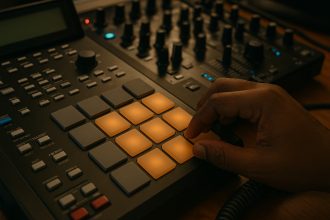
There are producers who do not just want speed. They want immediacy. They want to hit pads, build scenes, chop ideas, and feel rhythm physically before they think about a timeline. For that, Maschine 3 remains an important workflow tool in 2026. It is especially strong for producers who build around groove, scene logic, and hardware-assisted writing.
The newer Maschine software adds more relevance to that pitch because it is no longer just about classic groovebox energy. Stem separation, improved MIDI editing, and scene-level flexibility help it fit more naturally into modern production workflows. For beat-first creators, remixers, hybrid live producers, and anyone who prefers ideas to arrive through touch and repetition instead of mouse-heavy construction, Maschine still offers one of the quickest ways to get from nothing to something with attitude.
Loopcloud and Splice Are the Real Time-Savers for Sample-Heavy Producers
One of the biggest workflow killers in modern production is not lack of ideas. It is search fatigue. Too many producers lose absurd amounts of time browsing samples, checking pitch, dragging files, rejecting them, then repeating the process until the original spark has left the building. That is why Loopcloud and Splice Desktop remain two of the most useful music production tools for fast workflow in 2026.
Both reduce the friction between idea and audition. Loopcloud stands out for its deep DAW sync, automatic organization, and strong sample-to-project fit. Splice Desktop, especially with Bridge, keeps the preview process tight by letting producers hear sounds in the project’s key and tempo before they commit. That may sound like a modest convenience, but in real sessions it saves enormous time. The faster you can audition in context, the less often you mistake “interesting sample” for “useful sample.”
For anyone making sample-driven electronic music, hip-hop, pop, trailer music, or fast-turnaround content, these libraries are no longer just shopping tools. They are workflow infrastructure.
XO by XLN Audio Is Still One of the Best Drum Workflow Plugins
Sample libraries keep getting bigger, which means drum workflow keeps getting more fragile unless the browsing process gets smarter. That is exactly why XO by XLN Audio still deserves a place on this list. XO is not valuable because it merely stores drums. It is valuable because it changes how you find them. Instead of folder-diving through endless kicks, snares, percussion, and one-shots, XO turns drum discovery into something visual, intuitive, and fast enough to feel creative.
That is a bigger deal than it sounds. Fast workflow is often the difference between building a groove in ten minutes and abandoning it after forty because the snare hunt became a part-time job. XO keeps the producer focused on listening and swapping instead of managing file hierarchies like a stressed librarian of transients. For beatmakers, electronic producers, and anyone with too many drum packs and not enough patience, it remains one of the smartest time-saving plugins available.
Serato Sample Is Still One of the Fastest Ways to Flip Audio
For sampling-heavy workflows, Serato Sample continues to be one of the most useful plugins around. It stays relevant because it does not just slice audio. It speeds up the whole act of turning found material into playable, reshaped musical content. Time-stretching, pitching, chopping, and stem-based manipulation all happen with a speed that makes experimentation feel natural instead of administrative.
That makes it especially useful for hip-hop, house, remix work, sample-based pop, and any workflow where manipulating existing audio is part of the writing process rather than a separate technical stage. A fast workflow tool should make you try more ideas before the inner editor wakes up. Serato Sample still does that exceptionally well.
Mixed In Key Studio Edition Quietly Solves a Real Problem
Not every workflow bottleneck is dramatic. Sometimes the slowdown comes from uncertainty. You have a great sample, a loop, a vocal chop, or a melodic phrase, but you are not fully sure what key it is in, how it will sit harmonically, or whether you are about to force the track into an avoidable theory accident. That is where Mixed In Key Studio Edition becomes more useful than flashy.
Tools like this do not usually make headlines, but they can save remarkable amounts of time because they remove guesswork from the front end of creation. Faster harmonic decisions mean faster arrangement decisions. Faster arrangement decisions mean fewer abandoned ideas that died because two beautiful elements refused to get along politely.
Tonal Balance Control 3 Is the Modern Sanity Check
Workflow is not just about composing faster. It is also about finishing faster without making reckless decisions. That is why Tonal Balance Control 3 is one of the most valuable finishing tools to have in 2026. It does not mix the song for you, and thankfully does not pretend to. What it does is shorten the path between uncertainty and perspective.
When you have been in a session too long, your ears become diplomatically unreliable. Tonal Balance Control 3 helps restore a sense of proportion by giving you genre targets, custom references, and a quick read on tonal balance, vocal balance, dynamics, and stereo width. That is immensely useful because bad workflow often shows up late in a session as indecision. A tool that helps you verify whether the mix is leaning too dark, too bright, too narrow, too flat, or too vocal-heavy can save hours of circular editing.
Ozone 12 Still Matters Because Fast Mastering Is Not the Same as Lazy Mastering
There is a difference between rushing a master and accelerating the decisions that lead to a better one. Ozone 12 remains one of the most relevant tools in that space because it combines genuinely useful intelligent assistance with enough control to keep the process musical. For producers finishing their own tracks, it can speed up the move from “good mix, uncertain finish” to a more credible release-ready result without turning mastering into guesswork or superstition.
The important point is not that faster mastering is always better. It is that better feedback loops create faster learning. Tools like Ozone help producers hear what still needs work more quickly, which makes them useful even when the final result still benefits from human refinement. Speed, at this level, is really about reducing wasted doubt.
The Best Workflow Stack in 2026 Is Modular, Not Maximal
The biggest mistake producers still make with workflow is assuming they need one giant ecosystem to solve everything. In reality, the best music production tools for fast workflow in 2026 usually work as a modular stack. A DAW handles writing and structure. A sample tool reduces search drag. A drum organizer speeds up rhythm building. A sampling plugin accelerates flips and edits. A harmonic helper reduces guesswork. A referencing tool speeds up mix judgment. A mastering suite shortens the road to a final draft that actually feels finished.
That is a much healthier way to think about speed. Workflow is not one magic button. It is a chain of moments where friction used to appear, and now appears less often. The right tool is the one that removes the kind of friction you actually suffer from, not the one with the loudest marketing voice or the most impressive screenshot.
Fast Workflow Is Really About Protecting the Idea
Underneath all of this, the real goal stays the same. You are not trying to work fast for the sake of speed. You are trying to protect the vulnerable moment when a track is becoming something. That moment is fragile. It can survive a little uncertainty, a few wrong turns, and the occasional dramatic snare choice. It usually does not survive long stretches of friction, indecision, poor browsing, awkward routing, or endless technical interruption.
That is why the best music production tools in 2026 matter. They do not make you creative. They make it easier to remain creative long enough to finish something worth hearing. And in a field where half the battle is getting from inspiration to completion without losing the pulse of the original idea, that is not a small advantage. It is the whole game.
These tool descriptions were verified against current official product pages and current official product/help materials: Ableton Live 12 highlights MIDI Transformations and Generators, Studio One Pro 7.1 highlights Launcher, stem separation, drag-and-drop workflows, and Splice integration, FL Studio continues to advertise Lifetime Free Updates, Maschine 3 adds stem separation and MIDI workflow improvements, Loopcloud and Splice Desktop both emphasize in-DAW sample previewing and key/tempo-aware workflow, XO is positioned as a visual drum-sample organizer and beat maker, Serato Sample emphasizes chopping, stems, time-stretch, and pitch workflows, and Tonal Balance Control 3/Ozone 12 are currently positioned around faster referencing and AI-assisted mastering workflows. ([ableton.com][1])
[1]: https://www.ableton.com/en/live/?utm_source=chatgpt.com « What’s new in Live 12 »