Fabrik Free by KreisKlang is a free node-based synthesizer designed for producers and sound designers who want to build instruments through visual signal flow rather than follow a fixed subtractive synthesis architecture.
Instead of placing oscillators, filters, envelopes and effects inside a predefined chain, Fabrik allows users to connect processing blocks freely. This approach makes it possible to create evolving pads, experimental basses, synthetic drums, cinematic textures, feedback systems and unusual modulation structures directly inside a DAW.
Fabrik Free became especially relevant in 2026 after KreisKlang introduced a permanent free version containing all available node types. The main restrictions concern preset loading and automatic project recall, but the core synthesis engine remains accessible without payment.
What Is Fabrik Free?
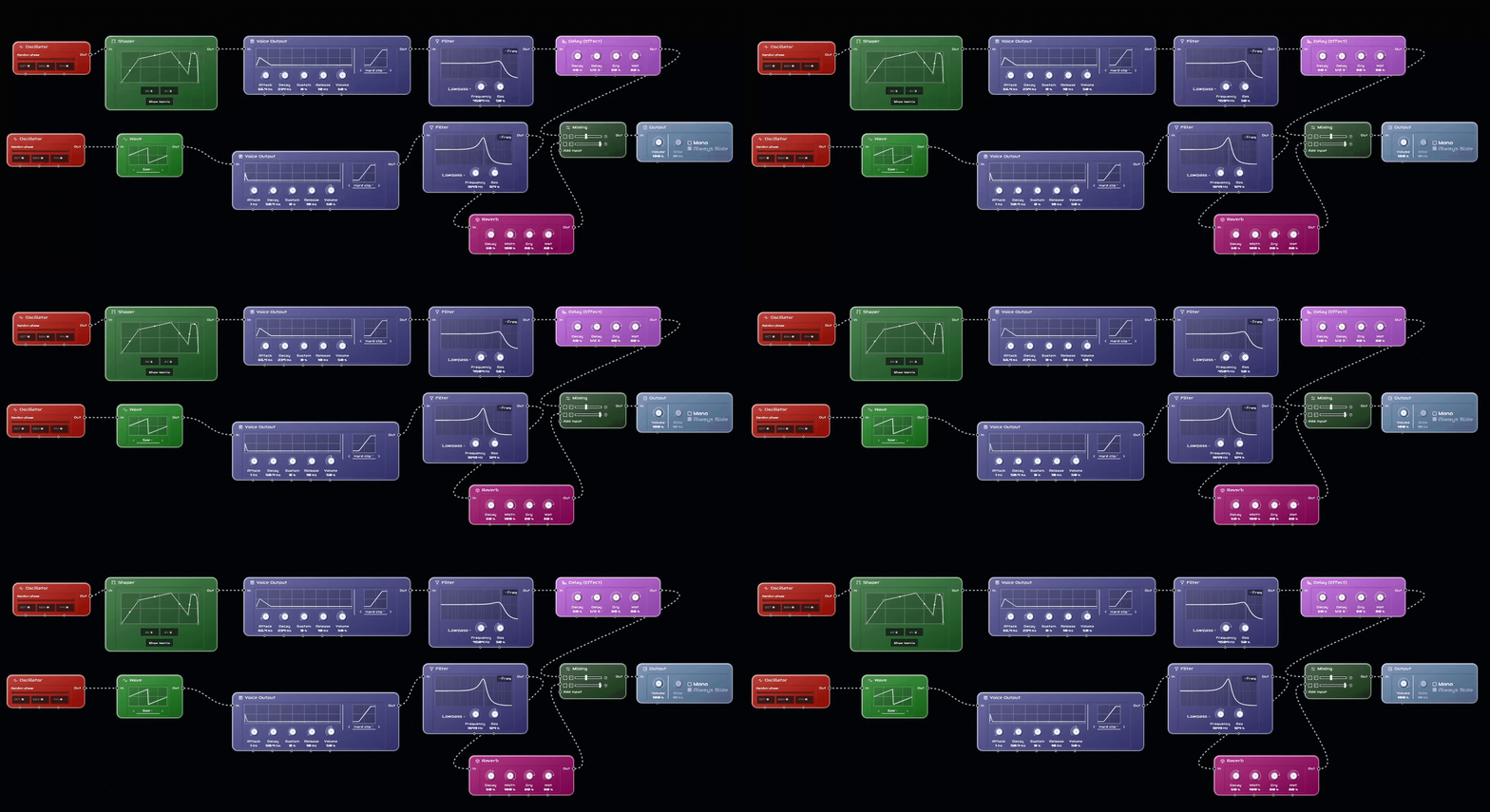
Fabrik Free is a visual synthesizer that represents every part of a sound as a separate node. Producers create patches by placing these nodes on a workspace and connecting them with virtual cables.
The concept is similar to drawing a signal-flow diagram. An oscillator can be connected to a filter, the filter can be controlled by an envelope, and its cutoff frequency can be modulated by an LFO or another audio-rate signal.
Unlike a traditional synthesizer, Fabrik does not force users to follow one specific route. Nearly every component can be connected, reordered or used as a modulation source.
A Visual Approach to Sound Synthesis
Most software synthesizers use a familiar oscillator-filter-amplifier structure. This workflow is efficient, but it can limit experimentation because the internal routing is usually fixed.
Fabrik replaces this structure with a visual node editor. Each node performs a clear function, and users decide how the signal moves through the patch.
The available building blocks include:
- Oscillators
- Noise generators
- LFOs
- Envelopes
- Filters
- Waveshapers
- Mathematical processing functions
- Distortion
- Delay
- Reverb
- Signal-routing utilities
This modular approach encourages producers to think about how a sound is constructed rather than simply browse through presets.
All Nodes Are Included in Fabrik Free
One of the most important advantages of Fabrik Free is that the synthesis engine is not reduced to a small collection of demonstration modules.
The free edition includes all node types available in the Fabrik environment. Users can therefore explore oscillators, modulation, filtering, effects and more advanced routing without purchasing an upgrade.
The paid versions mainly improve workflow by adding preset collections, preset loading and automatic project-state recall.
Oscillators and Sound Sources
Oscillators form the starting point for many Fabrik patches, but they do not have to follow a conventional signal path.
A waveform can be processed through several shaping stages, modulated by another oscillator or sent into a feedback structure. Noise generators can also be mixed with tonal sources to create percussion, impacts, textures or atmospheric layers.
Because every connection is visible, it is relatively easy to understand how each processing block changes the sound.
Flexible Modulation Routing
Fabrik allows modulation sources to be connected directly to compatible parameters. Envelopes, LFOs, oscillators and shaped control signals can therefore influence filters, amplitude, pitch, effects or other modulation sources.
This means an LFO can modulate another LFO, an oscillator can control a filter at audio rate, or an envelope can shape the amount of distortion applied over time.
The result is a level of flexibility that is difficult to reproduce inside fixed-architecture synthesizers.
Feedback Synthesis
One of Fabrik’s most distinctive features is its ability to create controlled feedback loops using the Signal Delay block.
Feedback synthesis sends part of a signal back into an earlier point in the processing chain. Depending on the delay time and processing nodes placed inside the loop, the result can range from subtle resonance to aggressive digital instability.
These structures can be used to produce:
- Metallic percussion
- Physical-modelled tones
- Aggressive bass sounds
- Evolving drones
- Synthetic wind instruments
- Resonant plucks
- Experimental sound effects
Feedback must be handled carefully because small parameter changes can produce dramatic volume increases. Starting with conservative gain settings is strongly recommended.
Designing Basses with Fabrik Free
Fabrik is particularly suitable for electronic bass design because oscillators, filters, distortion and feedback can be arranged in almost any order.
A basic bass patch might begin with a saw or pulse oscillator connected to a low-pass filter. An envelope can control the filter cutoff, while a second oscillator introduces subtle frequency modulation.
For more aggressive results, users can add waveshaping or distortion before the filter. Placing saturation inside a feedback loop can produce unstable textures suitable for drum and bass, dubstep, industrial music and experimental techno.
Creating Pads and Evolving Textures
Long-form sounds benefit from Fabrik’s flexible modulation environment.
Several slowly moving LFOs can control oscillator pitch, filter cutoff, stereo movement and effect levels independently. Modulation sources can also influence one another, creating movement that does not repeat in an immediately obvious pattern.
Delay and reverb nodes can then be added at the end of the signal path to create ambient pads, cinematic atmospheres and evolving drones.
Synthetic Drums and Percussion
Fabrik Free is not limited to melodic instruments. Its node system can also generate drum sounds from scratch.
A sine oscillator with a short pitch envelope can form the basis of a kick drum. Noise processed through a short amplitude envelope can produce snares, claps or hi-hats.
Filters, resonators, distortion and feedback can then be used to add character. Because each part of the sound remains editable, Fabrik can create percussion that is more flexible than a static sample.
Using Fabrik for Sound Design
Sound designers can use Fabrik to create material for film, games, trailers and sample libraries.
Complex patches can generate impacts, mechanical sounds, interface noises, drones, alarms and science-fiction textures. The ability to connect almost any node to another makes the plugin particularly useful for sounds that do not fit conventional musical categories.
A productive workflow is to record a long performance while adjusting parameters, then edit the most interesting sections into individual samples.
Important Limitations of Fabrik Free
Fabrik Free includes the complete collection of nodes, but it has several important workflow restrictions.
- No factory presets are included
- Preset loading is disabled
- Plugin states are not automatically recalled by the DAW
- Projects may reopen without restoring the Fabrik patch
This last limitation is particularly important. A producer should not assume that a Fabrik Free patch will return automatically when reopening a Studio One, Ableton Live, FL Studio, Cubase or Logic Pro project.
KreisKlang allows users to save their work manually inside Fabrik. Producers should save important patches separately and consider rendering the instrument to audio before closing a session.
Recommended Workflow for DAW Projects
To use Fabrik Free safely in a serious production, follow this workflow:
- Create the patch inside Fabrik.
- Save the patch manually within the plugin.
- Export or record the MIDI performance as audio.
- Keep the rendered audio inside the DAW project.
- Take a screenshot of complex routing when necessary.
This avoids losing an important sound when the project is reopened later.
Fabrik Free Versus Traditional Synth Plugins
Fabrik is not designed to replace every conventional synthesizer. Plugins such as Vital, Serum and Surge XT are usually faster when a producer wants to select a preset and begin writing immediately.
Fabrik is more appropriate when the objective is to explore signal flow, build an instrument from the ground up or create a sound that requires unusual routing.
Its closest comparisons are modular or node-based environments, but Fabrik presents its blocks in a relatively clear visual format intended to remain approachable for producers who are new to modular synthesis.
Is Fabrik Free Suitable for Beginners?
Fabrik can look complex at first, but its visual design helps users understand how signals move through a synthesizer.
A beginner can start with three simple nodes:
- An oscillator to generate sound
- A filter to shape the frequency content
- An output node to hear the result
An envelope and LFO can then be added gradually. This makes Fabrik useful not only for sound creation but also for learning synthesis and modulation principles.
CPU Performance
Node-based synthesizers can become demanding when a patch uses many voices, effects and feedback paths.
KreisKlang states that Fabrik has been optimized to run efficiently on most systems. Anti-aliasing can also be disabled when a particularly complex patch consumes too much CPU.
As with any modular environment, actual performance depends heavily on patch complexity, polyphony and oversampling settings.
Plugin Compatibility
- Developer: KreisKlang
- Plugin: Fabrik Free
- Type: Node-based synthesizer
- Price: Free
- Formats: VST3 and AU
- Operating systems: Windows and macOS
- Best suited to: Electronic music, experimental production, cinematic composition and sound design
Who Should Download Fabrik Free?
Fabrik Free is particularly relevant for:
- Sound designers
- Electronic music producers
- Drum and bass producers
- Techno and experimental artists
- Film and game composers
- Producers learning synthesis
- Musicians interested in modular routing
Producers who mainly rely on presets may find the free edition restrictive. However, anyone who enjoys designing sounds manually will gain access to a remarkably flexible synthesis environment.
Final Verdict
Fabrik Free is one of the most interesting free synthesizer options available to producers in 2026.
Its node-based workflow provides significantly more routing freedom than a conventional fixed-architecture synth. Oscillators, modulation, waveshaping, filters, effects and feedback can all be combined visually, making Fabrik suitable for both musical instruments and experimental sound design.
The lack of automatic project recall is a genuine limitation and should not be ignored. Producers must save patches manually and render important parts to audio. Once that precaution becomes part of the workflow, the free edition offers an unusually complete creative engine.
Fabrik Free is not a preset machine designed to deliver polished sounds after a single click. It is a sound-design laboratory. The blank canvas may be less convenient, but it is also where the interesting accidents tend to happen.
Download Fabrik Free from the official KreisKlang website:
https://kreisklang.com/