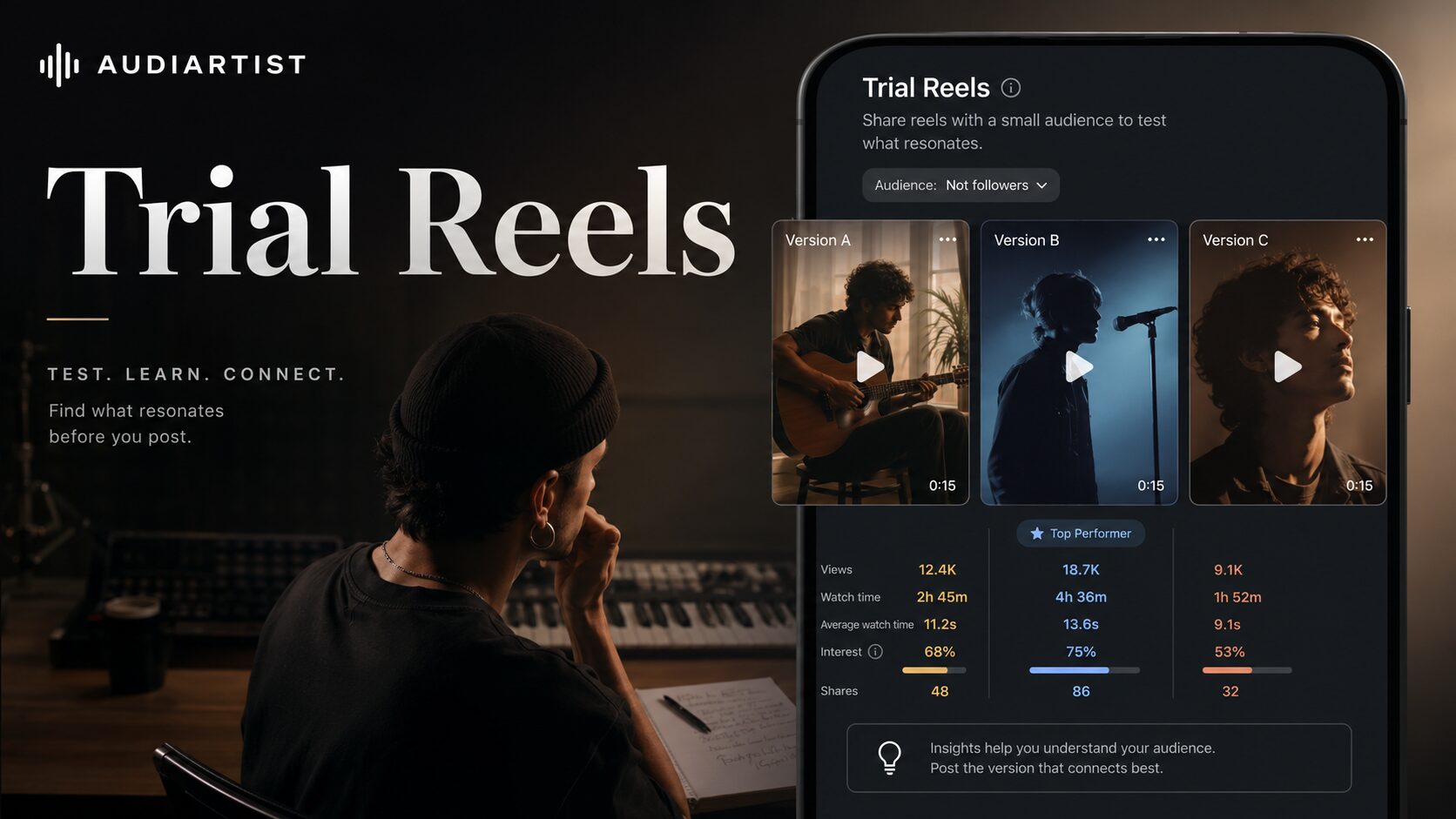

For artists promoting a new single, this changes the role of Instagram Reels. Promotion no longer has to begin with a guess about which fifteen-second section will attract attention. An artist can test several excerpts, compare the results and then publish the strongest version to the wider audience.
The feature is particularly useful for musicians who want to experiment without turning their Instagram profile into a flashing advertising board filled with nearly identical videos.
What Are Instagram Trial Reels?
Trial Reels are Instagram Reels that are initially distributed to non-followers rather than being immediately promoted to an artist’s existing audience.
The Reel does not normally appear on the creator’s main profile grid or public Reels tab during the trial stage. Followers are also not expected to see it in their regular feed unless the content reaches them through another route, such as a direct share, an audio page, a location page or a related recommendation.
This creates a controlled testing environment. Artists can experiment with a different visual style, musical section, opening sentence or storytelling format without repeatedly asking their existing followers to react to another version of the same promotional post.
After the Reel has gathered enough data, the creator can review its performance and decide whether to share it with everyone.
Why Trial Reels Matter for Music Promotion
Independent artists face a recurring problem when preparing a release campaign: the section they personally consider the strongest is not always the section that attracts new listeners.
The official chorus may sound perfect in the context of the full song, but a vocal phrase from the second verse might create more curiosity in a short video. A carefully designed music video scene may look impressive, while a simple studio performance could generate stronger watch time and more shares.
Without testing, these decisions are usually based on personal preference, advice from friends or a last-minute debate between the artist and producer.
Trial Reels introduce real audience behaviour into that decision.
Artists can use them to test:
- Different sections of the same single
- Alternative opening hooks
- Performance footage versus narrative visuals
- Lyrics on screen versus a clean image
- Direct-to-camera introductions versus immediate music
- Studio footage versus polished promotional content
- Instrumental drops versus vocal sections
- Different edits of the same music video
The objective is not to let an algorithm make every creative decision. It is to identify which presentation gives the song the best chance of being discovered.
Trial Reels Are Now Available More Widely
Instagram initially introduced Trial Reels as a testing feature for eligible creators. Meta later announced that the tool had been made available more broadly, allowing more users to share Reels with non-followers first.
According to Meta’s internal analysis, 40 percent of creators who tried Trial Reels began posting Reels more frequently. Among those creators, 80 percent experienced an increase in their reach from non-followers.
These figures do not guarantee that every Trial Reel will perform well. They do, however, suggest that reducing the pressure associated with regular posting can encourage experimentation and help creators reach people outside their existing community.
For independent musicians, non-follower reach is especially valuable. Followers may already know the artist, while a Trial Reel is designed to introduce the music to people who have not yet chosen to follow the account.
How Instagram Trial Reels Work
The publishing process is similar to creating a normal Reel.
- Create and edit the Reel as usual.
- Prepare the caption, cover and audio settings.
- Activate the Trial option before publishing.
- Publish the Reel to begin testing it with non-followers.
- Review the available performance data after the initial testing period.
- Share the Reel with everyone if the results are encouraging.
Instagram states that creators can usually begin viewing key engagement metrics approximately 24 hours after publishing a Trial Reel. These metrics can include views, likes, comments and shares, along with comparisons against previous trials.
Creators can also choose an automatic sharing option. When enabled, Instagram may share the Reel with followers if the platform determines that it has performed well based on its results during the first 72 hours.
Artists who want more control may prefer to review the results manually before making the Reel public to followers.
How to Test Three Excerpts From One Single
A useful Trial Reel campaign should test clear creative hypotheses. Uploading three almost identical videos without defining what is being compared produces data, but not necessarily useful information.
Imagine an independent artist preparing to release a new song. The track contains three possible promotional sections:
- A memorable lyric from the first verse
- The main chorus
- An instrumental drop after the second chorus
Each section should become a separate Trial Reel with a distinct purpose.
Trial Reel One: The Lyrical Hook
The first Reel can focus on a line that creates curiosity or emotional recognition.
For example, the video could begin with the text:
“I wrote this line after realizing the relationship was already over.”
The Reel would then move directly into the relevant lyric.
This version tests whether the audience connects with the song through its meaning and emotional context.
Trial Reel Two: The Main Chorus
The second Reel can present the strongest and most accessible section of the song without a long introduction.
The visual might show the artist performing directly to camera, singing in the studio or appearing in a carefully selected scene from the official music video.
This version tests the immediate strength of the chorus itself.
Trial Reel Three: The Production Moment
The third Reel can focus on the instrumental drop, beat switch, guitar solo or production detail.
A useful opening might be:
“The entire track changed when we added this sound.”
The Reel can briefly show the musical element in isolation before revealing it inside the final mix.
This version tests whether the song attracts attention through production, musicianship or sonic impact rather than lyrics.
Change One Main Variable at a Time
For the comparison to be useful, each Trial Reel should not be completely different in every possible way.
If one video uses a polished music video, another uses rehearsal footage and the third contains animated lyrics, it becomes difficult to know whether the result came from the musical excerpt, the visual presentation or the opening text.
A stronger testing method keeps several elements consistent.
For example:
- Use a similar video length
- Keep the visual quality consistent
- Use the same caption structure
- Publish within a comparable time period
- Use a similar call to action
- Change the musical excerpt or opening hook
The principle is simple: compare one major creative choice at a time.
This is not a laboratory experiment, and social media audiences are never perfectly controlled. However, a disciplined structure provides more useful information than randomly publishing several unrelated versions.
Which Metrics Should Musicians Compare?
Views are the most visible metric, but they should not automatically decide which Trial Reel wins.
A Reel can generate a high number of views because the opening frame attracts attention, while producing little meaningful interest in the song. Another Reel may receive fewer views but generate more shares, profile visits or comments from people asking where they can hear the full track.
Views
Views indicate how widely the Trial Reel was played. They are useful for measuring initial distribution, but they do not show whether viewers were genuinely interested in the music.
Watch Time and Retention
Retention shows whether people continued watching after the opening seconds.
When viewers leave before the musical section begins, the introduction may be too long. When they remain through the chorus or replay the video, the selected excerpt may be strong enough to hold attention.
Shares
Shares are particularly important for music discovery. A person who sends the Reel to a friend is doing more than passively viewing it. The content has created enough interest, emotion or entertainment value to be recommended personally.
Comments
Comments can reveal what the audience noticed.
Listeners may mention the vocal, lyrics, bass line, guitar tone, visual concept or similarity to another musical style. These reactions can help shape the wider promotional campaign.
Likes
Likes provide a basic engagement signal, but they require relatively little effort from the viewer. They should be considered alongside stronger actions such as sharing, commenting and visiting the artist’s profile.
Profile Activity
When available, profile visits and follows are especially relevant to independent artists. They suggest that the Reel created interest beyond the specific video.
A Practical Trial Reel Scorecard
Artists can create a simple comparison table after the first results become available.
| Test | Creative Angle | Views | Shares | Comments | Profile Interest | Decision |
|---|---|---|---|---|---|---|
| Reel 1 | Emotional lyric | Record result | Record result | Record result | Record result | Review |
| Reel 2 | Main chorus | Record result | Record result | Record result | Record result | Review |
| Reel 3 | Production breakdown | Record result | Record result | Record result | Record result | Review |
The winning Reel should not simply be the one with the largest view count. The artist should choose the version that best supports the campaign objective.
For a discovery campaign, reach and retention may matter most. For a release campaign, shares, profile visits and interest in the full track may be more valuable.
Do Not Publish All Three Tests at Once
Although Trial Reels are initially shown to non-followers, publishing several versions simultaneously can make the comparison less reliable.
The videos may compete for similar audiences, and external factors can influence the result. One Reel may receive stronger distribution simply because it was posted during a more active period.
A more organised approach is to space the tests apart.
For example:
- Monday: lyrical hook
- Wednesday: main chorus
- Friday: production moment
- Weekend: compare results and select the strongest concept
This gives each Reel time to collect data while keeping the test within the same stage of the release campaign.
Artists should avoid spreading the experiment across several months, since audience behaviour, account activity and promotional context may change too much for a useful comparison.
Avoid Turning Trial Reels Into Spam
Trial Reels reduce the pressure placed on followers, but they should not become an excuse to upload endless low-quality variations.
Testing works best when each version has a clear creative reason to exist.
Three strong concepts can help identify the best promotional direction. Twenty minor edits featuring the same chorus, caption and studio wall are unlikely to reveal much beyond the limits of everyone’s patience.
Artists should also remember that some followers may still encounter a Trial Reel through direct shares or pages connected to the same audio, location or filter.
The content should therefore remain polished enough to represent the artist professionally, even when it is being used as a test.
Trial Reels Should Not Replace a Release Strategy
Instagram Trial Reels are a testing tool, not a complete music marketing system.
A successful Reel may help an artist identify the strongest promotional excerpt, but the wider campaign still needs a clear path from discovery to listening.
The selected Reel should guide viewers toward an appropriate next step:
- Visit the artist’s profile
- Use the official audio
- Follow for the release date
- Listen to the full song
- Save the release
- Watch the complete music video
- Join a broadcast channel or mailing list
The call to action should match the stage of the campaign. Asking viewers to stream a song that has not yet been released creates unnecessary friction. Before release day, following, pre-saving or commenting may be more realistic actions.
How to Turn a Winning Trial Into a Full Campaign
Once one Trial Reel clearly outperforms the others, the artist can expand the concept rather than simply reposting the exact same video repeatedly.
If the lyrical version performs best, the campaign can continue with:
- The story behind the complete lyric
- A stripped-back vocal performance
- A lyric video using the same emotional theme
- A discussion about the event that inspired the song
- Audience reactions to the line
If the production version performs best, the artist can create:
- A full track breakdown
- A before-and-after mix comparison
- A demonstration of the main instrument or plugin
- A live performance of the instrumental section
- A producer reaction or remix invitation
The Trial Reel identifies the doorway. The wider campaign builds the room behind it.
Common Trial Reel Mistakes Musicians Should Avoid
Testing Weak Content
A Trial Reel is not a recycling bin for footage that was not good enough for the main profile. The video still needs a strong opening, clear sound and professional presentation.
Changing Too Many Elements
When the audio, visual, caption, length and call to action are all different, the artist cannot determine which element influenced the result.
Choosing the Winner by Views Alone
A large number of passive views may be less valuable than a smaller number of highly engaged viewers who visit the profile or share the music.
Publishing Without a Goal
Every test should answer a question. Which chorus works best? Does the audience prefer performance footage? Does an immediate musical opening outperform a spoken introduction?
Ignoring Brand Identity
Experimentation should not make the artist appear completely inconsistent. Different formats can still share the same musical identity, visual standards and tone.
Automatically Sharing Every Successful Reel
A Reel may perform well with non-followers while still being unsuitable for the artist’s main profile strategy. Manual review allows the creator to consider quality, positioning and timing before sharing it more widely.
Who Should Use Instagram Trial Reels?
Trial Reels are particularly useful for:
- Independent artists preparing a new release
- Producers testing instrumental excerpts
- Singers comparing different vocal sections
- Bands deciding between live and studio content
- DJs promoting an original track or remix
- Artists changing genre or visual direction
- Musicians with a small but highly engaged follower base
- Creators who hesitate to publish experimental content
They can also help established artists test a new direction without making every experiment part of the permanent profile narrative.
When Trial Reels Are Less Useful
Not every post needs to become a test.
A tour announcement, release confirmation, press feature or important community message may need to reach existing followers immediately. In those cases, a standard Reel, Story or feed post may be more appropriate.
Trial Reels are most valuable when the artist is uncertain about the creative presentation and wants feedback from a discovery audience.
They are less useful when the primary objective is communicating essential information to people who already follow the account.
A Seven-Day Instagram Trial Reel Plan for Musicians
Day One: Define the Question
Choose one decision the test should help resolve. For example: which part of the song should lead the campaign?
Day Two: Select Three Excerpts
Choose sections with genuinely different promotional strengths, such as emotion, melody and production.
Day Three: Prepare Consistent Visuals
Create three videos with similar length, quality and caption structure.
Day Four: Publish the First Trial
Begin with the section the artist currently considers strongest.
Day Five: Publish the Second Trial
Test the alternative musical or visual angle.
Day Six: Publish the Final Trial
Complete the comparison with the third creative hypothesis.
Day Seven: Compare and Decide
Review the metrics, audience reactions and campaign objective. Select the strongest concept and develop it into the main release content.
Final Thoughts
Instagram Trial Reels provide independent musicians with something social media promotion often lacks: room to experiment without overwhelming the existing audience.
Instead of repeatedly publishing different versions of the same song to followers, artists can test selected ideas with new viewers, measure the response and make a more informed promotional decision.
The feature is not a shortcut to guaranteed reach. A weak song excerpt, slow opening or generic visual will not become effective simply because it is published as a trial. The quality of the music and content still matters.
Used correctly, however, Trial Reels can help artists identify the lyric, chorus, performance or production moment most capable of turning a passing viewer into a potential listener.
The modern artist does not need to guess which fifteen seconds will lead the campaign. Test three strong ideas, study the reactions and let the best one earn its place on the main profile. Your followers will appreciate being spared the other seventeen versions.