
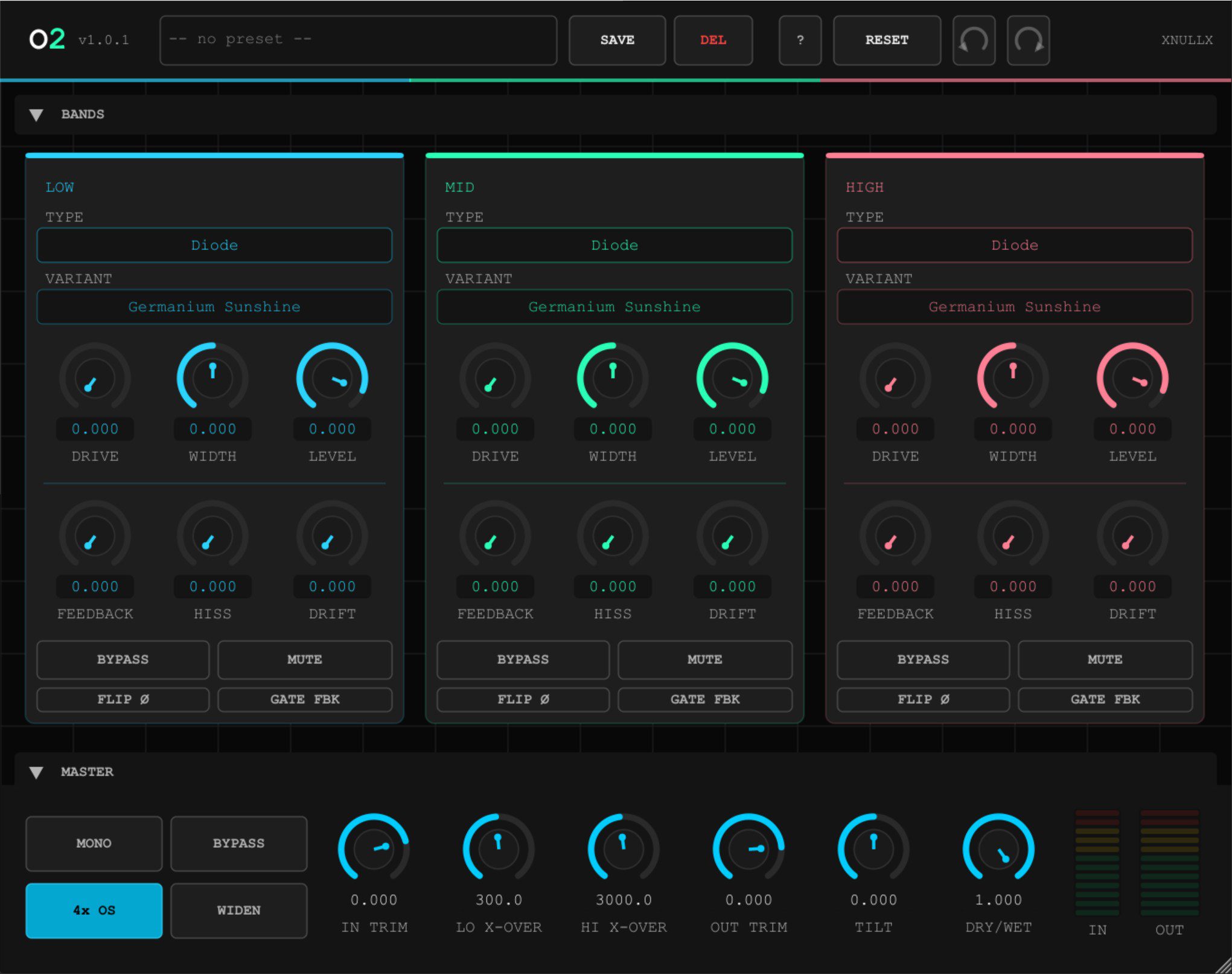
O2 by XNULLX is a free multiband saturation and stereo-width plugin designed for producers who want more control than a conventional single-band distortion effect.
Released in 2026 as part of the XNULLX donationware collection, O2 divides the signal into three independent frequency bands. Each band can use its own saturation model, drive level, feedback, drift and stereo-width settings.
Three Independent Saturation Bands
O2 separates the incoming audio into low, mid and high-frequency bands. Producers can therefore add weight to the bass, aggression to the midrange and brightness to the top end without processing the entire signal equally.
Each band provides several saturation characters inspired by circuits such as tubes, transistors, transformers, tape and diodes. The intensity can range from gentle harmonic colour to heavier fuzz-style processing.
Drift, Feedback and Stereo Width
The Drift control introduces slow movement into the drive level, preventing static saturation settings from sounding completely fixed.
Feedback can push individual bands toward dense resonance and controlled self-oscillation. O2 also includes a delay-based widening system designed to create stereo information while remaining more reliable when the signal is collapsed to mono.
Main Features
- Three independent frequency bands
- Different saturation models for each band
- Several character variations per model
- Per-band drive, level and stereo width
- Analog-style Drift modulation
- Feedback and feedback gating
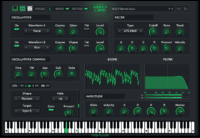
- Adjustable crossover frequencies
- Oversampling
- Input spectrum display
- Output limiter
- Resizable interface
- Undo and redo
Best Uses for O2
O2 can be used on individual instruments, buses or complete mixes. It is particularly effective for:
- Adding harmonics to bass and 808 sounds
- Increasing drum bus density
- Giving synthesizers more midrange presence
- Adding brightness to dull samples
- Widening pads and melodic layers
- Creating distorted sound-design textures
- Applying subtle colour to a mix bus
Using O2 on Bass
Keep the low band relatively centred and add moderate drive to generate harmonics that remain audible on small speakers.
The mid band can carry more distortion and width, while the high band may only need a small amount of saturation. This preserves the fundamental frequency while increasing perceived presence.
Using O2 on Drums
On a drum bus, use the low band to reinforce kick weight, the mid band to add snare and percussion character, and the high band to brighten cymbals.
Increase the settings gradually. Multiband saturation can quickly make a drum loop sound louder, but excessive processing may reduce punch and exaggerate harsh frequencies.
Compatibility
- Developer: XNULLX
- Price: Free donationware
- Windows: VST3
- macOS: VST3 and AU
- Plugin type: Multiband saturation and stereo width
- License key: Not required
XNULLX updated the plugin family in July 2026 with interface refinements, resizable windows, contextual help and undo/redo. O2 also received an input spectrum display, an output limiter and several stability fixes.
Final Verdict
O2 is a useful free saturation plugin for producers who want detailed tonal control without building a complicated multiband chain inside the DAW.
Its separate low, mid and high-frequency processing makes it suitable for basses, drums, synths and complete buses, while Drift and feedback provide more experimental possibilities.
The interface remains approachable despite the amount of control available. O2 can add subtle harmonic density or turn a polite sound into something considerably less employable.
Download O2 from the official XNULLX website:
https://www.xnullx.com/o2.html