
The truth is simple: great music production does not come from owning every tool. It comes from understanding the creative chain. A strong track begins with an idea, becomes a groove, grows through arrangement, gains identity through sound design, becomes professional through mixing, and reaches release quality through mastering. Whether you are opening your first DAW or refining your tenth release, the fundamentals remain the same.
This complete guide brings together some of the most useful music production resources on Audiartist, organized as a practical roadmap for musicians, beatmakers, home studio producers, electronic artists, composers, and independent creators who want to improve their sound without losing the reason they started making music in the first place.
Start with the Right Mindset: Finish More, Overthink Less
The first mistake many new producers make is believing that they need a perfect setup before they can create serious music. In reality, progress comes from finishing tracks, not from preparing endlessly to someday begin. The most valuable early skill is not advanced mixing. It is momentum.
A beginner needs three things: a DAW, a simple sound palette, and a repeatable method for turning ideas into complete sketches. The Audiartist guide Music Production for Beginners: Build Your First Beat, Choose the Right Gear, and Avoid Costly Mistakes is the best starting point because it focuses on practical foundations: building a first beat, understanding basic gear, avoiding beginner mixing traps, learning gain staging, and grasping core audio concepts such as Hz, dB, mono, stereo, and phase.
For beginners, the goal should not be to sound like a professional producer in one week. The goal is to finish a simple track, understand why it works, then repeat the process with better decisions each time. For experienced musicians, the same lesson still applies. Complexity is useful only when it serves the song. A clean four-track idea with direction will always beat a crowded session full of decorative noise.
Choose a DAW That Helps You Create, Not One That Impresses Other Producers
The DAW is the center of modern music production. It is where ideas are recorded, edited, arranged, mixed, and mastered. Yet choosing a DAW can quickly become a tribal debate, with every producer defending their software like it raised them from childhood. The smarter question is not “Which DAW is the best?” but “Which DAW helps me finish music?”
If you are just starting, the guide The Best Free DAWs for Every OS in 2026 is a strong resource because it covers free options for Windows, macOS, and Linux, while also helping producers understand what matters in a production environment: recording, MIDI editing, plugin support, automation, mixing tools, stability, and workflow.
A good DAW should feel fast enough to keep up with inspiration and deep enough to grow with your skills. Beginners should avoid switching software every month. Experienced producers should also beware of the same trap under a more elegant name: “workflow optimization”. At some point, the music must win against the menu diving.
Build a Smart Plugin Setup: Instruments First, Then Effects
Plugins are essential in modern music production, but they can easily become a distraction. A producer does not need hundreds of instruments. A producer needs a small set of reliable tools that cover drums, bass, keys, synths, textures, effects, and mixing.
The article The Ultimate Starter Pack for Music Production is useful for anyone building a production setup from scratch. It focuses on free VST instruments and effects that can give beginners a complete creative toolkit without spending money too early.
For producers who want to go deeper into instruments, Best VST Instruments in 2026 to Start Music Production helps clarify which tools can turn an empty session into a real musical idea. This matters because the first sound you choose often shapes the whole track. A good bass patch can define the groove. A strong piano can reveal the chord progression. A textured pad can create the emotional world of the song before the drums even arrive.
Once the foundation is solid, the comparison between free and paid plugins becomes important. 10 Indispensable Free VST and Paid Plugins for Music Production offers a practical way to think about the modern plugin folder: free tools can be powerful, paid tools can be worth it, but every plugin must earn its place in the workflow.
Turn Loops into Real Tracks
One of the most common problems in music production is the famous eight-bar loop trap. The beat sounds good, the groove works, the producer smiles for eight seconds, then the project slowly becomes a prisoner of repetition. A loop is not a song. It is a promise.
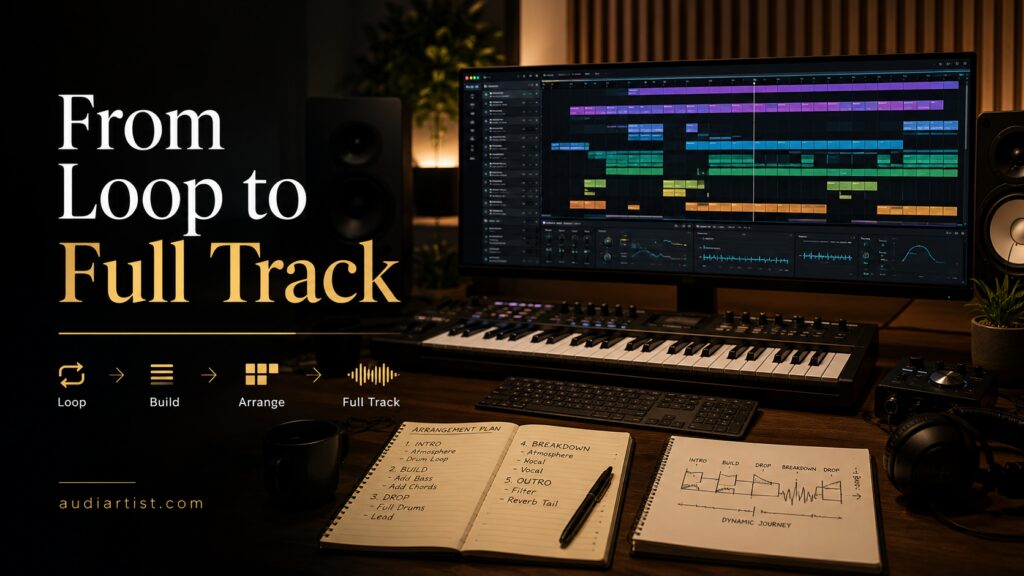
The guide From Loop to Full Track: Beatmaking & Arrangement Techniques That Turn Ideas into Real Productions is essential because it addresses the missing step between inspiration and completion. Arrangement is where a producer decides how energy moves over time. It is not only about adding sections. It is about controlling expectation.
A strong arrangement usually needs contrast: intro, groove, development, breakdown, return, variation, and ending. Even in minimal music, the listener needs movement. Drums can drop out. Bass can enter late. A melody can appear only after the groove is established. FX can mark transitions. Silence can create tension. Arrangement is not decoration, it is storytelling with sound.
For beginners, the key is to duplicate the loop across the timeline, then remove elements to create sections. For advanced producers, the challenge becomes more subtle: making every section feel necessary. If nothing changes, the listener leaves. If too much changes, the track loses identity. The best productions create movement without sounding restless.
Compose by Ear and Stop Waiting for Perfect Music Theory
Music theory is useful, but it should not become a locked gate. Many producers, especially in electronic music, hip-hop, lo-fi, Afro house, synthwave, and cinematic music, build strong ideas by ear before they can explain them on paper. That is not a weakness. It is often the beginning of a personal sound.
If harmony feels intimidating, the article Compose by Ear: The Three-Chord Method That Always Works gives a producer-first way to think about chords: home, tension, and return. This approach helps musicians build progressions based on emotion and direction rather than academic pressure.
A simple chord progression can support a complete production if the rhythm, sound selection, bassline, arrangement, and mix decisions are strong. Three chords can become a house anthem, a lo-fi sketch, a pop hook, or a cinematic motif. The difference is not always harmonic complexity. It is how the producer shapes the musical environment around those chords.
Sound Design: Create Identity Without Overcomplicating Everything
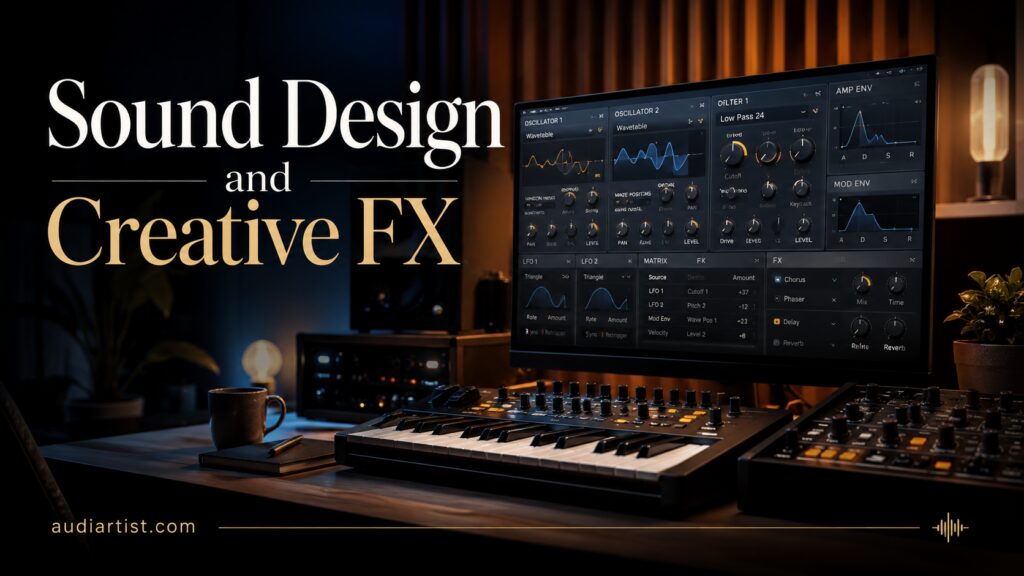
Sound design can look terrifying from the outside. Oscillators, filters, envelopes, LFOs, modulation matrices, wavetables, granular engines, routing, macros, and mysterious knobs that seem to exist purely to make beginners question their life choices. But effective sound design often starts with simple decisions.
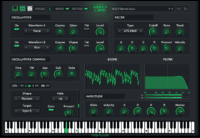
The article Simple Sound Design for Beginners: Create Better Sounds Without Overcomplicating Your Workflow is valuable because it removes the fear around synthesis. Instead of treating sound design like a secret laboratory, it brings the process back to musical roles: lead, bass, pad, texture, movement, and space.
A producer does not need to design every sound from scratch. Presets are not cheating. The real skill is knowing how to choose, adjust, layer, and place sounds in context. A preset that works perfectly in the track is more professional than an original patch that fights every other element. Sound design is not about showing how many parameters you understand. It is about giving the track an identity.
Use Creative FX to Add Movement, Space, and Signature
Creative effects are where a production starts developing personality. Reverb, delay, chorus, saturation, distortion, granular processing, stereo widening, and multi-effects can transform a dry idea into something cinematic, hypnotic, aggressive, nostalgic, intimate, or futuristic.
The guide Best Creative FX Plugins in 2026 for Music Producers is a strong resource for producers who want to build a modern FX palette. It explains how free and paid plugins can shape space, rhythm, width, texture, and movement.
The danger with creative FX is excess. Beginners often add reverb to make something sound professional, then add delay to make it interesting, then chorus to make it wide, then distortion to make it powerful, then another reverb because the first one looked lonely. The result is usually a foggy mix with no center.
A better method is to assign a role to each effect. Reverb creates distance. Delay creates rhythm and echo. Chorus creates width and movement. Saturation adds harmonic density. Distortion adds attitude. Granular effects create transformation. Automation brings change over time. When every effect has a job, the production becomes more intentional.
Mixing: Clarity Comes Before Loudness
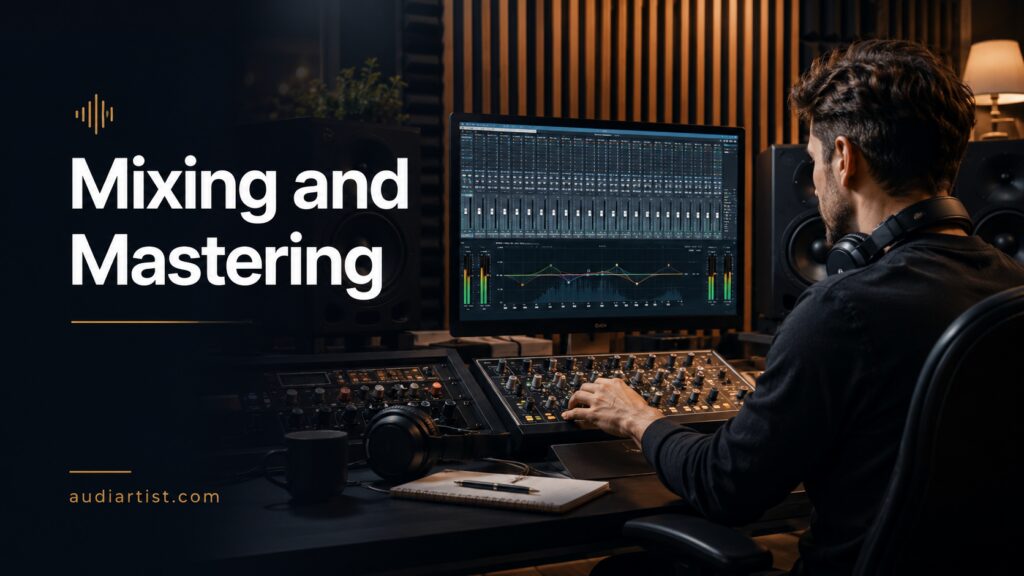
Mixing is where a production becomes readable. The listener should understand the rhythm, bass, vocal, melody, harmony, and emotional focus without feeling the technical work behind it. A great mix is not only louder or brighter. It is clearer, more balanced, and more emotionally convincing.
The article Best Mixing Plugins in 2026: EQ, Compression, Saturation and Essential Tools for Music Producers is a strong overview of the tools that matter most: EQ, compression, saturation, metering, vocal control, and problem-solving plugins. It also makes an important point: a good mix begins with judgment, not with expensive software.
For beginners, the most important mixing moves are simple. Balance the volume first. Keep the low end controlled. Remove unnecessary low frequencies from non-bass instruments. Avoid drowning everything in reverb. Check the mix quietly. Compare with reference tracks. Leave headroom. If the kick and bass fight, do not solve it by making both louder. That is not mixing, that is two sounds arguing in public.
For experienced producers, mixing becomes a question of intention. Which element leads the song? What should feel close? What should feel wide? What should stay dry? Where should the emotional peak happen? Advanced mixing is less about stacking processors and more about making every sound justify its position.
EQ: From Beginner Cleanup to Advanced Tonal Control
EQ is one of the most important skills in music production. At the beginner level, it helps remove mud, rumble, harshness, and masking. At the advanced level, it becomes a way to control movement, resonance, balance, and long-term listening comfort.
For producers learning the basics, Mastering EQ in Music Production is a useful entry point. It explains why equalization matters and how frequency shaping helps every instrument find space in the mix.
Once the basics are understood, Advanced EQ Moves: Dynamic EQ, Resonance Control, and Tonal Balance takes the topic further. Dynamic EQ is especially useful because not every frequency problem is constant. A vocal may only become harsh on certain words. A bass may only boom on one note. A synth may only become sharp during one section. Static EQ can solve part of the problem, but dynamic EQ can respond only when needed.
The deeper lesson is that EQ is not only about making sounds brighter or darker. It is about behavior. A professional mix feels stable because the producer controls the moments where sounds become too loud, too sharp, too muddy, or too crowded. Small EQ decisions, made in context, often create more impact than dramatic boosts.
Compression: Control Energy Without Crushing Life
Compression is one of the most misunderstood tools in music production. It can make drums punch, vocals sit forward, basslines feel stable, and buses sound glued. It can also destroy transients, flatten groove, and make a mix feel tired if used without purpose.
The guide Understanding Compression in Music Production gives a clear foundation for producers who want to understand threshold, ratio, attack, release, gain reduction, and makeup gain. The goal is not to memorize settings. The goal is to hear what compression is doing.
For dance music, Sidechain Compression in Dance Music is especially important. Sidechain compression helps the kick and bass work together, creating space, groove, and the familiar pumping movement found in house, EDM, techno, and related genres.
Advanced producers can go further with Parallel Compression vs Serial Compression: When to Use Each. Parallel compression can add density while preserving the original transient. Serial compression can shape dynamics in stages, often more naturally than forcing one compressor to do everything. Compression is not only volume control. It is energy design.
Drums: Punch Starts Before the Plugin Chain
Drums often define the power of a production. Whether it is a house groove, trap beat, pop rhythm, rock pattern, Afro house percussion section, or cinematic pulse, weak drums can make the entire track feel smaller than it should.
The article How to Make Your Drums Punch Through the Mix is useful because it starts with the right principle: drum impact begins with sound selection. A weak kick will not become magical because a compressor was asked politely. Strong samples, smart layering, transient control, EQ, compression, and groove all work together.
A punchy drum mix usually needs three layers of thinking. First, the individual sounds must be strong. Second, the groove must leave room for impact. Third, the mix must protect the transient and low-end foundation. Too much processing can make drums louder but less powerful. True punch is not just volume. It is contrast, timing, and focus.
Stereo Width, Panning, and Translation
Width is seductive. A wide mix can feel expensive, immersive, and modern. But uncontrolled stereo processing can weaken the low end, create phase issues, and collapse badly on mono systems, phones, club speakers, or social media playback.
The guide Panning and Stereo Imaging in Music Production explains how placement helps create separation and space inside a mix. It is a fundamental skill because not every sound should fight for the center.
For a deeper look at modern width, Stereo Width: How to Make Your Mix Sound Bigger helps producers understand where width works and where it becomes dangerous. Kick, sub bass, and core low-end elements usually need to stay centered. Pads, background vocals, percussion details, guitars, reverbs, and atmospheric textures can often carry more width.
A professional stereo image is not wide everywhere. It is wide by contrast. The center gives the track power. The sides give it dimension. When both are balanced, the mix feels bigger without falling apart.
Reference Tracks: The Producer’s Reality Check
One of the fastest ways to improve production, mixing, and mastering is to use reference tracks. A reference track is not there to copy. It is there to recalibrate your ears. After hours inside one session, the producer starts normalizing problems. Too much bass begins to feel normal. Harsh highs feel exciting. A weak vocal feels acceptable because the brain has heard it fifty times.
The article How to Reference Tracks Like a Professional Producer explains how references help with arrangement, tone, balance, loudness, groove, and genre expectations. Reference tracks give perspective, especially when working alone in a home studio.
At the mastering stage, Mastering with Reference Tracks and Ozone 12: How to Make Better Final Decisions takes this idea further. Mastering is not a rescue mission. It is the final stage of translation. References help producers avoid making masters that are too bright, too loud, too thin, too muddy, or too compressed.
Mastering: Prepare the Track for the Real World
Mastering is often treated like a mysterious final spell. In reality, it is the final quality-control stage before release. A master should translate across headphones, monitors, phones, cars, laptops, clubs, and streaming platforms. It should improve impact without damaging the mix.
The guide Best Mastering Plugins in 2026 for Independent Music Producers is a strong resource for producers building a practical mastering chain. It covers the tools that matter most: EQ, compression, saturation, limiting, loudness metering, tonal balance, stereo control, and reference checking.
The biggest mastering mistake is trying to fix production and mixing problems too late. If the kick and bass fight in the mix, mastering will not turn them into best friends. If the vocal is buried, a limiter will not suddenly develop emotional intelligence. Mastering works best when the mix already makes sense.
For independent producers, the best approach is simple: finish the mix first, export with headroom, compare with references, make gentle mastering moves, check loudness, test on multiple systems, then stop before the waveform starts looking like a brick with ambition.
Templates: Speed Up the Workflow Without Becoming a Clone of Yourself
Templates can be extremely useful in music production. A well-built template saves time by loading routing, buses, instruments, send effects, reference tools, markers, meters, drum groups, vocal chains, and mix organization before the session begins.
The article Using a Music Production Template: Creative Shortcut or Dangerous Comfort Zone? explores both sides of the subject. Templates can protect inspiration by removing technical friction. They can also make every track sound the same if the producer never questions the default setup.
For beginners, a template can teach organization. For experienced producers, it can accelerate professional output. The key is to treat the template as a starting point, not a prison. Change instruments. Delete unused tracks. Rebuild chains when the song needs something different. A template should serve creativity, not politely domesticate it.
A Practical Roadmap for Every Producer
If you are a beginner, follow this order: choose one DAW, build one small plugin setup, make one complete beat, arrange it into a full track, learn basic EQ and compression, use simple creative FX, compare with references, then finish a rough master. Do not chase perfection too early. Completion is the best teacher.
If you are already experienced, use the same roadmap with more precision. Refine your templates. Improve your sound selection. Make faster arrangement decisions. Use dynamic EQ instead of over-cutting. Use compression for energy, not habit. Build creative FX chains with purpose. Master with references, not ego. Develop a signature by making better choices, not by adding more tools.
The best producers in 2026 will not be the ones with the largest plugin folder. They will be the ones who can move from idea to finished track with clarity, taste, speed, and intention. Music production is no longer limited by access. The tools are here. The real difference is workflow, listening, and the ability to finish.
Essential Audiartist Music Production Resources
- Music Production for Beginners: Build Your First Beat, Choose the Right Gear, and Avoid Costly Mistakes
- The Best Free DAWs for Every OS in 2026
- The Ultimate Starter Pack for Music Production
- Best VST Instruments in 2026 to Start Music Production
- From Loop to Full Track: Beatmaking & Arrangement Techniques That Turn Ideas into Real Productions
- Simple Sound Design for Beginners
- Best Creative FX Plugins in 2026 for Music Producers
- Best Mixing Plugins in 2026
- Advanced EQ Moves: Dynamic EQ, Resonance Control, and Tonal Balance
- How to Make Your Drums Punch Through the Mix
- Panning and Stereo Imaging in Music Production
- Sidechain Compression in Dance Music
- Parallel Compression vs Serial Compression: When to Use Each
- How to Reference Tracks Like a Professional Producer
- Mastering with Reference Tracks and Ozone 12
- Best Mastering Plugins in 2026 for Independent Music Producers
- Using a Music Production Template: Creative Shortcut or Dangerous Comfort Zone?
Conclusion: Better Production Comes from Better Decisions
Music production is not a race to own more plugins, follow more tutorials, or copy more presets. It is the art of making decisions that serve the song. A beginner improves by finishing, listening, correcting, and repeating. An experienced producer improves by simplifying, refining, and making every sound earn its place.
The modern home studio gives musicians an extraordinary level of power. But the real craft still comes from the same timeless skills: rhythm, emotion, arrangement, tone, balance, space, dynamics, and taste. Learn the tools, but do not worship them. Build a workflow, but do not let it become mechanical. Use references, but keep your identity. Finish tracks, then finish better ones.
That is where real music production begins: not inside the most expensive plugin, but in the moment when a clear idea becomes a finished record.