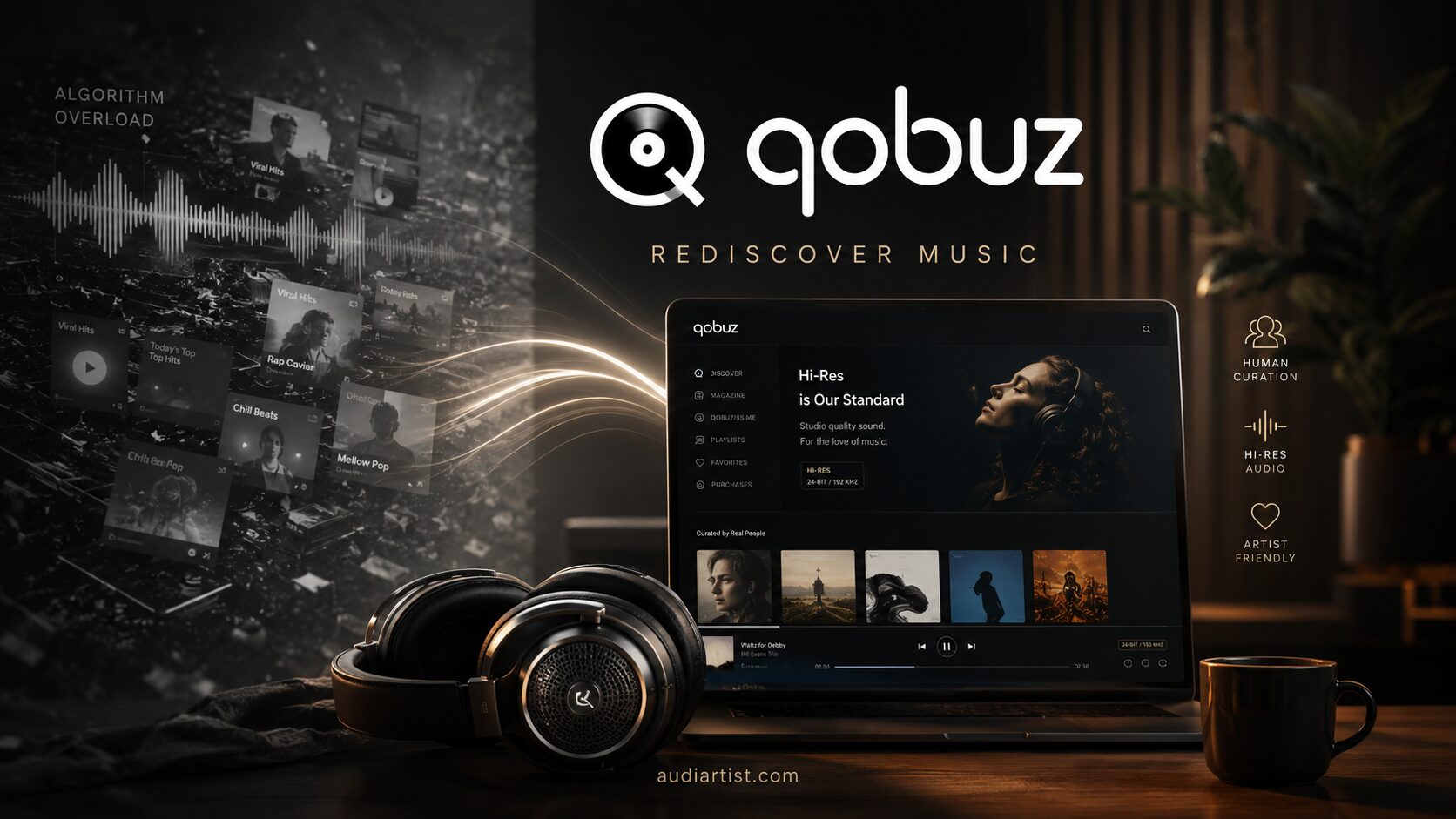

This strategy gives Qobuz a clear and increasingly valuable image. While Spotify, Apple Music, Amazon Music, and YouTube Music focus on scale, convenience, and algorithmic discovery, Qobuz presents itself as a more editorial, premium, and music-centered service. It feels less like an endless supermarket of tracks and more like a specialized record store designed for people who still want to listen to music as an artistic experience, not just as background noise between notifications.
A Direct Answer to Streaming Fatigue
Streaming has completely transformed the way people access music. It has made almost every song available instantly, but it has also created a new kind of fatigue. Too many releases, too many automatic recommendations, too many interchangeable tracks, and often too little context around the artists. For many listeners, the musical experience has slowly become an algorithmic flow rather than a meaningful discovery journey.
Qobuz is gaining attention because it speaks directly to that frustration. Its message is not only about technology. It is about listening better. The platform highlights high-resolution audio, lossless quality, digital booklets, editorial recommendations, music articles, and the possibility to buy or download albums. This creates a deeper connection with music culture, especially for listeners who want to understand what they hear, explore catalogues with care, and escape predictable recommendation loops.
Sound Quality Becomes a Cultural Argument
One of Qobuz’s strongest selling points remains sound quality. In a market dominated by quick mobile listening and compressed audio habits, the platform defends a more audiophile experience with lossless and hi-res streaming. This may sound technical, but it is also cultural. It reminds listeners that sound is not a minor detail, especially for producers, sound engineers, musicians, and fans who care about mix dynamics, recording depth, and the subtle details of an arrangement.
This positioning is particularly relevant at a time when the volume of available music keeps exploding. When everything is accessible, the real difference is no longer only the size of the catalogue. It is the quality of the experience. Qobuz does not simply sell access to millions of songs. It sells a more attentive, more demanding, and more respectful way of listening.
A More Artist-Friendly Image
Qobuz also benefits from a more positive image among many independent artists and labels. In an industry where streaming payouts are constantly criticized, the platform has positioned itself as a more transparent and artist-conscious alternative. Its communication around average per-stream remuneration gives it a strong symbolic advantage in a market often accused of undervaluing music.
Of course, the real income received by artists still depends on many factors, including distribution agreements, label contracts, publishing rights, territories, and the structure of each rights holder’s deal. Still, Qobuz scores an important point by speaking openly about value. In an economy that often feels opaque, this kind of positioning matters. It gives artists and listeners the impression that music is being treated with more respect.
Human Curation as an Antidote to the Algorithm
Another major strength of Qobuz is its editorial approach. While many streaming services rely heavily on automated recommendations, Qobuz continues to value human perspective: album selections, reviews, curated features, genre guides, and deeper catalogue exploration. This gives the platform an identity closer to a music magazine than to a purely technical streaming service.
For artists, this difference matters. A platform that provides context can support a release more meaningfully than a system that simply measures listening behavior. For listeners, it can open the door to genres, scenes, and records that an algorithm might never push forward. In a world where automated recommendations often trap people inside their own habits, human curation starts to feel almost luxurious.
A Strong Position in the Age of AI Music
Qobuz is also gaining relevance because the streaming industry now faces a major challenge: the massive arrival of AI-generated music. Platforms are receiving huge volumes of tracks created fully or partially with artificial intelligence, often with little transparency. For artists and listeners, this raises a crucial question: how can the value of human-made music be protected in a catalogue that can be filled at industrial speed by machines?
Qobuz has chosen a clear position. The platform emphasizes creator protection, transparency, and resistance to unwanted generative content. This gives it a strong advantage among listeners who care about the origin of the music they consume. In this context, the anti-Spotify image of Qobuz is no longer only about audio quality. It touches a deeper issue: what kind of music ecosystem do we want to support?
Not the Biggest Platform, but a Strategic Alternative
Qobuz does not operate at the same scale as Spotify or Apple Music. That is precisely what makes its positioning interesting. The platform does not need to be the biggest streaming service to become important. It can exist as a premium, specialized, coherent, and culturally recognizable alternative.
In today’s music industry, that difference can become a strength. Mainstream platforms dominate everyday usage, but they are also increasingly exposed to criticism: diluted artistic value, catalogue saturation, low payouts, algorithm dependency, the rise of AI-generated content, and a growing lack of editorial identity. Qobuz, by contrast, offers a clearer promise: less noise, more quality, more context, and more respect for the work itself.
A Strong Signal for Artists and Serious Listeners
The growing attention around Qobuz shows that part of the audience no longer wants only access to music. It wants to listen better, understand more, and support artists in a more meaningful way. This shift may seem modest compared with the massive numbers of the market leaders, but it reveals an important trend: trust is becoming a central factor in streaming.
For independent artists, Qobuz can offer a more qualitative showcase, even if it does not replace the discovery power of the largest platforms. For labels, it provides a space where catalogue value can be presented with more care. For listeners, it delivers a calmer, more premium, and more music-focused experience.
Conclusion: Qobuz Turns Its Difference into an Advantage
Qobuz is gaining ground because its positioning arrives at exactly the right moment. In a market tired of automation, impersonal playlists, low-value listening habits, and the rise of AI-generated music, the French platform defends a more human vision of streaming. High-resolution audio, editorial curation, no advertising, downloads, transparency, and respect for creators all contribute to a strong and increasingly distinctive identity.
Qobuz may not replace Spotify in mass-market usage. But it can become one of the clearest symbols of a more conscious, more demanding, and more respectful streaming culture. At a time when everything moves fast, catalogues are exploding, and algorithms too often decide what deserves to be heard, that difference no longer feels like a niche. It feels like a direction.