
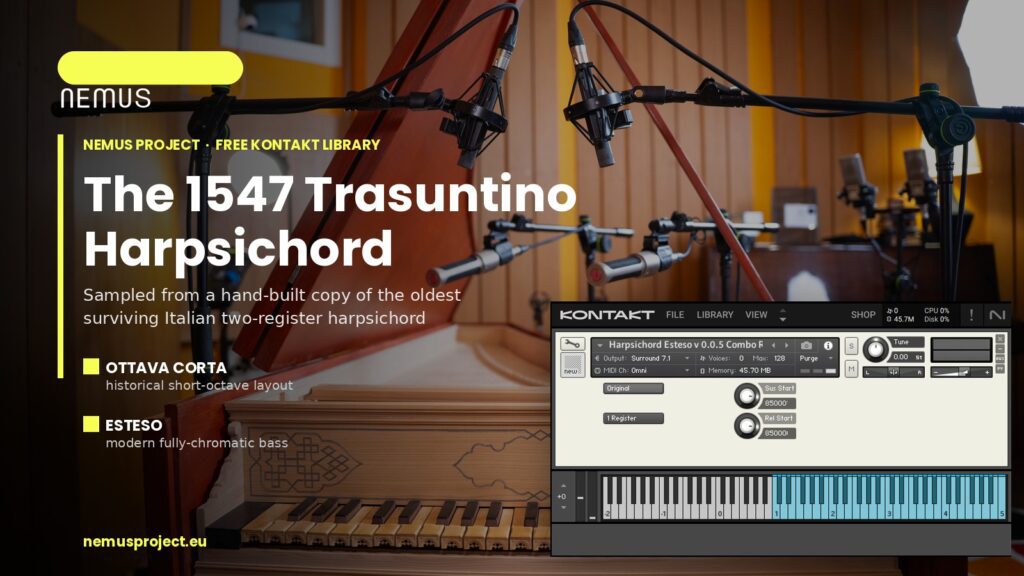
The NEMUS Project has released The 1547 Trasuntino Harpsichord, a free Kontakt library built from recordings of a faithful reconstruction of one of the oldest surviving Italian two-register harpsichords.
Rather than sampling a modern instrument styled to sound historical, the project began with detailed research into an original harpsichord attributed to Alessandro Trasuntino and dated 1547. The result connects musical heritage, instrument conservation and modern sample-library production in a particularly unusual way.
What Is The 1547 Trasuntino Harpsichord?
The 1547 Trasuntino Harpsichord is a free sampled instrument created by the NEMUS Project, an academic research initiative coordinated by the University of Bologna.
The original historical instrument is preserved in the Tagliavini Collection at Museo San Colombano in Bologna. Its surviving materials provide important evidence about Renaissance instrument construction, but its fragile condition prevents it from being restored and played safely.
Instead of modifying the original, NEMUS commissioned master harpsichord builder Roberto Livi to construct a faithful acoustic copy. That playable reconstruction was then recorded and transformed into a Kontakt library.
A Silent Museum Instrument Brought Back Through Sampling
Historical musical instruments create a difficult conservation problem.
An instrument was built to produce sound, but playing and restoring it can gradually replace original parts, change its structure and remove evidence of how it was first constructed.
The Trasuntino harpsichord is especially valuable because its original 1547 cypress soundboard has never been removed or thinned. Restoring it to playing condition would risk damaging precisely the material that makes it important.
NEMUS therefore created two different copies. The physical reconstruction restores the acoustic voice of the instrument, while the digital version allows musicians and museum visitors to experience its character without touching the original.
Recorded From a Faithful Physical Reconstruction
The acoustic copy was built in Roberto Livi’s workshop in Pesaro between 2024 and early 2026.
Its geometry, materials, soundboard measurements, keyboard mechanism, decorative details and plectra were recreated from research conducted on the original instrument.
The finished copy was recorded at Simone Coen’s studio near Milan in February 2026. The sessions included both musical performances and detailed sampling of individual notes for the digital instrument.
Two Kontakt Keyboard Layouts
The library provides two different approaches to the lower register.
Ottava Corta
Ottava Corta recreates the historical short-octave layout associated with early Italian keyboard instruments.
This configuration preserves the original relationship between the visible keys and the bass notes they produce. It is useful for performers and researchers who want to explore the instrument through a more historically informed layout.
Esteso
Esteso provides a modern chromatic bass arrangement.
This version is easier to play from a contemporary MIDI keyboard because the lower notes follow the conventional chromatic order expected by modern producers and composers.
Both layouts use recordings from the same reconstructed harpsichord. The difference lies in how the bass samples are mapped across the keyboard.
Original and Denoised Recordings
The Kontakt interface provides a switch between Original and Denoised sample sets.
The Original setting preserves more of the natural recording-floor character and mechanical detail captured during the sessions.
The Denoised option provides a cleaner presentation for arrangements where the historical instrument needs to sit more quietly inside a modern production.
This choice is valuable because noise is not always a defect. In exposed classical, ambient and cinematic passages, a small amount of mechanical and room detail can make the instrument feel more physical and believable.
One or Two Registers
The interface also allows musicians to choose between one and two registers.
Using a single register creates a more focused and restrained sound. Activating both registers produces a denser tone with additional weight and harmonic complexity.
This makes the library flexible enough for delicate solo lines, contrapuntal writing, rhythmic ostinatos and larger Renaissance-inspired keyboard passages.
Adjustable Mechanical Character
Controls labelled Sus Start and Rel Start provide additional control over the beginning of the sustain and release portions of the samples.
These settings can influence how much of the captured action and mechanical behavior is heard around each note.
Reducing these elements can produce a cleaner result, while allowing more of the recorded mechanism to remain can make the performance feel closer to a real historical keyboard.
Fixed Historical Identity
The 1547 Trasuntino is not designed as a general-purpose modern harpsichord collection with dozens of microphone positions, effects and heavily processed presets.
Its identity comes from a specific instrument, a specific construction method and a carefully researched historical context.
This focused approach makes the library especially relevant for early-music arrangements, historical composition, museum projects and soundtracks that need something more authentic than a generic keyboard preset.
Best Uses for the Library
- Renaissance and early Baroque arrangements
- Historical music reconstruction
- Film, documentary and television scoring
- Period-inspired game soundtracks
- Classical and chamber compositions
- Cinematic ostinatos
- Experimental electronic music
- Layering with strings, choir and percussion
- Educational and museum projects
Using the Harpsichord in Modern Production
The library can also work outside historically accurate arrangements.
Short harpsichord notes can add a sharp and organic attack to electronic sequences. Longer passages can be processed with reverb, delay, distortion or granular effects to create unusual cinematic textures.
Producers can record the instrument as audio, reverse individual notes, build rhythmic loops or layer it with synthesizers for a hybrid acoustic and electronic sound.
Its naturally bright transient can also help melodic patterns remain audible without occupying the same space as a piano or heavily sustained pad.
Kontakt and System Compatibility
The library is supplied as a 1.2 GB Kontakt download.
The official NEMUS download page currently lists compatibility with macOS 10.13 through macOS 26 and Windows 11.
It is not a standalone virtual instrument. Native Instruments Kontakt and a compatible DAW or plugin host are required.
The public download page does not explicitly confirm compatibility with the free Kontakt Player or publish an exact minimum Kontakt version. Users should therefore consult the documentation included with the download before installation rather than assuming Kontakt Player support.
Free License for Music Production
NEMUS distributes the library free of charge under its Freeware Audio Plugin Licence Agreement.
The licence allows musicians to install and use the software to create audio works. Producers retain full rights to the audio they create with the instrument.
The library itself cannot be sold, shared, sublicensed or redistributed as a standalone product. The licence also prohibits using the software or audio it generates to train, fine-tune or validate artificial intelligence and machine-learning models.
How to Download The 1547 Trasuntino
The complete 1.2 GB Kontakt library is available from the official NEMUS software-download page.
No commercial purchase is required. The download is hosted through the official project website as a public result of its historical-instrument research.
Download The 1547 Trasuntino Kontakt library
Read the official NEMUS Trasuntino case study
Important Limitations
This is a focused historical instrument rather than a complete keyboard-production suite.
It does not advertise a large preset browser, modern modulation system, built-in sequencer or extensive collection of processed hybrid sounds.
The fixed historical character may also be less suitable for producers looking for a bright contemporary pop harpsichord or an aggressively processed cinematic keyboard.
Its value comes from specificity, authenticity and the unusual research story behind the samples.
Final Verdict
The 1547 Trasuntino Harpsichord is one of the most interesting free Kontakt libraries released in 2026.
It does more than preserve the sound of an old instrument. It demonstrates how sampling can provide access to musical heritage without putting a fragile original at risk.
The two keyboard layouts, original and denoised recordings, selectable registers and adjustable mechanical character provide practical flexibility without obscuring the instrument’s historical identity.
For classical composers, film scorers, game-audio creators, experimental producers and musicians interested in early keyboard instruments, this free NEMUS library offers a rare sound with a genuine story behind every note.