
New research suggests that identifying AI-generated music may be more complicated than simply training a detector to separate synthetic tracks from human recordings. A study published as a preprint in August 2026 found that heavily edited human audio can become a particularly difficult “hard negative” for AI detection systems, highlighting a major challenge for streaming platforms, distributors and rights holders that increasingly want to label or moderate synthetic music automatically.
The music industry wants reliable AI detection. New research shows why that goal may be harder than it sounds.
A research paper published in August 2026 examines whether an audio classifier can distinguish AI-generated music not only from ordinary human recordings, but also from human-made tracks that have been edited and processed in ways that may create similar spectral artifacts.
That second category is crucial.
Real-world music is routinely compressed, mastered, pitch-shifted, denoised, stem-separated, resampled and exported through multiple codecs. Those processes can alter the audio in ways that confuse systems trained on cleaner examples.
Key Results
- The researchers built a dataset containing AI-generated, edited and original audio variants.
- The system used a pretrained PaSST spectrogram transformer.
- Reported video-level balanced accuracy reached approximately 0.811.
- AI-generated clips achieved an F1 score of about 0.836.
- Edited human audio was harder, with an F1 score of about 0.720.
- The study suggests AI-generated music can retain detectable spectral cues.
- It also shows that ordinary audio editing can overlap with some of those cues and make classification more difficult.
- The paper is a research preprint and should not be treated as a final industry standard.

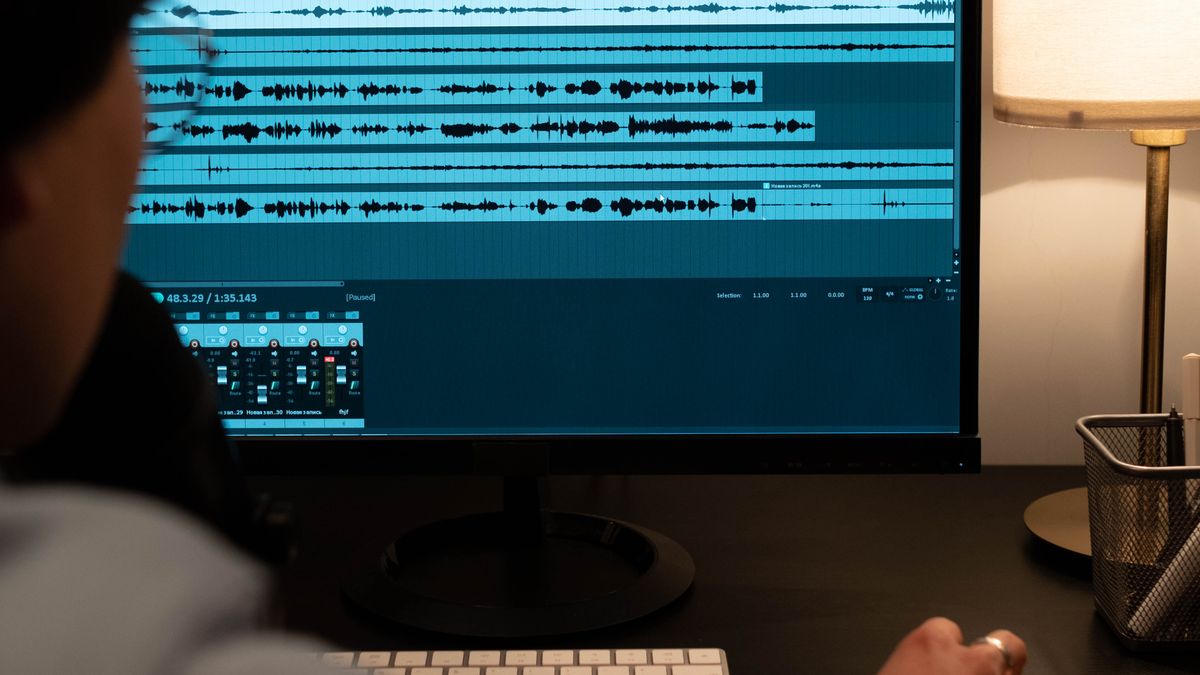
Photo: Jerson Vargas / Pexels
Why Edited Human Audio Is the Real Test
It is relatively easy to imagine a detector performing well when the comparison is between a clean studio recording and a raw AI-generated file created by one known model.
That is not what a streaming service sees.
Commercial releases arrive after mastering, encoding, distribution and platform transcoding. Independent creators may process a track through multiple plug-ins, stem tools and online services before uploading it.
A detection system therefore needs to distinguish the origin of the music rather than simply recognize the technical fingerprints of one export pipeline.
The new study treats edited human audio as a hard negative: material that is genuinely human-created but contains characteristics that make it more difficult for the classifier to reject as AI.
AI Music Appears to Leave Spectral Clues
The researchers found that AI-generated music can contain patterns that remain detectable in spectrogram-based analysis.
A spectrogram is a visual representation of how energy is distributed across frequencies over time. Machine-learning systems can use those patterns to identify relationships that may be difficult for a human listener to hear consistently.
The reported performance suggests that generative systems do leave useful statistical traces.
But those traces are not a perfect watermark.
If normal editing operations create similar artifacts, a detector can become less certain about whether it is recognizing AI generation or simply recognizing heavy digital processing.
Audiartist Analysis
This is the central problem for platform moderation. A detector that misses some AI music is inconvenient. A detector that incorrectly labels a real artist’s heavily processed track as AI can damage distribution, royalties and reputation. Accuracy therefore has to be evaluated against difficult human-made material, not only against clean benchmark recordings.
An 81% Balanced Accuracy Is Useful, Not Conclusive
The study reports video-level balanced accuracy of approximately 0.811.
That is promising for a research system, but it is far from the level at which a platform should automatically make irreversible decisions about an artist.
Even a detector with strong benchmark performance can generate large numbers of mistakes when applied to millions of uploads.
For example, if AI-generated tracks represent only a minority of the catalog, a small false-positive rate can still affect many legitimate recordings simply because there are so many more human tracks in the system.
This is why detection scores are best used as evidence within a wider review process rather than as an unquestionable verdict.
The Problem Gets Harder With Hybrid Music
Another recent research direction makes the binary question even less realistic.
Modern music can be partly human and partly AI-generated.
A producer might record a real vocal, generate a backing texture, use AI-created drums, replace one stem and then mix everything manually. Is that an AI song or a human song?
A separate August 2026 preprint has proposed estimating the proportion of AI-generated material inside hybrid mixes rather than forcing every track into a simple yes-or-no category.
That approach reflects how professional production is likely to evolve. AI may become one source among many rather than the origin of an entire recording.

Photo: cottonbro studio / Pexels
Why Streaming Platforms Care
Streaming services are under growing pressure to distinguish human-created music from fully synthetic uploads.
The reasons include royalty fraud, mass-upload spam, recommendation quality, artist identity, disclosure and consumer choice.
If a platform wants to label AI music or exclude some synthetic content from recommendation systems, it needs a reliable way to determine what the recording actually is.
Metadata supplied by distributors can help, but declarations are only useful when uploaders are honest and the definitions are clear.
Audio detection therefore becomes an additional layer of verification.
The new research shows that such systems may be valuable, but they need to be designed around the messiness of real music production.
The Moderation Rule That Matters
A detector should probably trigger investigation, not punishment. AI probability scores can help platforms prioritize suspicious uploads, but automatically removing music or withholding royalties on the basis of one classifier would create serious risks for legitimate artists.
Mastering and Compression Can Complicate Detection
Streaming music rarely reaches listeners in the exact form produced inside a DAW.
A track may be exported to WAV, encoded by a distributor, normalized, converted into different streaming formats and then captured again through video platforms or social networks.
Every transformation changes the signal.
If a detector relies too heavily on codec artifacts or frequency patterns associated with one model, those transformations can either hide the AI signature or accidentally create a similar signature in human audio.
Robust detection therefore requires training on many different forms of processing and not just the pristine output of current generative models.
AI Detectors Will Have to Keep Learning
There is another fundamental problem: generative models change quickly.
A detector trained on today’s Suno, Udio or open-source systems may perform differently against models released six months later.
As generation quality improves, some of the artifacts that make current AI music detectable may disappear.
That creates an arms race between generation and detection.
Platforms will need continually updated datasets representing new models, new editing workflows and hybrid production techniques.
What Artists Should Know
For human artists, the research is a reminder that AI detection should never be treated as infallible.
Heavy processing, unusual sound design and complex digital workflows can make audio statistically unusual without making it AI-generated.
Artists and producers may therefore benefit from keeping project files, stems and session documentation when originality becomes important to prove.
Distributors and streaming services should also provide meaningful appeal systems if automated tools flag legitimate releases.
Conclusion
AI music detection is progressing, but the problem is more difficult than separating obvious synthetic songs from traditional studio recordings.
The new study shows that a modern audio classifier can identify many AI-generated examples, while edited human tracks remain substantially more challenging.
That finding has direct consequences for the music industry.
If streaming platforms are going to label, demote or remove synthetic music, they need systems that understand the difference between AI generation and the countless forms of digital processing already used by human producers.
The future of AI music moderation will therefore depend on more than a detection percentage. It will require better datasets, transparent policies, human review and a clear recognition that music production itself is becoming increasingly hybrid.
Source: August 2026 research preprint, “Distinguishing AI-Generated Music from Edited Audio as a Hard-Negative Robustness Task,” available through arXiv. Additional context from research on estimating AI-generated stem proportions in hybrid music mixtures.