
Galdr: A Free Dark Wavetable Synth for Heavy Sound Design
Subtractive synthesis, wavetable morphing, FM, granular textures and cavernous effects inside one free open-source instrument.
Galdr is a free and open-source synthesizer developed by Sognevo. Released in August 2026, the instrument combines subtractive synthesis, wavetable morphing, frequency modulation and granular textures inside a dark interface inspired by black metal imagery.
Its name comes from an Old Norse term describing a spell that is sung rather than spoken. That concept fits the plugin well. Galdr can produce conventional basses, leads and pads, but its strongest personality appears when those sounds are pushed toward distorted drones, metallic timbres, frozen atmospheres and cinematic darkness.
Galdr is not a restricted free edition or a time-limited trial. The complete instrument and its source code are distributed under the GNU GPLv3 licence. Official builds are available for Windows, macOS and Linux.
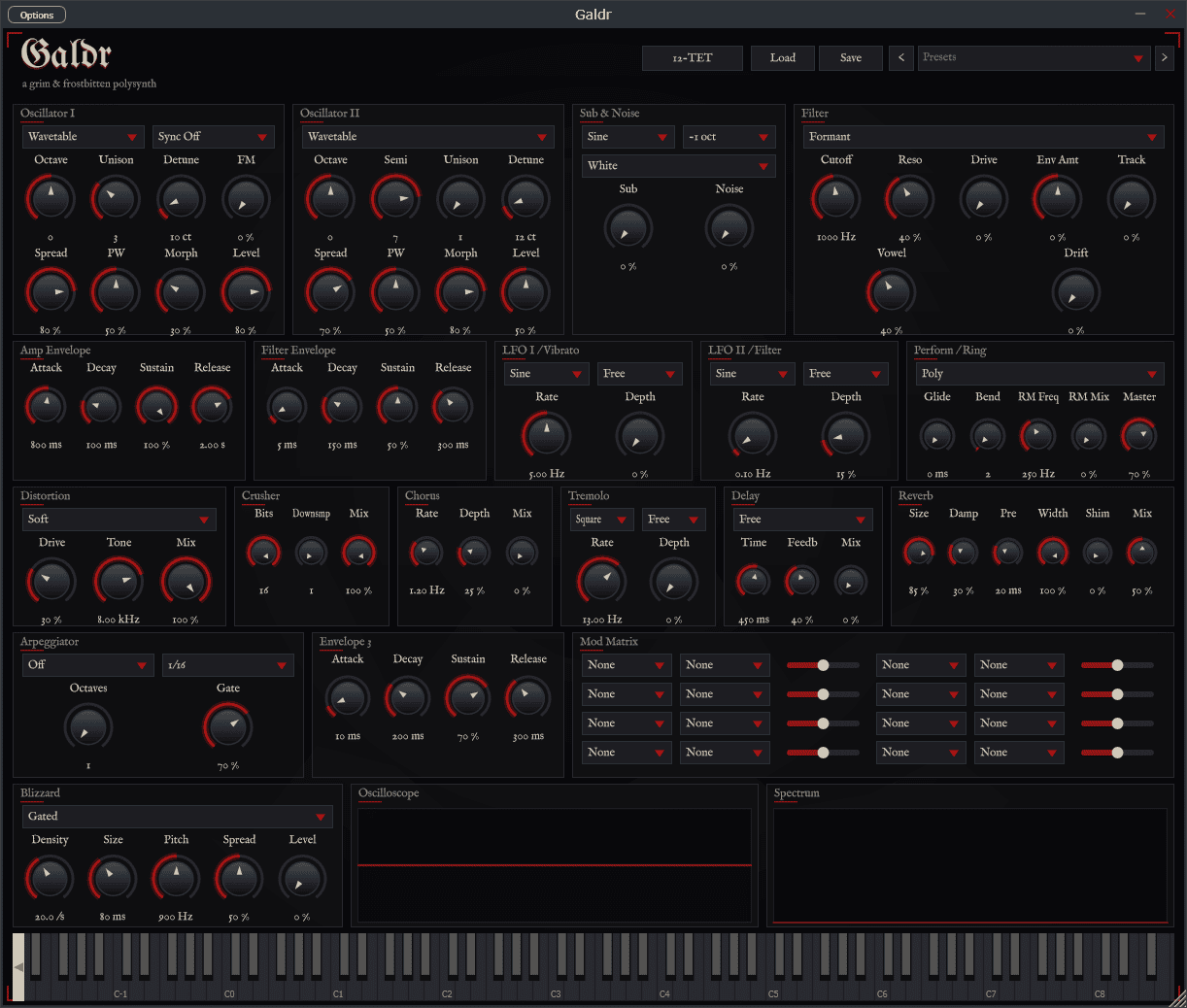
What Is Galdr?
Galdr is a twelve-voice software synthesizer with polyphonic, monophonic and legato playing modes. Its sound engine begins with two band-limited oscillators, a sub oscillator and selectable white or pink noise.
Each main oscillator supports up to seven unison voices with independent detuning and stereo spread. This allows the instrument to move from focused monophonic basses to broad pads and aggressive stacked leads.
The oscillators also support hard sync and frequency modulation, with oscillator two modulating oscillator one. These options are especially useful for metallic basses, sharp leads and unstable harmonic textures.
Galdr includes analog-style pitch drift at voice level, helping repeated notes and sustained chords feel less mathematically identical.
Morphing Wavetable Engine
The wavetable mode contains 32 mip-mapped frames that move from a basic sine wave through saw-based shapes and into a more inharmonic spectrum.
The Morph control allows producers to travel continuously between these frames. Subtle modulation can create evolving pads and animated basses, while faster movement produces more obvious digital textures.
Because the wavetable becomes increasingly complex toward its final frames, a single patch can begin with a relatively clean tone and gradually develop more abrasive harmonics.
The wavetable position can be controlled through the modulation matrix, making it possible to connect movement to envelopes, LFOs, velocity, pressure, the modulation wheel or per-note random values.
Filter and Modulation
Galdr includes a multimode filter with 12 dB and 24 dB low-pass modes, high-pass, band-pass and vowel-formant filtering.
The filter provides drive, keyboard tracking and a dedicated envelope. This makes it suitable for traditional subtractive patches as well as vocal-style sweeps and more resonant sound-design effects.
An eight-slot modulation matrix allows sources to be routed toward oscillator pitch, wavetable morphing, filter cutoff, FM level, effect sends and other destinations.
The available modulation sources include two LFOs, the amplifier and filter envelopes, an additional third envelope, velocity, modulation wheel, pressure and random values generated independently for each note.
The two LFOs can run freely or synchronize with the DAW tempo. This is useful for rhythmic filter movement, tremolo, evolving textures and precisely timed electronic sequences.
Arpeggiator and Expressive Control
The built-in arpeggiator provides up, down, up-down, random and as-played modes. Patterns can extend across four octaves and synchronize with musical divisions of the host tempo.
Galdr also supports MPE-friendly per-note pitch bend and pressure. Compatible controllers can therefore change individual notes inside a chord instead of applying the same modulation to the entire instrument.
Scala tuning files are supported for producers working with alternative temperaments and microtonal composition. Standard twelve-tone equal temperament remains available for conventional production.
These features make Galdr suitable not only for darker electronic music, but also for experimental scoring, evolving drones and expressive lead performances.
Blizzard Granular Texture Layer
One of Galdr’s most distinctive features is Blizzard, a granular layer designed to place a moving texture above the main synthesizer voices.
Blizzard can follow note activity or operate continuously as a free-running drone. Its density, grain size, pitch, stereo spread and level can be adjusted independently.
At restrained settings, it adds a quiet layer of air and movement behind pads or leads. Stronger settings can create noisy wind, frozen atmospheres and unstable granular clouds.
This layer is particularly useful for cinematic cues and ambient sound design because it creates background movement without requiring a separate noise recording or granular plugin.
Built-In Effects
Galdr includes an extensive effects chain designed to reinforce its dark and aggressive identity.
- Distortion: Four selectable characters with drive, tone and mix controls.
- Bitcrusher: Bit-depth and downsampling controls for digital degradation.
- Ring modulation: Metallic and inharmonic frequency processing.
- Chorus: Stereo modulation for wider pads, leads and atmospheric patches.
- Tremolo picking: Fast rhythmic volume movement inspired by black metal guitar techniques.
- Delay: Free or tempo-synchronized repeats.
- Cavern reverb: A dark feedback-delay-network reverb with pre-delay, width and octave-up shimmer.
The nonlinear effect stages use 2x oversampling to reduce unwanted digital artifacts during distortion and other heavy processing.
Best Uses
Dark ambient: Combine long envelopes, Blizzard and cavern reverb to create slowly evolving drones.
Cinematic scoring: Use wavetable movement and granular noise for tension beds, supernatural atmospheres and transitions.
Metal and industrial production: Design distorted basses, aggressive leads and synthetic layers that complement guitars.
Techno and electronic music: Create resonant sequences, metallic percussion-style patches and wide detuned basses.
Synthwave and experimental music: Reduce the distortion and use the wavetable, chorus and delay sections for animated pads and leads.
The factory direction is dark, but the synthesis engine is flexible enough for more conventional electronic sounds. A black interface does not legally require every preset to sound like a collapsing cathedral.
Compatibility and Installation
Galdr v0.5.0 is available for Windows, macOS and Linux.
- Windows: VST3, CLAP and standalone
- macOS: VST3, CLAP, Audio Unit and standalone
- Linux: VST3, CLAP and standalone
- Interface: Fully resizable with contextual tooltips
- Licence: GNU GPLv3 or later
- Price: Completely free and open source
Download the archive created for the required operating system, then copy the VST3, CLAP or Audio Unit file into the standard plugin directory. The standalone version can run directly without being loaded inside a DAW.
Galdr also includes a preset browser, factory and user preset locations, an oscilloscope, a spectrum analyser and an on-screen MIDI keyboard.
Final Verdict
Galdr is one of the most original free synthesizers released in 2026. Its dark visual identity is supported by a genuinely capable synthesis engine rather than functioning as simple decoration.
The combination of subtractive oscillators, wavetable morphing, FM, an eight-slot modulation matrix and the Blizzard granular layer gives producers several approaches to building complex sounds.
Its integrated effects are particularly useful for aggressive and atmospheric production, while MPE and Scala support extend the instrument into expressive and experimental workflows.
Galdr is still a young open-source project, but version 0.5.0 already offers a substantial feature set across Windows, macOS and Linux. Producers looking for a free synth with a clearly defined personality should find plenty to explore.
It may have a black-metal soul, but it can still produce a perfectly polite pad. Whether the pad remains polite after the distortion, Blizzard and cavern reverb are activated is another matter.