
CloudReverb by xunil-cloud is a free algorithmic reverb plugin designed for large spaces, evolving echoes and heavily modulated ambience. Updated to version 0.5 in April 2026, it rebuilds the CloudSeed reverb engine with the JUCE framework to improve cross-platform compatibility.
The plugin offers detailed control over early reflections, diffusion, modulation, filtering and late reverb. It is especially useful for ambient music, cinematic production, melodic techno, experimental electronics and any track that needs more than a conventional room simulation.

What Is CloudReverb?
CloudReverb is based on the open-source CloudSeed algorithm originally developed by Valdemar Erlingsson. Its purpose is not limited to recreating realistic rooms. The engine can also generate long, dense and modulated reverb tails that behave more like evolving sound-design layers.
The signal is divided into early reflections and late reverberation. Producers can balance these sections independently, making it possible to create anything from a short reflective space to a large atmospheric wash.
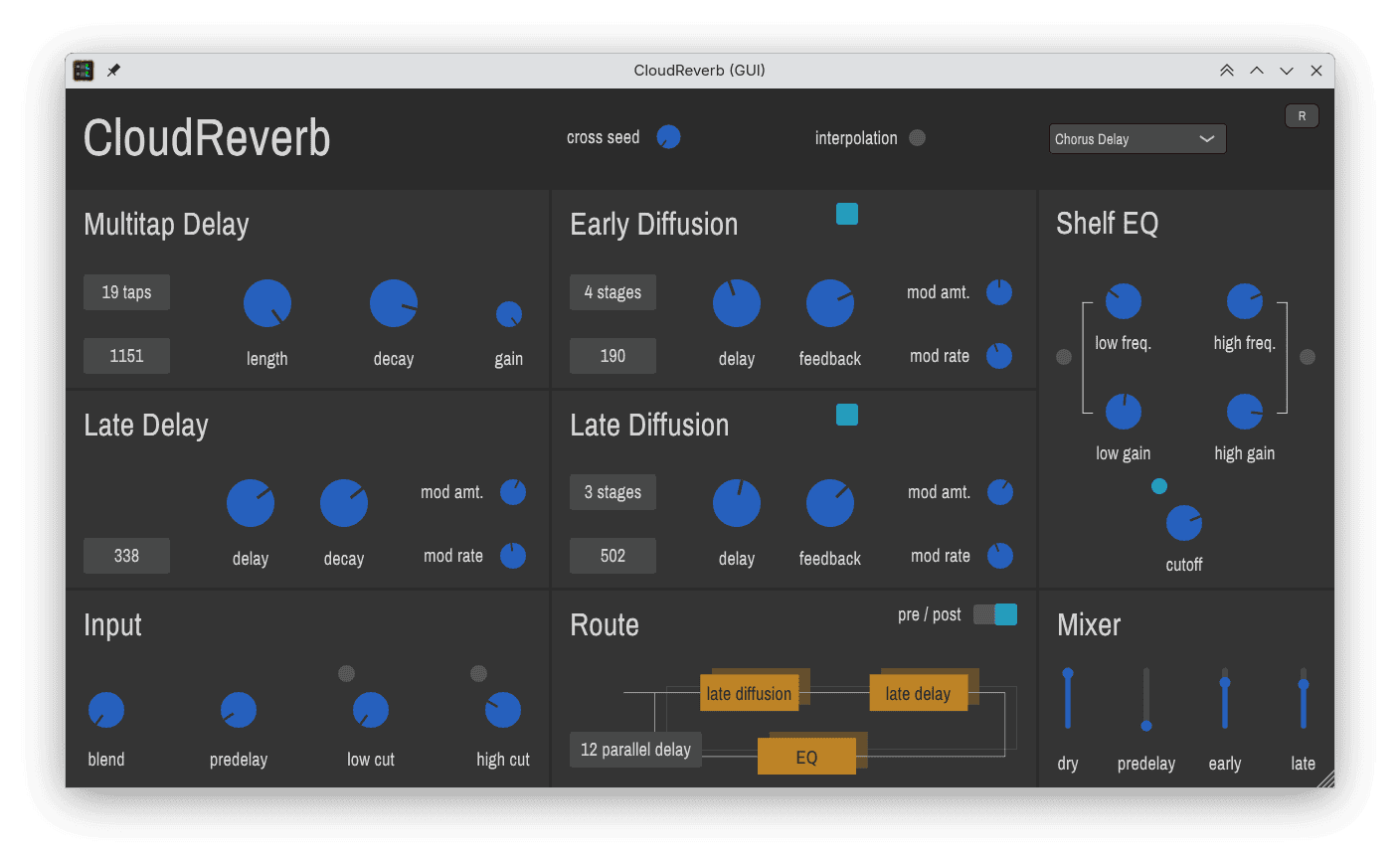
Main Reverb Controls
- Pre-delay: separates the original sound from the beginning of the reverb.
- Early reflections: controls the initial impression of room size and surface response.
- Diffusion: changes the density and smoothness of the reflections.
- Modulation: introduces movement into the delay and diffusion stages.
- Late reverb: controls the longer and more atmospheric section of the tail.
- Low and high filtering: shapes the frequency content entering and circulating inside the reverb.
- Seed controls: generate different reflection patterns and stereo responses.
- Dry, early and late levels: balance each part of the processed signal.
The random seed controls are one of CloudReverb’s most interesting features. Changing a seed modifies the internal delay and diffusion patterns, allowing producers to find smoother, darker, wider or more metallic variations without rebuilding the entire preset.
Best Uses in Music Production
CloudReverb works particularly well on pads, drones, vocal textures, guitars, synth leads and effect returns. Long decay times and modulation can transform a simple note into an evolving atmospheric layer.
In ambient and cinematic production, the plugin can create large spaces that continue moving after the original sound has disappeared. For melodic techno and progressive house, shorter settings can add depth to arpeggios and leads while preserving the main rhythm.
The early-reflection section can also provide more controlled ambience for drums and percussion. Reducing the late tail creates a tighter result, while increasing diffusion produces a denser and smoother space.
CloudReverb is less suited to producers who only need one large Mix knob and a preset called “Nice Vocal.” It rewards experimentation, but fortunately it does not require an architectural degree.
A Practical Workflow
Begin by setting the pre-delay and balancing the early and late outputs. Use more early reflections for a defined room impression or increase the late section for a larger atmospheric tail.
Next, adjust diffusion and modulation. Higher diffusion usually creates a smoother reverb, while stronger modulation adds movement and can reduce static metallic ringing.
Use the low-cut filter to prevent bass frequencies from building up inside the tail. Reducing high frequencies can also help the reverb sit behind the original instrument rather than covering it.
On an auxiliary channel, remove the dry signal and use CloudReverb as a fully wet effect. This allows several tracks to share the same space and keeps the overall mix easier to control.
Formats and Compatibility
- Current version: 0.5
- Latest release: April 14, 2026
- Price: Free
- License: GPL-3.0 open source
- Formats: VST3, Audio Unit and LV2
- Standalone application: Available
- Operating systems: Windows, Linux and macOS builds are documented
- Registration: No account, serial number or license manager required
The developer confirms testing under Windows and Linux. The macOS build is expected to work but has not been tested directly, so Mac users should verify compatibility before relying on it in an important project.
Visit the official CloudReverb GitHub repository for documentation and source code.
The current installers are available from the official CloudReverb Releases page.
Important Limitations
CloudReverb provides deeper control than a basic reverb, but its interface may feel technical to producers who prefer simplified controls. The public documentation also does not publish a factory preset count or detailed host compatibility list.
The macOS version remains officially untested by the developer. No AAX format is listed, so Pro Tools users do not have a native edition.
Extreme feedback, diffusion and decay settings can produce very dense tails. High-pass filtering and careful level control are recommended when using the plugin on bass-heavy arrangements.
Final Verdict
CloudReverb is a strong free option for producers who want atmospheric reverb with deeper control over reflections, modulation and stereo character.
Its CloudSeed-based engine is most convincing on pads, synths, guitars, cinematic textures and experimental effects. The interface requires more adjustment than a simple room reverb, but the seed controls and separate reflection stages provide considerable sound-design potential.
For ambient, cinematic and modern electronic production in 2026, CloudReverb delivers expansive spaces without subscriptions, activation systems or a reduced free edition.