
DuskVerb by Dusk Audio is a free open-source algorithmic reverb designed for producers who want several genuinely different spatial processors inside one plugin. Updated to version 0.6.0 in July 2026, it combines 11 independent DSP engines rather than offering minor variations of the same basic algorithm.
The collection covers plates, chambers, halls, springs, gated spaces, reverse effects and pitch-shifted shimmer reverbs. With 20 factory presets, tempo-synced pre-delay, ducking, freeze, stereo-width control and detailed damping, DuskVerb can handle everyday mixing as well as atmospheric sound design.
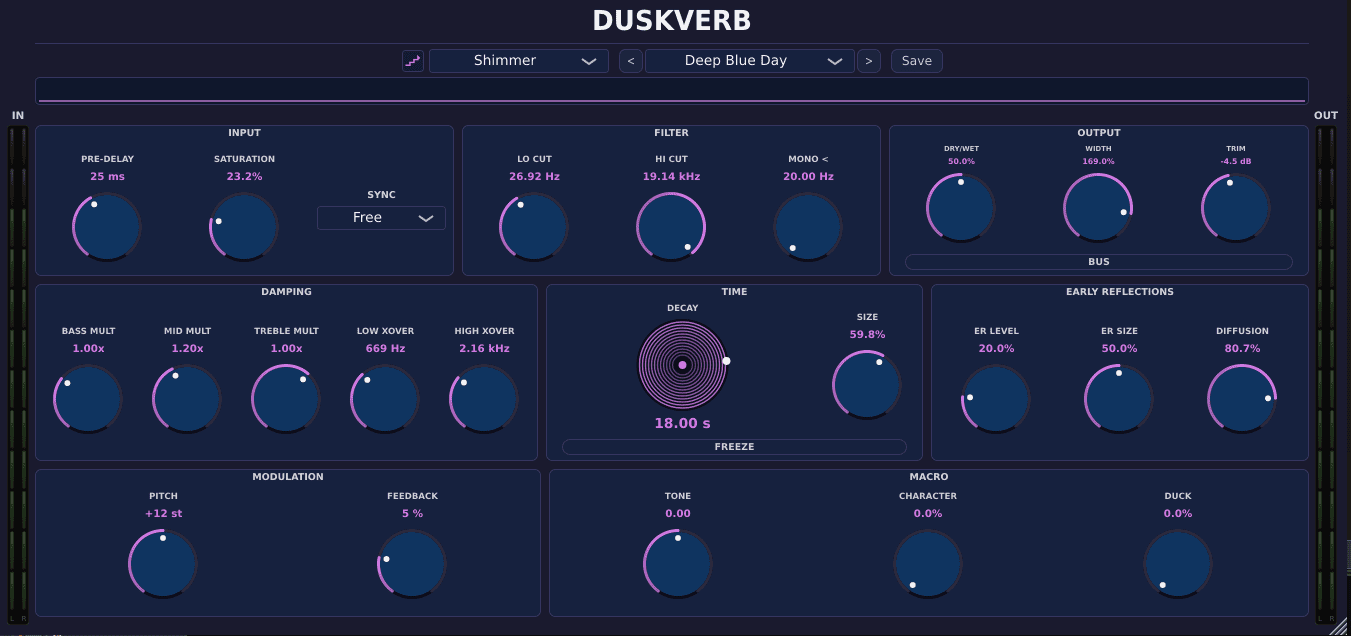
What Is DuskVerb?
DuskVerb is an algorithmic reverb plugin built around separate processing architectures. Choosing another engine does not simply change a few hidden settings. It replaces the internal reverb structure with a different network of delays, diffusion stages, filters and modulation.
This gives each engine its own response. A plate can provide dense vocal ambience, a chamber can create a more physical room impression, while the shimmer and reverse engines are designed for evolving textures and transitions.
The plugin is free, open source and distributed under the GPL-2.0 license. No subscription, serial number or proprietary license manager is required.
Eleven Different Reverb Engines
- Plate: a bright and dense plate suited to vocals, snares and melodic instruments.
- Vintage Plate: a warmer version with additional vintage-style tonal shaping.
- Smooth Plate: a highly diffused engine for pads, soft ambience and dense tails.
- Chamber: a more realistic space with strong early reflections and clean decay.
- Spring: a characterful three-spring design inspired by classic guitar hardware.
- Gated: an envelope-shaped reverb for short, dramatic drum and snare effects.
- Shimmer: a pitch-shifted feedback network for ambient pads, drones and cinematic textures.
- Reverse: a rising reverb response that swells toward the source transient.
- Hall: a spacious engine with frequency-dependent decay control.
- Tiled Room: a short, bright room with a darker late tail.
- Dense Hall: a heavily diffused engine for smooth and expansive concert spaces.
This range allows DuskVerb to move from tight drum ambience to extremely long atmospheric effects without loading several separate plugins.
Twenty Factory Presets
DuskVerb includes 20 presets divided across plates, springs, halls, chambers, rooms, gated reverbs, reverse effects and shimmer spaces.
The presets reference familiar studio-reverb aesthetics, including vintage plates, gated drum rooms, large halls and infinite ambient effects. They are practical starting points rather than locked processing chains, and every parameter can be adjusted after loading them.
Users can also save, load and delete their own presets directly from the plugin.
Tone, Character and Duck Macros
Version 0.6.0 introduced three macro controls for faster mixing decisions.
- Tone: shifts the overall reverb from darker to brighter.
- Character: increases modulation and saturation for more movement and texture.
- Duck: lowers the wet signal while the dry source is present, then allows the reverb to return between notes or phrases.
The Duck control is particularly useful on vocals, leads and busy melodic parts. It preserves clarity while the source is active without requiring a separate sidechain compressor.
Detailed Reverb Shaping
The main Decay control covers RT60 values from approximately 0.2 to 30 seconds. Short settings can create drum rooms and subtle ambience, while longer values work for cinematic pads and evolving electronic textures.
Pre-delay can be synchronized to the host tempo, making it easier to separate vocals, synths and percussion from their reverb tails. Size, diffusion, early reflections and modulation controls provide further control over the perceived space.
Independent bass and treble decay multipliers determine how quickly different frequency regions disappear. This can produce darker natural spaces, brighter artificial tails or reverbs where low frequencies continue ringing after the upper spectrum has faded.
Low-cut and high-cut filters are applied to the wet signal, while the stereo Width control ranges from mono to 200 percent. A dedicated mono-maker can keep low-frequency reverb more focused in bass-heavy mixes.
Freeze and Bus Mode
The Freeze function stops new audio from entering the reverb and sustains the current tail indefinitely. It can transform short notes, vocals and effects into continuous pads or drones.
Bus Mode forces the plugin to output a fully wet signal for use on an auxiliary or send channel. This avoids accidentally blending the dry signal twice when DuskVerb is used as a shared reverb.
Both features are straightforward, but they cover two common workflows without requiring mysterious routing ceremonies at two in the morning.
Practical Uses in Modern Production
- Vocals: use Plate or Chamber with pre-delay and Duck to preserve intelligibility.
- Drums: apply Gated, Tiled Room or Drum Plate settings for depth and impact.
- Afro House: add short rooms to organic percussion and darker plates to vocal phrases.
- Melodic Techno: use Hall or Dense Hall for arpeggios, leads and atmospheric layers.
- Ambient music: combine Shimmer, Freeze and long decay times to create evolving pads.
- Cinematic production: use Reverse, Shimmer and large halls for transitions and tension beds.
- Guitars: select Spring for vintage character or Chamber for a more natural space.
- Sound design: automate engine parameters, filters and modulation before resampling the result.
Sound and Performance
DuskVerb uses random-walk modulation rather than a repetitive sine-wave movement. This helps the reverb tail evolve without producing an obvious periodic wobble.
Preset and engine changes use internal crossfading to reduce clicks and abrupt tail interruptions. The plugin is also sample-rate independent and has been tested at 44.1, 48, 96 and 192 kHz.
The interface is resizable and includes a large decay visualization and a live tail meter. These visual elements help confirm how long the reverb is continuing without replacing the need to listen.
Formats and Compatibility
- Current version: 0.6.0
- Latest update: July 2, 2026
- Price: Free
- License: GPL-2.0 open source
- Windows: Windows 10 or later, VST3
- macOS: macOS 10.13 or later, VST3 and Audio Unit
- Linux: VST3 and LV2, with glibc 2.31 or later
- DAW requirement: A compatible 64-bit host
- Supported sample rates: 44.1 to 192 kHz
DuskVerb has been tested officially in Logic Pro, Reaper and Ardour. The developer also expects compatibility with Studio One, Ableton Live, FL Studio, Cubase, Bitwig and GarageBand.
Visit the official DuskVerb product page for documentation, demonstrations and installation information.
The current installers are available from the official DuskVerb GitHub Releases page.
Important Limitations
DuskVerb is still labelled as a pre-release product. Although version 0.6.0 already offers a substantial feature set, parameters, presets and compatibility may continue to change before a final 1.0 release.
The available formats also vary by operating system. Windows users receive VST3, Linux users receive VST3 and LV2, while Audio Unit is limited to macOS. No native AAX version is documented for Pro Tools.
The large number of engines and controls may be excessive for producers who only need a simple room reverb. In that situation, choosing one factory preset and adjusting Decay, Tone and Duck is usually enough.
Final Verdict
DuskVerb is an unusually complete free reverb plugin for music production in 2026. Its 11 independent DSP engines provide substantially more variety than a conventional multi-algorithm reverb built around small preset changes.
The plates, rooms and chambers are useful for everyday mixing, while the shimmer, reverse, gated and freeze functions extend the plugin into ambient and cinematic sound design.
Its pre-release status should be considered before using it in critical long-term sessions. Even so, the open-source license, cross-platform support, 20 presets and extensive spatial controls make DuskVerb a serious free option for producers who want both practical spaces and more creative reverb effects.