
The message from streaming platforms is becoming impossible to ignore: the era of unlimited uploads, vague artist identities, synthetic catalogues, and anonymous music projects is coming under stronger control. For independent artists, this is not just a technical update. It is a strategic warning.
For serious independent artists, this shift can be seen as a threat or as an opportunity. The threat is obvious: the digital environment is becoming more demanding. The opportunity is more interesting: real artists with a clear identity, professional presentation, and authentic audience connection may become more valuable in a market flooded with synthetic noise.
The Streaming Market Is Entering a Trust Era
Streaming was built on access. Any artist could distribute music worldwide. Any listener could discover almost any song instantly. That open model changed music forever, but it also created a major problem: oversupply.
Every day, platforms receive enormous amounts of new content. Some of it comes from talented independent artists. Some of it comes from labels and professional teams. Some of it comes from anonymous upload factories, fake profiles, AI-generated catalogues, and projects built only to exploit algorithms. The result is a discovery environment where quality, identity, and trust are harder to read.
This is why platforms are changing their behavior. They are no longer only asking, “Is this track available?” They are asking, “Who is behind it?” “Can this profile be trusted?” “Should this content be recommended?” “Is this a real artist project or an industrial upload strategy?”
That change matters deeply for independent musicians. In the new streaming economy, the artist profile is no longer just a place where songs are displayed. It is a trust signal.
Real Artists Need Real Profiles
The first lesson is simple: independent artists must stop treating their streaming profiles as secondary details. A Spotify profile, an Apple Music profile, a YouTube channel, a Deezer artist page, or a SoundCloud account is now part of the artist’s public identity.
A weak profile creates doubt. No biography, no social links, inconsistent visuals, generic artwork, no clear genre direction, no official website, and no visible activity can make even good music look unfinished or suspicious. In a world where AI-generated tracks and fake artist personas are multiplying, absence of identity becomes a problem.
A strong profile does the opposite. It helps listeners understand who the artist is, what the project represents, and why the music deserves attention. It gives curators confidence. It gives journalists material to work with. It gives fans a reason to follow the artist beyond one track.
For independent artists, profile hygiene is no longer cosmetic. It is professional infrastructure.
AI Has Changed the Meaning of Authenticity
The rise of AI-generated music has changed the way platforms and audiences think about authenticity. The question is not whether technology should exist in music. Music production has always evolved through technology: drum machines, samplers, synthesizers, digital audio workstations, autotune, virtual instruments, mastering assistants, and AI-powered tools are all part of modern creation.
The real question is different: is there a human artistic identity behind the music?
An artist using AI as a tool for editing, sound design, visual experimentation, or workflow support is not the same as an anonymous account uploading hundreds of fully generated tracks with no creative world, no story, no intention, and no accountability. Platforms are beginning to make that distinction more clearly.
This is where independent artists must be careful. If AI is part of the process, the artist identity must remain strong. The listener should feel that a real creative decision is behind the music. The danger is not using tools. The danger is looking like a tool made the entire project while the artist disappeared behind the upload button.
Why Visual Identity Matters More Than Ever
In the current streaming environment, sound alone is not enough. Visual identity has become a central part of music discovery. Cover art, artist photos, video clips, short-form content, YouTube visuals, Spotify Canvas, Instagram Reels, TikTok videos, and press images all contribute to how an artist is perceived.
A coherent visual identity helps separate a real artist from a disposable catalogue. It gives the music a recognizable world. It makes the project easier to remember. It also helps platforms, curators, blogs, and listeners understand the positioning of the artist.
This does not mean every independent artist needs a huge budget. It means the visual direction must be intentional. A simple but consistent aesthetic is stronger than random images generated without concept. A clean press photo, a clear logo, a coherent color palette, and artwork that fits the music can already make a serious difference.
In a market where synthetic visuals can be created in seconds, taste becomes more important than technical spectacle. The goal is not to look expensive. The goal is to look real, coherent, and memorable.
The Press Kit Is Back
For years, many independent artists underestimated the value of a press kit. In the new streaming reality, it is becoming essential again.
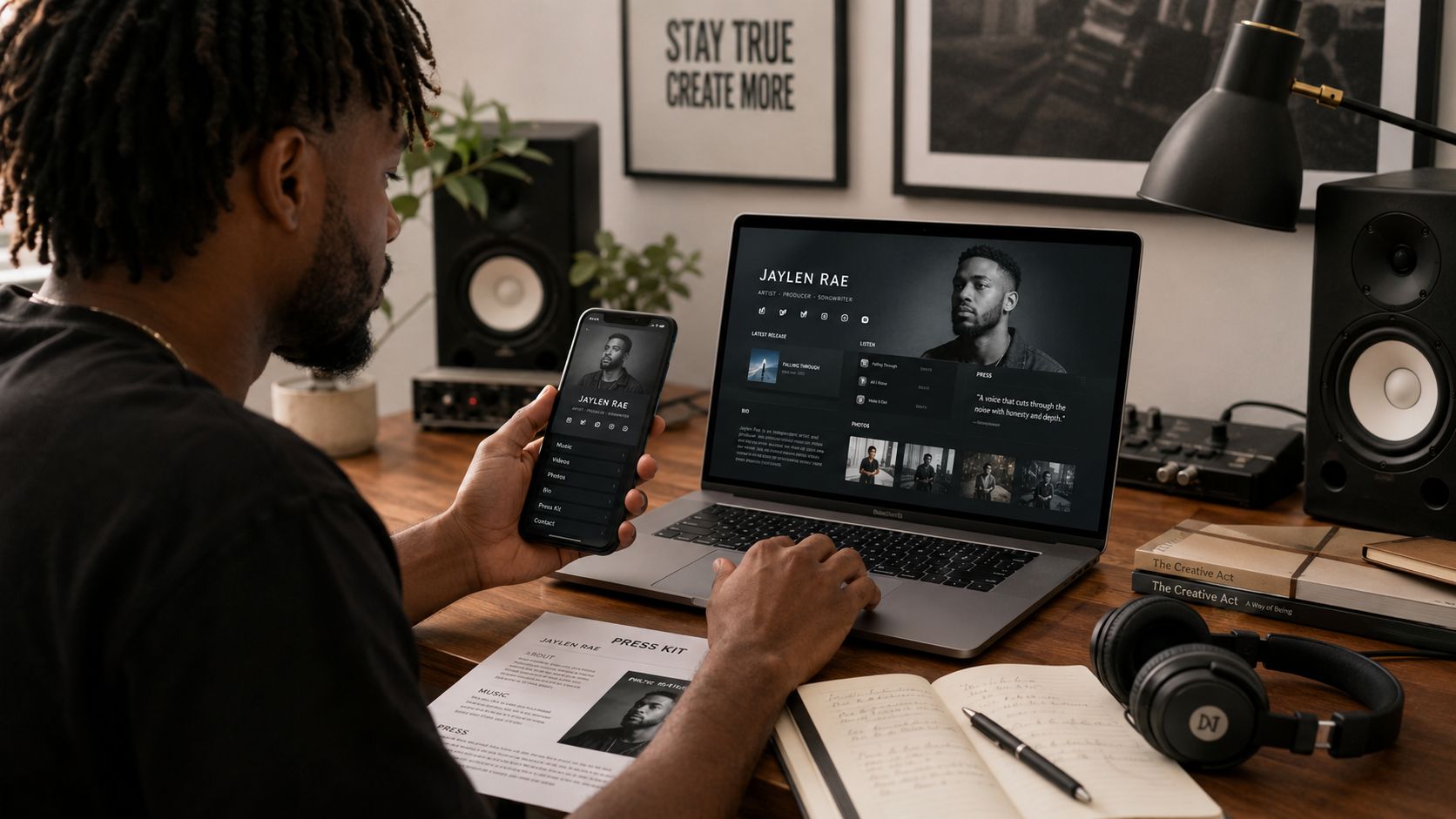
A proper press kit should include a clear artist biography, professional photos, official links, streaming links, social media links, press coverage, selected achievements, recent releases, contact information, and a short description of the artist’s sound. It does not need to be overloaded. It needs to be useful.
Curators, journalists, radio hosts, playlist owners, and music blogs do not have time to investigate every unclear profile. If an artist sends a track with no context, no image, no bio, and no official links, the submission starts with a handicap. If the artist provides a clean and professional identity, the music has a better chance to be taken seriously.
The press kit is not decoration. It is proof that the artist project exists beyond one uploaded file.
Consistency Beats Upload Volume
One of the biggest mistakes independent artists can make is confusing productivity with strategy. Releasing music often can be useful, but only if each release supports a clear artistic direction.
Uploading too much music without a coherent identity can make an artist look like a catalogue factory. This is especially risky now, because platforms are paying more attention to profiles that resemble industrial upload systems. A serious artist should not look like a random content pipeline.
Consistency is more powerful than volume. A clear sound, strong artwork, a release calendar, proper metadata, real social activity, and meaningful promotion create a stronger long-term signal than releasing tracks without direction.
The goal is not to feed the platforms. The goal is to build recognition.
Curators Will Become More Selective
Playlist curators are also affected by this shift. As AI-generated music, fake artists, unrelated submissions, and low-effort catalogues increase, curators must become more selective. A track can be well produced and still raise doubts if the profile behind it looks empty or artificial.
For independent artists, this means the submission process must become more professional. Send the right music to the right playlist. Respect the genre. Provide useful links. Avoid spam. Keep the message clear. Show that the project has a real identity.
Curators do not only listen to a track. They often look at the artist profile, artwork, social presence, and general credibility. A strong profile can support a good song. A suspicious profile can weaken it.
The New Independent Artist Checklist
Every independent artist should now think like a small media brand. That does not mean becoming fake or corporate. It means taking control of presentation, identity, and trust.
Claim and update all official artist profiles. Write a clear biography. Use consistent visuals. Link active social networks. Create a simple press kit. Keep official links organized. Avoid confusing artist names and messy metadata. Do not upload music without a release plan. Build a recognizable visual universe. Communicate like a real person, not like an automated campaign.
Most importantly, avoid anything that makes the project look like an upload factory. Too many disconnected releases, generic artwork, no public identity, vague descriptions, and artificial-looking activity can damage credibility.
Authenticity Is Becoming a Competitive Advantage
The good news is that real artists still have something AI catalogues cannot easily replace: human context. A story. A sound. A face. A scene. A creative journey. A relationship with listeners. A reason to exist.
As platforms increase verification and detection, authenticity becomes more than a romantic idea. It becomes a competitive advantage. Artists who can prove they are real, active, coherent, and connected to an audience will have stronger foundations in the next phase of streaming.
This does not guarantee success. A clean profile will not save a weak song. A press kit will not replace emotion. A visual identity will not create replay value by itself. But in a saturated market, these elements can make the difference between being ignored and being taken seriously.
The Bottom Line
The trend is clear. Streaming platforms want more control, more verification, and more separation between real artists, AI-generated content, suspicious profiles, and industrial catalogues.
For independent artists, the best response is not panic. It is professionalism. Build a strong profile. Keep social networks alive. Create a real visual identity. Prepare a clean press kit. Use official links. Communicate clearly. Release with intention. Protect the human value of the project.
The future of streaming will not only reward artists who upload music. It will reward artists who can be recognized, trusted, and remembered.
In an age where anyone can generate sound, the most powerful signal may be simple: a real artist, with a real identity, making music that actually means something.