
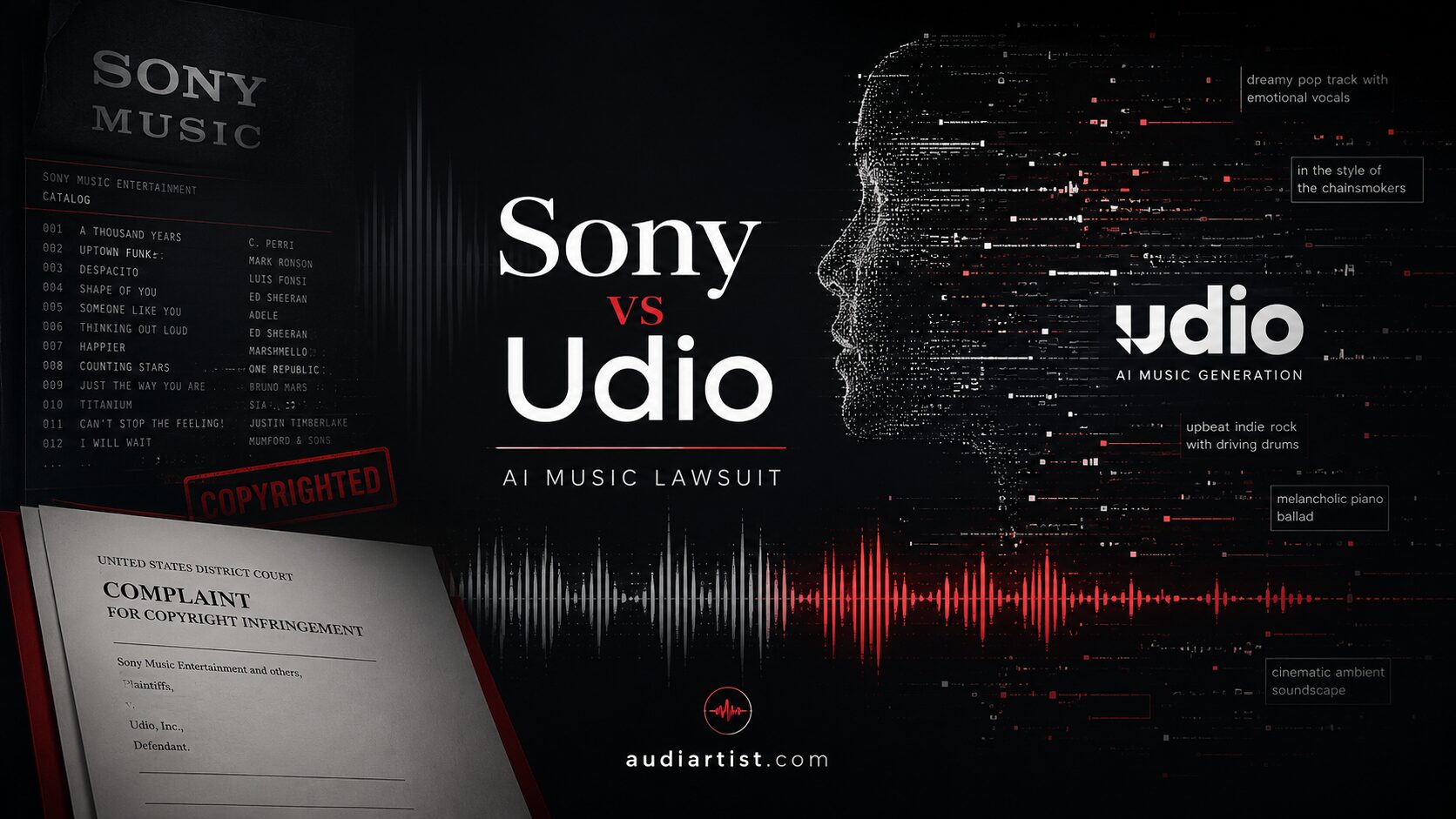

Sony Music Entertainment has opened a new front in the legal battle over generative artificial intelligence, filing a second copyright infringement lawsuit against Udio over the alleged unauthorized use of 30,117 sound recordings.
The complaint was filed on Monday, July 20, 2026, in the US District Court for the Southern District of New York. Sony claims that Udio copied and incorporated thousands of protected recordings into the datasets used to train its generative music models without obtaining permission from the relevant copyright owners.
The catalogue identified in the case spans several generations of popular music. Recordings associated with Beyoncé, Harry Styles, Britney Spears, Johnny Cash and Elvis Presley are among the works listed by Sony. Examples reportedly include Elvis Presley’s “Hound Dog,” Beyoncé’s “Say My Name” and Harry Styles’ “As It Was.”
However, Sony argues that the 30,117 recordings named in the complaint represent only a limited portion of the material that may have been used during Udio’s model training.
A Second Lawsuit Rather Than an Expanded Case
This new action is closely connected to the copyright lawsuit originally filed against Udio in June 2024. At that time, Sony Music, Universal Music Group and Warner Records accused Udio and rival platform Suno of using copyrighted recordings without authorization to develop commercial AI music generators.
The original case against Udio was built around a smaller group of recordings. During the discovery process, Sony gained access to information concerning Udio’s training data and says it used audio fingerprinting technology to identify a much larger number of matching recordings.
Sony subsequently attempted to add more than 30,000 works to the existing lawsuit. Judge Alvin K. Hellerstein rejected that request, concluding that introducing such a large volume of additional material near the end of document discovery would significantly expand the scope of the proceedings.
The ruling did not prevent Sony from pursuing separate legal action. Instead of abandoning the additional claims, the company has now placed 30,117 recordings at the centre of a second lawsuit.
Sony Alleges Music Was Extracted From YouTube
Among the most significant allegations in the new complaint is Sony’s claim that Udio obtained part of its training material by extracting audio from YouTube.
The label group alleges that Udio used the open-source downloading tool YT-DLP to retrieve recordings while circumventing technological measures designed to control access to content hosted on the video platform.
These claims remain allegations and have not yet been proven in court. Nevertheless, they could add another layer to the dispute. The case is no longer limited to the question of whether copyrighted music may be used for AI training under the US fair use doctrine. It may also require the court to examine how the recordings were acquired and whether access protections were bypassed in the process.
Udio Continues to Rely on Fair Use
Udio has previously acknowledged that its models were trained using large collections of sound recordings. The company has argued that this process qualifies as fair use under US copyright law.
This defence sits at the heart of several lawsuits involving generative AI companies. Developers argue that machine-learning systems analyse existing works in order to learn patterns and produce new material, rather than simply distributing copies of the original recordings.
Rights holders reject that interpretation when commercial models are built from protected catalogues without consent, attribution or compensation. They argue that AI companies should not be permitted to create subscription businesses and competing music products from recordings they did not license.
The court will therefore have to consider a question with consequences far beyond Udio: whether copying complete sound recordings for the purpose of training a commercial generative model can be protected as transformative fair use.
A Potential Multibillion-Dollar Case
Sony is seeking an injunction that would prevent Udio from continuing to infringe the recordings named in the complaint. The company is also requesting statutory damages of up to $150,000 for each work if the alleged infringement is found to have been willful.
Applied to all 30,117 recordings, that figure would create a theoretical maximum exposure of more than $4.5 billion. Such a total should not be interpreted as an expected award. Courts do not automatically apply the maximum amount to every work, and Sony would first need to establish infringement, ownership and the relevant level of intent.
Even so, the scale of the catalogue gives the new lawsuit considerable financial and strategic weight. It transforms what was already a major copyright dispute into one of the largest cases yet involving music and generative AI.
Sony Takes a Different Path From Universal and Warner
The lawsuit also exposes a growing strategic division between the world’s largest record companies.
Universal Music Group and Warner Music Group have settled their respective claims against Udio and entered licensing partnerships with the company. These agreements are intended to support the development of authorized AI music services in which protected catalogues can be used under negotiated commercial terms.
Sony has not reached a comparable agreement with Udio and remains the only major music company continuing to pursue the platform through litigation.
This does not necessarily mean that Sony opposes generative AI as a technology. Its position is better understood as a demand that authorization and licensing must come before a company uses copyrighted recordings to construct a commercial model.
Udio’s recent licensing deals may strengthen the broader industry argument that AI developers are capable of negotiating with rights holders. At the same time, the existence of those deals does not automatically establish that Udio’s earlier training practices were unlawful.
The Music Industry’s AI Conflict Is Entering a New Phase
The first wave of AI music disputes focused on proving whether commercial generators had been trained on copyrighted recordings. The next phase is likely to focus on scale, consent and compensation.
Major labels now have access to increasingly sophisticated audio fingerprinting systems, internal training records and evidence obtained through discovery. This may allow them to identify alleged training material with far greater precision than was possible when the first lawsuits were filed.
For artists and independent labels, the consequences are equally important. A legal framework built only around agreements between technology companies and major catalogue owners could leave smaller creators with limited bargaining power, even when their recordings have also contributed to the development of AI systems.
The case therefore concerns more than a dispute between Sony Music and Udio. It raises fundamental questions about who controls the recorded history of music, who may use that history to build new technology and how the people behind the original recordings should participate in the value created from them.
A Defining Test for Generative Music
No court has yet delivered a definitive answer to the central copyright questions surrounding commercial AI music training. Sony’s new lawsuit could become one of the most important tests.
If Udio succeeds with its fair use defence, AI developers may gain greater freedom to train models on existing music without negotiating individual licences. If Sony succeeds, companies could be required to secure permission before protected recordings are copied into training datasets.
Either outcome would reshape the emerging market for generative music.
For now, the contrast is striking. Universal and Warner are attempting to turn former legal opponents into licensed technology partners. Sony is asking a federal court to decide whether Udio’s original business was built on more than 30,000 unauthorized recordings.
The music industry has spent years debating whether artificial intelligence represents an opportunity or a threat. Sony’s latest complaint moves the discussion away from predictions and towards a more concrete question: who gave the machine permission to listen?