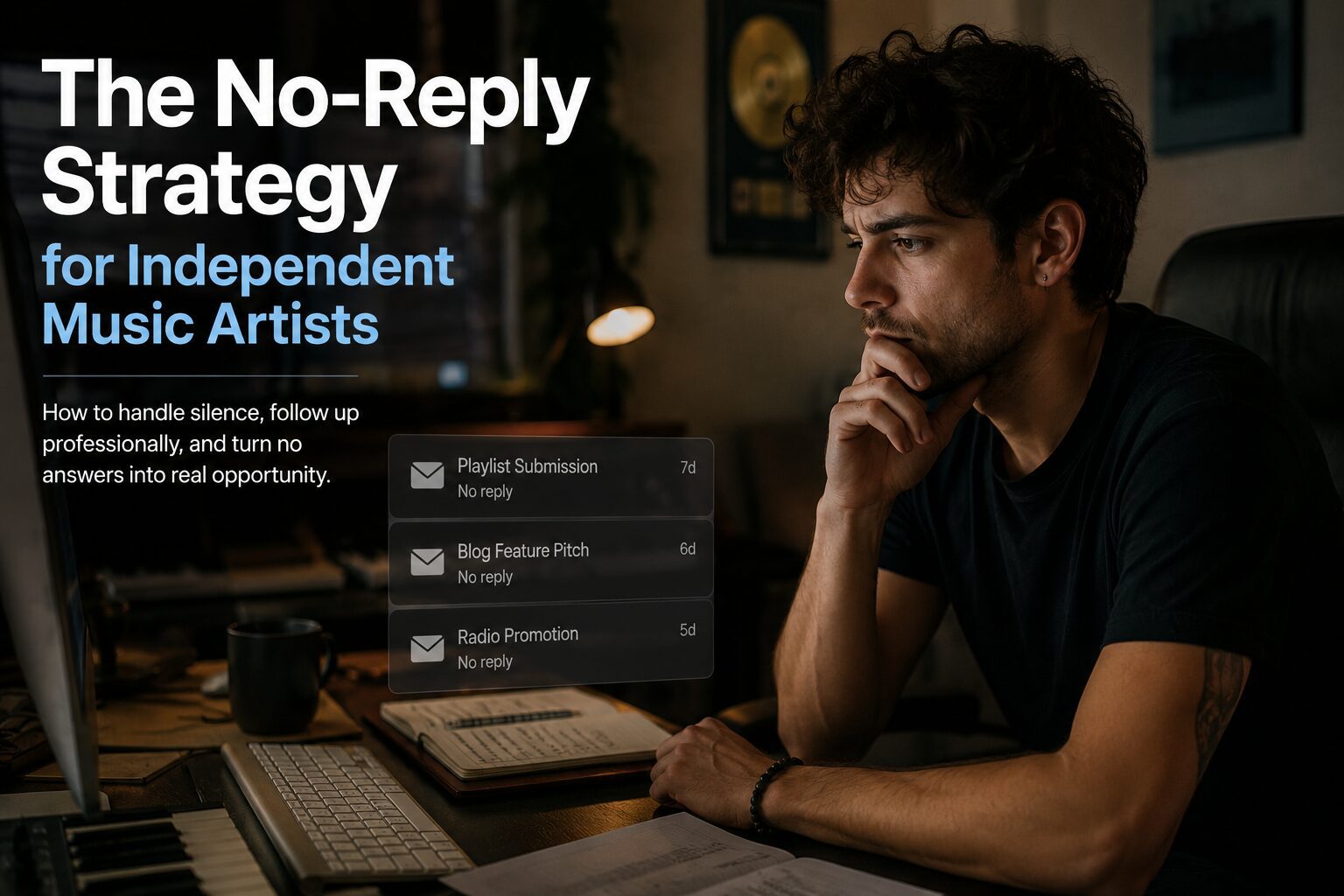

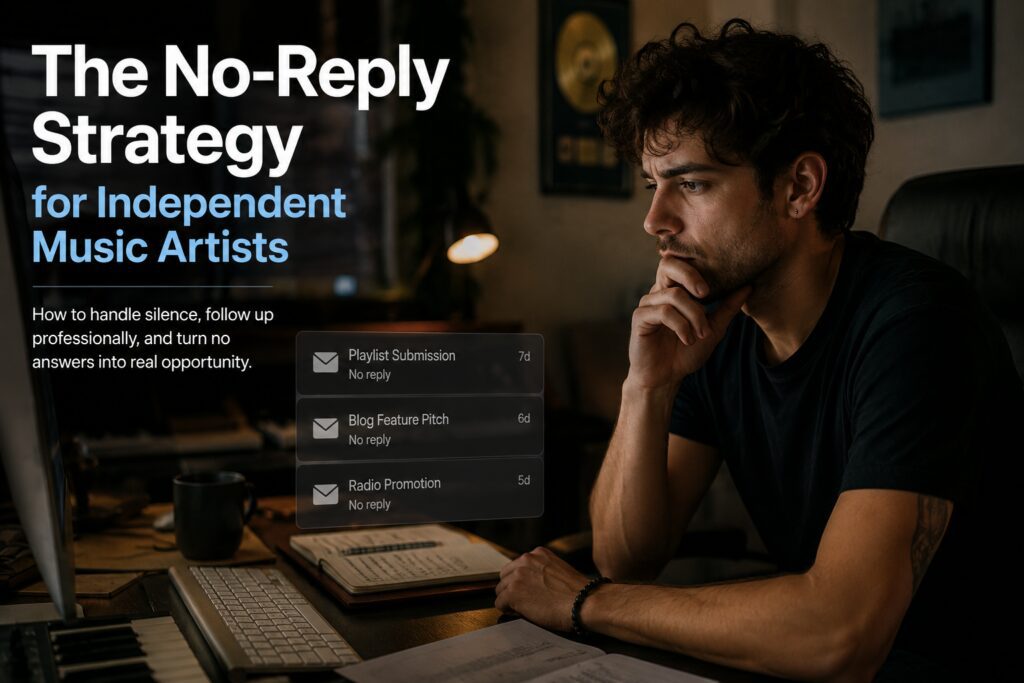
No answer from the playlist curator. No reply from the blog. No reaction from the radio host. No feedback from the label contact. No response from the influencer who asked artists to submit music. No acknowledgment from the media page that seemed perfect for the track. The email remains unopened, the DM sits in limbo, and the artist is left staring at a quiet inbox, wondering whether the music was ignored, rejected, lost, or simply never seen.
This is one of the least glamorous parts of music promotion, and one of the most common. Silence is not an exception. It is part of the independent artist’s daily reality. The problem is not only that nobody answers. The real problem is what artists do next.
Some panic and send the same message again too quickly. Some become bitter and assume the industry is closed. Some take silence as proof that the song is bad. Some stop pitching entirely. Others push harder, louder, and messier, until their outreach starts to feel desperate. None of these reactions build a stronger campaign.
A no-reply strategy is different. It treats silence as data, not humiliation. It gives artists a professional way to follow up, adjust the pitch, improve targeting, protect their confidence, and continue building momentum without begging for attention. In modern music promotion, knowing how to handle no answer is just as important as knowing how to pitch.
Silence Is Not Always Rejection
The first mistake artists make is assuming that no reply means no interest. Sometimes it does. Often, it does not. Curators, journalists, bloggers, radio hosts, playlist owners, music supervisors, and content creators receive more music than they can realistically process. A strong song can disappear inside a crowded inbox. A good pitch can arrive at the wrong time. A relevant submission can be missed because the recipient is overloaded, traveling, working on another campaign, or simply not checking that channel regularly.
This does not mean artists should excuse every silence or wait forever. It means they should avoid turning every unanswered message into an emotional verdict. No reply is a weak signal. It tells the artist that the pitch did not create a visible response. It does not automatically explain why.
The reason could be the song, but it could also be the subject line, timing, target, message length, link format, genre mismatch, lack of context, missing press assets, poor personalization, or simple inbox saturation. The artist’s job is not to guess dramatically. The job is to diagnose professionally.
Silence becomes useful when it pushes the artist to improve the system instead of attacking their own confidence.
Do Not Follow Up Too Fast
One of the quickest ways to damage a potential relationship is to follow up too aggressively. A message sent on Monday does not need another message on Tuesday morning asking whether the person has listened. Curators and media contacts do not work on an artist’s emotional schedule.
A good follow-up respects time. For most music promotion outreach, waiting five to seven days is reasonable. For larger media outlets, labels, sync contacts, or radio shows, a longer delay may be more appropriate. The key is to avoid sounding impatient.
The follow-up should be short, polite, and useful. It should not repeat the full original pitch. It should not guilt the recipient. It should not say, “I know you are busy, but…” followed by a long paragraph. It should simply remind them of the track, restate the fit, provide the link again, and make it easy to say yes or no.
A professional follow-up sounds calm because the artist is building a relationship, not chasing a rescue. The tone matters. People are more likely to respond to artists who make their work easier, not heavier.
The Follow-Up Should Add Value
A weak follow-up only asks, “Did you listen?” A stronger follow-up adds something useful.
That might be a new piece of context: the track has gained early saves, entered a few personal playlists, received radio interest, performed well in a specific country, or now has a new visualizer. It might be a sharper reason why the song fits the curator’s playlist or the blog’s editorial angle. It might be a shorter, cleaner version of the original pitch if the first message was too long.
The goal is not to invent hype. The goal is to make the second message more useful than the first. If the first pitch was broad, the follow-up can be more specific. If the first email was too emotional, the follow-up can be more practical. If the original message did not explain the song’s mood clearly, the follow-up can correct that.
A good follow-up should feel like a professional update, not a knock on a locked door.
Know When to Stop
Persistence is important. Harassment is not. After one respectful follow-up, most artists should stop unless there is a strong reason to continue. Sending five messages about the same song to the same person is rarely strategic. It usually creates resistance.
The goal is to remain memorable for the right reasons. A curator who does not answer this time may answer the next release if the artist behaves professionally. A blog that ignores one pitch may still become relevant later. A radio host who misses one track may respond when the artist sends a better fit months later.
Burning relationships over one unanswered message is a long-term mistake. The music world is smaller than it looks, especially inside niche scenes. Artists who communicate with patience and respect build a stronger reputation over time.
The no-reply strategy requires discipline. Sometimes the smartest move is to let the silence stand and move the campaign elsewhere.
Audit the Pitch Before Blaming the Song
When nobody answers, many artists immediately question the music. That may be necessary at some point, but it should not be the first conclusion. The pitch itself may be the problem.
A good music pitch should be clear in seconds. The recipient should understand who the artist is, what the track sounds like, why it fits, where to listen, and what action is being requested. If the message is too long, too vague, too dramatic, too generic, or too focused on the artist’s feelings, it may fail before the song is heard.
Subject lines matter. A subject like “New song out now” does very little. A more specific subject can help: “Melodic Afro house single for late-night electronic playlists,” or “Dark cinematic pop release with new video,” or “Lo-fi instrumental for study and chill playlists.” The goal is not to be flashy. The goal is to be useful.
The body of the message should also avoid empty claims. Words like “unique,” “amazing,” “powerful,” and “hit potential” are weaker than concrete description. A curator does not need to be told the song is great. They need to know where it fits.
If nobody answers, the artist should revise the pitch before sending the same message to more people. A bad pitch repeated widely does not become a campaign. It becomes noise.
Targeting Is Often the Real Problem
Many unanswered pitches happen because the target was wrong from the beginning. The playlist does not fit the song. The blog does not cover that genre. The radio show focuses on local artists only. The curator accepts submissions through a form, not DMs. The media outlet covers established acts, not emerging releases. The influencer uses music only for comedy clips, not music discovery.
Artists often think outreach is a numbers game. Send enough messages and someone will answer. There is some truth to volume, but poor targeting creates exhaustion. It also teaches the artist the wrong lesson. If a dark techno track is sent to acoustic folk curators, silence does not mean the track failed. It means the outreach was misaligned.
Better targeting starts with research. The artist should check recent playlist additions, blog categories, social content, submission guidelines, genre focus, mood, audience, country, and contact preferences. A few minutes of research can prevent a wasted pitch.
Music promotion becomes more effective when artists stop asking, “Who can I send this to?” and start asking, “Who is most likely to understand this?”
Build a Tracking System
Outreach without tracking quickly becomes chaos. Artists forget who they contacted, when they sent the message, what version of the pitch they used, whether they followed up, and whether the person replied later. This leads to repeated messages, missed opportunities, and emotional confusion.
A simple tracking document can solve this. It should include the contact name, platform, email or submission link, genre fit, date sent, pitch version, follow-up date, result, and notes. The notes are important because they help the artist improve over time. Did a certain subject line get more opens? Did personalized pitches receive more replies? Did small curators answer more often than large ones? Did one genre description work better than another?
This system turns silence into measurable information. If 50 pitches are sent and none receive a reply, the artist can investigate the pattern. If 10 carefully targeted pitches receive three answers, the artist learns that precision works. Without tracking, everything feels like a blur of rejection.
Professional artists do not rely on memory. They build systems.
Use Silence to Improve Your Assets
Sometimes nobody answers because the campaign does not look complete enough. A curator may like the song but see no clear artwork, no artist bio, no social presence, no visual identity, no press photo, no release context, and no easy link. The music may be promising, but the package feels unfinished.
Artists should ask whether the pitch contains everything needed for a quick decision. Is there a streaming link? Is there a private link if the track is unreleased? Is the artist name clear? Is the release date included? Is the genre accurate? Is there a short bio? Is there a clean image or artwork? Is the song’s mood described in one useful sentence?
A strong release proof folder can make outreach easier. It can include photos, artwork, bio versions, streaming links, press text, social links, lyrics, credits, and a short pitch. When these assets are ready, the artist looks more professional and the recipient has fewer reasons to ignore the message.
Silence can be a sign that the song needs better packaging, not necessarily better music.
Do Not Take Public Silence Personally
One of the hardest parts of independent music promotion is that artists often connect professional silence to personal worth. A quiet inbox feels like nobody cares. A non-reply feels like disrespect. A missed opportunity feels like proof that the project has no future.
This emotional spiral is dangerous because it leads to bad decisions. The artist may stop promoting too soon, change direction too quickly, overspend to compensate, or begin sending messages from a place of frustration. None of that helps the music.
A healthier mindset is to separate personal identity from campaign performance. The pitch did not receive a reply. That is a campaign result. It is not a full judgment of the artist’s talent, potential, or future. Even excellent artists receive silence. Even strong songs are ignored. Even professional campaigns face low response rates.
Independent artists need emotional resilience because promotion is filled with delayed reactions. A song may be ignored by one contact and loved by another. A curator may skip one release and support the next. A listener may see five posts before finally clicking. Silence today does not close every door tomorrow.
Create More Entry Points Instead of Sending the Same Link
If nobody answers, the solution is not always to send the same song link to more people. Sometimes the artist needs more entry points. A bare streaming link can be too cold, especially for someone who has never heard the artist before.
A new entry point could be a short live performance, a studio clip, a lyric video, a visualizer, a production breakdown, a story post, a behind-the-song article, a playlist feature, or a strong editorial image. Each asset gives the recipient a different way to understand the track.
This matters because not everyone connects through the same door. A playlist curator may care about genre fit. A blog may need a story. A radio host may need clean audio and a concise intro. A social media page may need a strong visual. A fan may need an emotional reason. A producer community may respond to the technical process.
The more useful entry points the artist creates, the less pressure sits on one generic pitch.
Turn No Reply Into Better Segmentation
Silence can reveal that the artist is speaking to too many different people in the same way. A playlist curator, a journalist, a DJ, a radio programmer, and a content creator do not need the same message. They may all receive the same song, but they need different reasons to care.
A curator wants to know where the track fits in a listening experience. A journalist wants an angle. A DJ wants energy, structure, and crowd context. A radio programmer wants sound quality, clarity, and audience relevance. A content creator wants a usable moment, visual compatibility, or emotional hook.
If the artist sends one universal pitch to everyone, the message may feel too vague for all of them. A no-reply strategy should include segmentation. The same release can be presented in different ways depending on the recipient.
This does not mean inventing different identities. It means highlighting the most relevant part of the track for each contact. Good promotion is not only about what the artist wants to say. It is about what the recipient needs to understand.
Keep Momentum Without External Validation
One of the biggest risks of unanswered outreach is that the artist starts waiting. Waiting for the blog. Waiting for the playlist. Waiting for the radio answer. Waiting for the curator. Waiting for someone else to validate the release before continuing the campaign.
This is a mistake. External support is valuable, but the artist should not freeze without it. While waiting for replies, the campaign should continue through owned channels: social content, direct audience updates, YouTube, website posts, newsletter messages, community engagement, local outreach, and follow-up content.
The artist can also use silence as a reason to strengthen the campaign from within. Create a new video. Tell the story behind the song. Share the best part of the track. Post a studio breakdown. Ask listeners a real question. Build a playlist around the mood. Publish a short article on the artist site. Contact a smaller but more relevant curator.
Momentum should not depend entirely on other people opening a door. The artist must keep building doors of their own.
When a Reply Finally Comes, Be Ready
Sometimes a response arrives late. A curator replies two weeks later. A blog asks for more information. A radio host wants a clean file. A playlist owner asks for the release date. A journalist requests a quote. This is where preparation matters.
Artists should be ready to answer quickly and professionally. If someone asks for assets, they should not wait three days to organize a photo. If a curator asks for a clean link, it should already exist. If a blog asks for a short bio, the artist should not send a messy autobiography. If radio requests a WAV file, the artist should know where it is.
The no-reply strategy is not only about handling silence. It is about being prepared when silence breaks. Opportunities often arrive with limited patience. A professional response can turn a delayed reply into real support.
Measure Response Quality, Not Only Response Quantity
Not every reply is valuable. Some responses are vague, automated, irrelevant, or connected to suspicious paid offers. Artists should not treat every answer as a good sign. A serious music promotion strategy must distinguish between quality and noise.
A valuable reply usually shows that the person listened, understood the style, asked a relevant question, offered a clear opportunity, or gave useful feedback. A weak reply may push a paid placement, guarantee streams, or use generic language that could apply to any song.
The goal is not simply to receive more answers. The goal is to receive better answers from better-matched contacts. This is why targeting, pitch clarity, and professionalism matter more than mass messaging.
A campaign with five thoughtful replies can be more useful than one hundred empty messages sent into the void.
The Professional Way to Move On
At some point, the artist has to move on from unanswered pitches. This does not mean giving up on the song. It means reallocating energy. After the initial pitch and one follow-up, the artist should update the tracking sheet, note the result, and continue the campaign elsewhere.
Moving on professionally keeps the door open. The artist can contact the same person later with a future release, especially if the next song is a better fit. There is no need for bitterness, passive-aggressive posts, or frustrated messages. Silence does not require a public reaction.
The best artists learn how to leave space behind them cleanly. They do not turn every quiet contact into an enemy. They understand that music promotion is a long game, and today’s no-reply may simply be part of tomorrow’s relationship.
Silence Is Part of the System
Every independent artist will face unanswered messages. The difference is how they interpret them. Silence can create insecurity, or it can create better strategy. It can make the artist louder, or it can make the artist clearer. It can lead to resentment, or it can lead to sharper targeting, stronger assets, better follow-ups, and more professional outreach.
The no-reply strategy gives artists a healthier way to work. Send the pitch. Wait with patience. Follow up once with value. Track the result. Improve the message. Refine the targets. Strengthen the assets. Keep the campaign moving. Stop when it is time. Return later with better music and a better fit.
No answer is not the end of the release. It is one signal inside a larger campaign.
The artists who survive silence are not the ones who feel nothing. They are the ones who learn how to keep moving without letting the quiet decide their future.
Discover more independent music promotion strategies, artist resources, and playlist insights on Audiartist.