
Free Analog Synth Plugin
PolyMAX Synth: A Free Analog-Style VST by Universal Audio
Warm oscillators, flexible filters, vintage modulation and studio-quality effects inside an intuitive polyphonic synthesizer for Windows and macOS.
PolyMAX Synth is a vintage-inspired virtual instrument developed by Universal Audio. Previously sold as a commercial UAD instrument, the complete synth is now included permanently in the free UAD Explore FREE bundle.
This is not a restricted edition or a temporary trial. PolyMAX includes its full synthesis engine, factory presets, arpeggiator, modulation system and internal effects. It runs natively on a Windows or macOS computer without requiring an Apollo interface or other Universal Audio hardware.
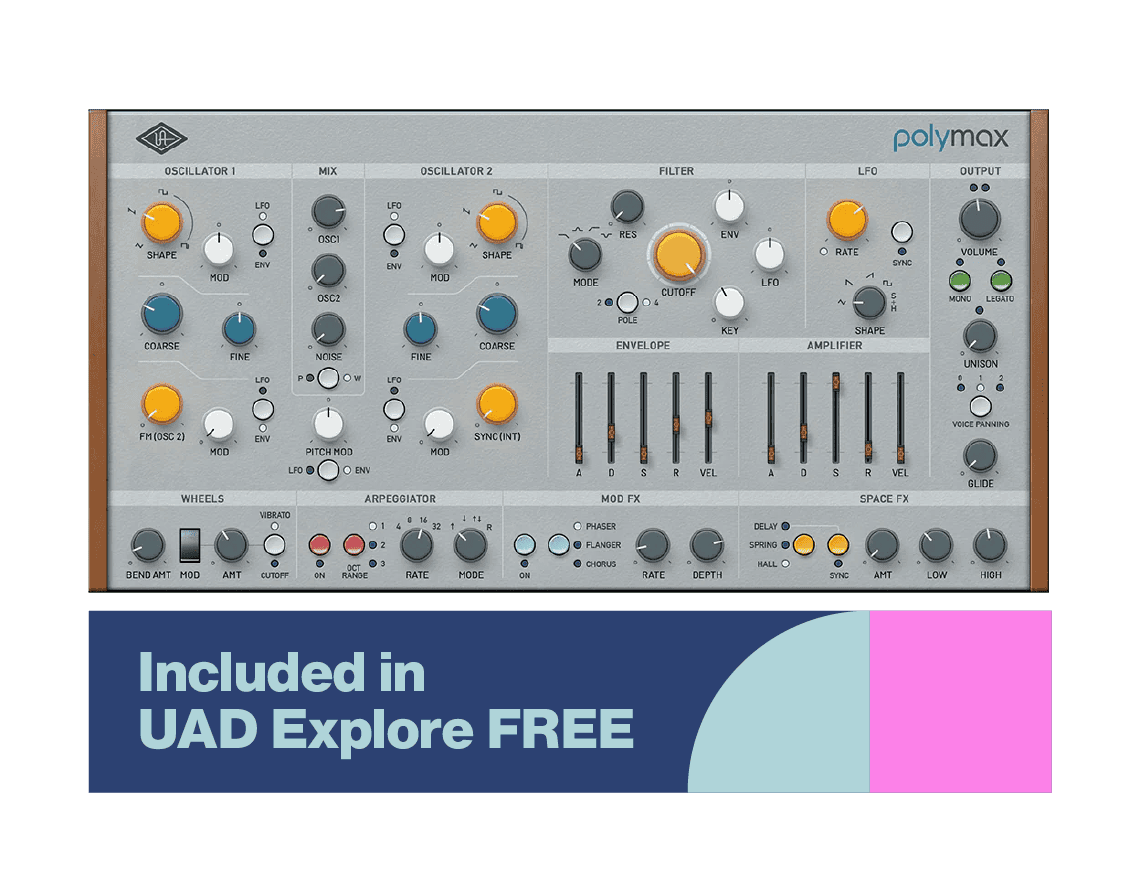
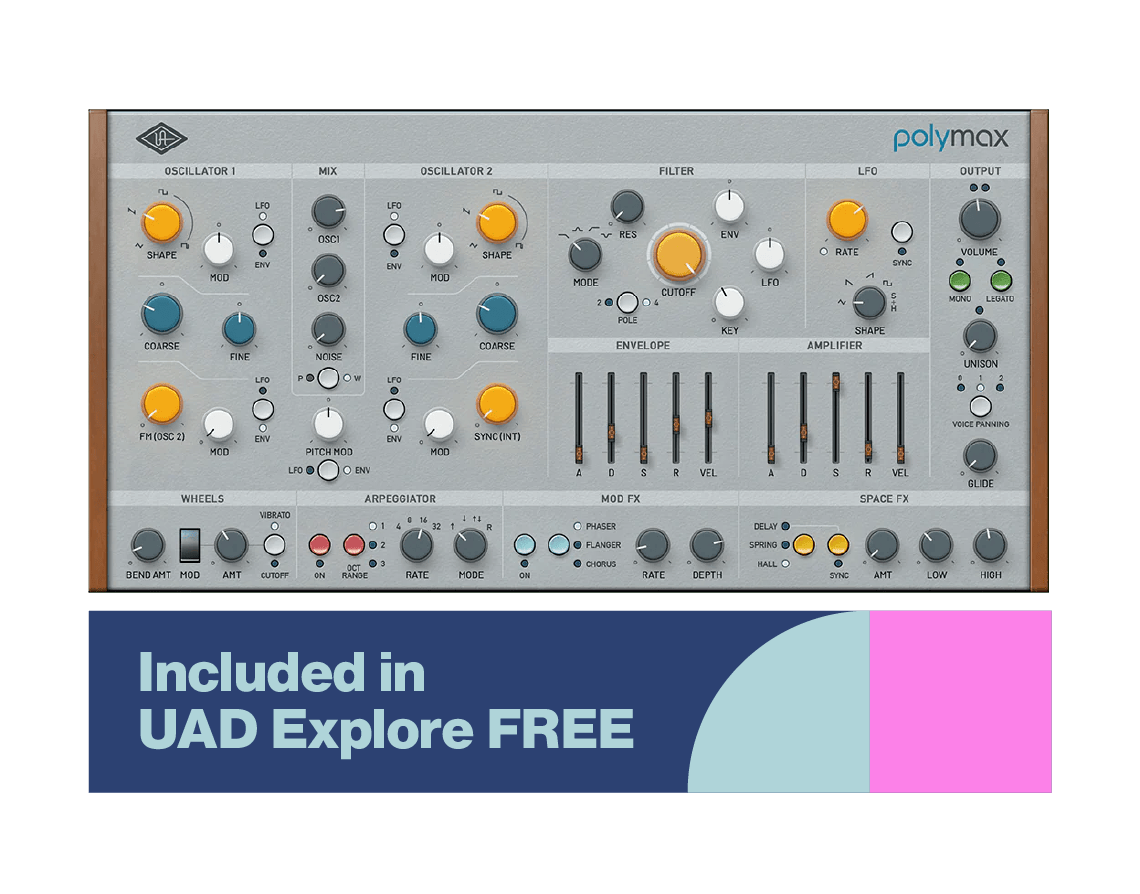
The instrument is designed around a direct knob-per-function interface. Producers can build basses, leads, keys, pads, brass sounds, plucks and cinematic textures without moving through several pages of menus.
| Developer | Universal Audio |
|---|---|
| Plugin type | Analog-modeled polyphonic synthesizer |
| Voice count | Up to 8 voices |
| Sound sources | Two oscillators and white or pink noise |
| Synthesis features | FM, oscillator sync, unison, glide and modulation |
| Built-in effects | Chorus, flanger, phaser, tape delay, spring reverb and digital hall |
| Platforms | Windows and macOS |
| Formats | VST3, Audio Unit and AAX |
| Price | Free through UAD Explore FREE |
Two Analog-Modeled Oscillators
PolyMAX uses two analog-modeled oscillators with continuously variable wave shapes. Each oscillator can move between triangle, sawtooth, square and narrower pulse waveforms.
The oscillators provide coarse and fine tuning controls, while a separate noise generator offers white or pink noise. These sources can be mixed to create classic analog basses, warm pads, bright leads and percussive keys.
Oscillator 1 can receive linear frequency modulation from Oscillator 2. This introduces metallic harmonics, bells, digital textures and more aggressive tones while retaining the warmer character of the analog-modeled signal path.
Oscillator sync is also available. Sweeping or modulating the sync amount can create sharper harmonics, animated leads and sounds associated with classic synthesizer solos.
Flexible Multimode Filter
The filter section includes low-pass, band-pass, high-pass and notch modes. Producers can also switch between two-pole and four-pole slopes.
The two-pole setting provides a gentler response that can preserve more brightness. The four-pole mode creates a steeper and more pronounced filter character for deeper basses, resonant sweeps and traditional analog-style patches.
Cutoff can respond to the dedicated envelope, keyboard position and modulation system. High resonance settings allow the filter to produce its own pitched tone, opening additional possibilities for sound effects and experimental patches.
Envelopes and Modulation
PolyMAX contains separate ADSR envelopes for amplitude and modulation. The second envelope can control filter cutoff, oscillator pitch, FM amount and oscillator sync.
A dedicated LFO provides triangle, ramp, square and sample-and-hold waveforms. Its rate can run freely or synchronize with the DAW tempo from four bars to rapid 1/128-note movement.
These tools can create slow pad movement, pulse-width modulation, vibrato, filter sequences, pitch effects and evolving digital textures.
The modulation architecture is more focused than a large modular synthesizer, but the main destinations remain visible and easy to adjust. This helps producers design sounds without turning the session into a research project.
Eight Voices, Unison and Glide
PolyMAX can play up to eight voices simultaneously. Its polyphonic mode is suitable for chords, pads, keys and brass-style sounds.
Mono mode activates legato and glide controls for basses and lead lines. Unison stacks all eight voices into a single note and introduces adjustable detuning.
Low unison values add weight and width, while stronger settings create more obvious movement and dissonance. Voice-panning options can distribute individual notes across the stereo field.
Universal Audio also models small variations between voices, helping repeated notes feel less mechanically identical.
Built-In UAD Effects
The modulation section includes chorus, flanger and phaser effects. Each mode provides rate and depth controls for adding width and movement.
The Space section offers tape delay, spring reverb and a digital Hall B reverb. Delay time can synchronize with the project tempo, while the reverbs provide compact controls for adjusting their size and tone.
These effects are integrated directly into the preset system. Producers can therefore create finished synth sounds without loading several additional plugins after PolyMAX.
Tempo-Synchronized Arpeggiator
The built-in arpeggiator converts held chords into repeating note patterns synchronized with the DAW tempo.
Available directions include up, down, up-and-down and random. Patterns can extend across one, two or three octaves, with rhythmic divisions ranging from quarter notes to 1/32 notes.
This makes PolyMAX useful for Synthwave bass sequences, House arpeggios, cinematic pulses and electronic Pop arrangements.
Best Uses
- Analog-style basses and leads
- Synthwave and retro electronic music
- House, Pop and melodic EDM
- Warm pads and cinematic textures
- Plucks, keys and brass-style sounds
- Tempo-synchronized arpeggios
- Vintage modulation and tape-delay effects
- Fast preset-based production
Compatibility and Installation
PolyMAX runs natively on 64-bit Windows 10 or Windows 11 systems and on macOS Big Sur 11 or later. Intel, AMD and Apple Silicon processors are supported.
The plugin is available in VST3, Audio Unit and AAX formats, depending on the operating system and DAW. No Universal Audio interface or DSP hardware is required.
To claim PolyMAX, register for UAD Explore FREE on the Universal Audio website. A short questionnaire, a Universal Audio account, UA Connect and a free iLok account are required.
No physical iLok USB key is necessary. The perpetual license can be activated in up to three locations, including computers or compatible iLok devices.
Universal Audio gives users 90 days to redeem and download UAD Explore FREE after registration. Once activated, PolyMAX remains available without a subscription or trial expiration.
Main Limitations
- Universal Audio and iLok accounts are required
- Installation must be completed through UA Connect
- No Linux version is available
- No standalone application is listed
- The instrument is limited to eight voices
- The modulation system is less extensive than a modular synthesizer
- Registration must be followed by redemption within 90 days
Final Verdict
PolyMAX Synth is one of the strongest commercial instruments to become permanently free through an official developer bundle.
Its analog-modeled oscillators, multimode filter, FM, oscillator sync, modulation tools, arpeggiator and high-quality effects provide enough flexibility for complete electronic productions.
The interface remains approachable, with important controls presented on one main panel rather than hidden behind a complicated modulation matrix.
The requirement for UA Connect and iLok adds several installation steps, but the result is a full unrestricted synthesizer rather than a limited promotional edition.
For producers seeking warm analog-style sounds without adding another payment to the plugin budget, PolyMAX is a serious free instrument that deserves more than a quick preset tour.