Free FM Synth Plugin
OctaSine: A Free FM Synth With Stereo Modulation
Four flexible operators, tempo-synced modulation and spatial FM sound design for electronic music, ambient textures and digital synthesis.
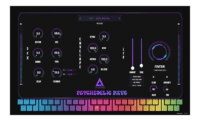
OctaSine is a free and open-source frequency modulation synthesizer developed by Joakim Frostegård. It provides four FM operators, flexible routing, individual envelopes and four modulation oscillators inside a clean interface designed for modern music production.
The instrument is available for Windows, macOS and Linux. It can be loaded in compatible DAWs as a VST2 or CLAP plugin, with no account, license key, subscription or online activation required.
OctaSine is particularly interesting for producers who want to explore FM synthesis without working through the complex algorithm diagrams and extensive menus found in some classic digital synthesizers.
| Developer | Joakim Frostegård |
|---|---|
| Plugin type | Frequency modulation synthesizer |
| Current version | 0.9.1 |
| Platforms | Windows, macOS and Linux |
| Plugin formats | VST2 and CLAP |
| FM operators | Four stereo operators |
| Modulation | Four LFOs with tempo sync, loop and one-shot modes |
| License | GNU AGPLv3 open-source license |
| Price | Free |
Four Flexible FM Operators
OctaSine uses four independent operators that can generate sine, square, triangle, sawtooth or noise waveforms.
Each operator provides controls for volume, panning, feedback and frequency. Frequency can follow a ratio relative to the played note or operate through free and fine-tuning modes for less conventional sounds.
The operators can modulate each other through a flexible routing system. They can also send part of their signal directly to the output, making it possible to combine frequency modulation with additive synthesis.
This flexibility can produce clean electric keys, metallic bells, digital basses, sharp percussion, evolving pads and deliberately unstable experimental tones.
Visual Feedback for FM Sound Design
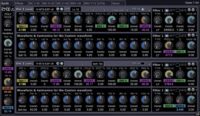
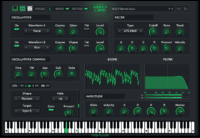
Frequency modulation can become difficult to understand when several operators interact. OctaSine provides stereo waveform displays that show the result of the modulation occurring inside each operator.
This visual feedback helps users connect parameter changes with the resulting waveform. Increasing feedback, changing a modulation amount or switching a waveform produces an immediate visible response.
The interface therefore makes FM synthesis more approachable without removing the depth required for detailed sound design.
Stereo Modulation Panning
One of OctaSine’s most distinctive features is modulation panning. The modulation generated by an operator can be positioned inside the stereo image rather than affecting both channels in exactly the same way.
This can create moving harmonics, asymmetric textures and sounds that change differently on the left and right sides.
The instrument also uses true stereo panning instead of simple balance control. Producers can therefore design width directly inside the synthesis engine rather than depending entirely on chorus or stereo-imaging effects.
Subtle settings can add movement to pads and keys, while stronger differences can create more experimental spatial effects.
Four LFOs With Tempo Sync
OctaSine contains four low-frequency oscillators with several waveform choices. Each LFO can operate in a continuous loop or as a one-shot modulation source.
The modulation rate can run freely or synchronize with the host DAW tempo. This makes it possible to create rhythmic timbral changes, synchronized pulses and repeating stereo movement.
LFOs can control most operator parameters and can also modulate selected parameters belonging to lower-numbered LFOs. This allows one modulation source to change the behavior of another over time.
These interactions are useful for evolving ambient patches, animated basses and digital textures that do not repeat in an entirely static way.
Individual ADSR Envelopes
Every operator has its own attack, decay, sustain and release envelope. This allows each component of the sound to develop independently.
A short modulator envelope can create a bright transient at the beginning of a note, while a longer carrier envelope maintains the body of the sound.
Separate envelopes are especially important in FM synthesis because the harmonic content can change throughout the note. A patch can begin with a sharp metallic attack and gradually become softer without requiring an additional filter.
Envelope groups make it easier to adjust related values together when several operators need similar timing.
Useful for Modern Electronic Music
OctaSine can create sounds suited to Techno, Ambient, IDM, Synthwave, House, Drum and Bass, experimental Pop and game music.
FM basses can provide strong upper harmonics while keeping a stable fundamental frequency. Bells and mallet sounds can cut through dense arrangements, while slower envelopes produce atmospheric digital pads.
Noise operators can add breath, percussion or texture. Strong feedback values can create distortion-like harmonics without loading a separate effect.
The instrument is capable of sounding clean and controlled, but it can become considerably stranger once several LFOs start modulating the routing. FM synthesis remains perfectly civilized until one knob convinces the others to form a committee.
Best Uses
- FM basses and digital leads
- Metallic bells and mallet sounds
- Evolving ambient pads
- Experimental stereo textures
- Electronic percussion and effects
- Techno, IDM and game music
- Tempo-synchronized modulation
- Learning frequency modulation synthesis
Compatibility and Installation
The official macOS download supports 64-bit Intel and Apple Silicon computers. VST2 and CLAP versions are included.
Windows users need a 64-bit installation of Windows 10 or Windows 11. The plugin is supplied as VST2 and CLAP files that must be copied into the appropriate plugin directories.
Linux support is available for 64-bit X11 systems. The developer recommends compiling the plugin from source, although a prebuilt Ubuntu 20.04 package is also provided and may work on compatible distributions.
No account, installer manager, license key or online activation is required.
Main Limitations
- No VST3 version is currently available
- No Audio Unit or AAX edition is provided
- Some modern DAWs no longer support VST2 plugins
- CLAP support depends on the selected DAW
- Linux installation may require compiling from source
- macOS users may need to remove the quarantine attribute manually
- The plugin remains below version 1.0
- No internal effects section is listed
Final Verdict
OctaSine is a distinctive free synthesizer for producers who want a clearer and more visual approach to frequency modulation.
Its four operators, flexible routing, individual envelopes and four LFOs provide enough depth for serious sound design. Stereo modulation panning gives the instrument an identity that separates it from many conventional FM synthesizers.
The absence of VST3 and Audio Unit formats will limit compatibility with certain DAWs, but CLAP support provides a modern alternative on compatible hosts.
For Windows, macOS and Linux producers interested in digital basses, metallic instruments, evolving pads and experimental stereo sounds, OctaSine is a valuable open-source download.