
Push and Groove has released RMS LEVEL LIMITER, a free dynamics plugin designed to control average signal energy rather than reacting only to short transient peaks.
Released in July 2026, the plugin combines an RMS-based gain-reduction stage with independent Safe Level peak control. It can be used on vocals, podcasts, drum buses, synthesizers, loops and stereo master outputs.
What Is RMS LEVEL LIMITER?
RMS LEVEL LIMITER is a free stereo audio effect developed by Push and Groove.
A conventional peak limiter reacts to instantaneous level spikes. This plugin instead measures average RMS energy over a selected period and applies smoother gain reduction to the body of the sound.
An additional Safe Level stage catches peaks that remain after the RMS processing.
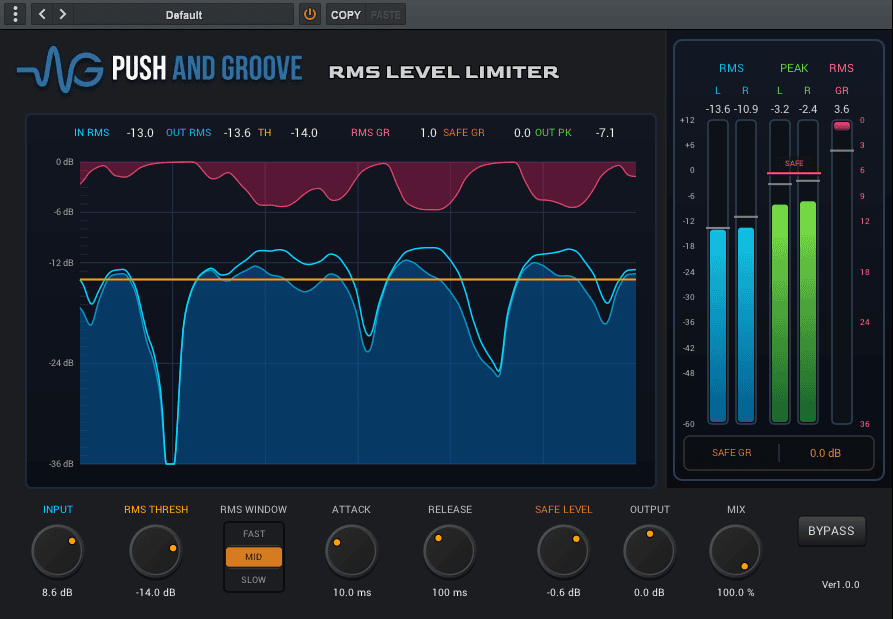
Three RMS Window Modes
The RMS Window setting determines how quickly the detector responds.
- FAST, 50 ms: Designed for drums, bass, percussion and rhythmic material
- MID, 300 ms: A general starting point for vocals, guitars and music production
- SLOW, 600 ms: Intended for pads, sustained sounds, buses and master output
FAST follows changes more closely, while SLOW creates smoother long-term leveling.
Main Controls
- Input gain
- RMS Threshold
- FAST, MID and SLOW RMS windows
- Attack and Release
- Safe Level peak control
- Output gain
- Dry and wet Mix
- Bypass
The Mix control makes parallel processing possible. Producers can apply stronger RMS reduction and blend part of the untreated signal back into the output.
Detailed Metering
The interface displays RMS levels for the left and right channels, peak levels, RMS gain reduction, Safe Level gain reduction and final output peak.
Keeping the RMS and safety stages visible separately helps producers understand whether the plugin is controlling average energy, occasional peaks or both.
Best Uses for RMS LEVEL LIMITER
- Stabilizing podcast and narration levels
- Smoothing inconsistent vocal recordings
- Controlling changing synth and loop density
- Leveling drum buses without chasing every transient
- Applying gentle RMS control on a stereo mix
- Creating parallel dynamics processing
A Practical Starting Workflow
Begin with the MID window and lower the RMS Threshold until the gain-reduction meter moves gently.
Adjust Attack and Release so that the source retains its natural movement. Set Safe Level to control the remaining peaks, then compare the processed and original signals at similar output levels.
For drums and bass, switch to FAST if the MID window feels too slow. For pads, sustained instruments and complete mixes, SLOW can provide a more stable response.
Safe Level Is Not a True Peak Limiter
The Safe Level stage controls peaks that remain after RMS reduction, but the developer states that it does not necessarily guarantee true peak compliance.
For streaming, broadcast or other strict delivery requirements, producers should verify the final result with a dedicated LUFS and true peak meter.
Plugin Formats
- Windows: VST3
- macOS: Audio Unit
- Channel configuration: Stereo
- Plugin type: RMS dynamics and limiter effect
A compatible DAW or plugin host supporting the supplied format is required.
No macOS VST3, Windows Audio Unit, AAX, CLAP or Linux version is currently listed on the official page.
Installation
Windows users can copy the VST3 file into the standard system folder:
C:\Program Files\Common Files\VST3
macOS users can copy the Audio Unit component into the user or system Components folder, then restart or rescan the DAW.
Some macOS builds may require manual approval through Privacy & Security if Gatekeeper blocks the plugin.
Free Download
RMS LEVEL LIMITER version 1.0.0 is available as a free download from the official Push and Groove website.
Download RMS LEVEL LIMITER from Push and Groove
Final Verdict
RMS LEVEL LIMITER is a focused free plugin for producers who need smoother control over average signal energy.
Its three RMS windows, independent peak-safety stage, parallel Mix control and detailed metering make it useful for vocals, spoken content, drums, synths, loops and gentle bus processing.
It is not a replacement for a dedicated true peak mastering limiter, but it provides a practical and musical approach to RMS-based dynamics control.