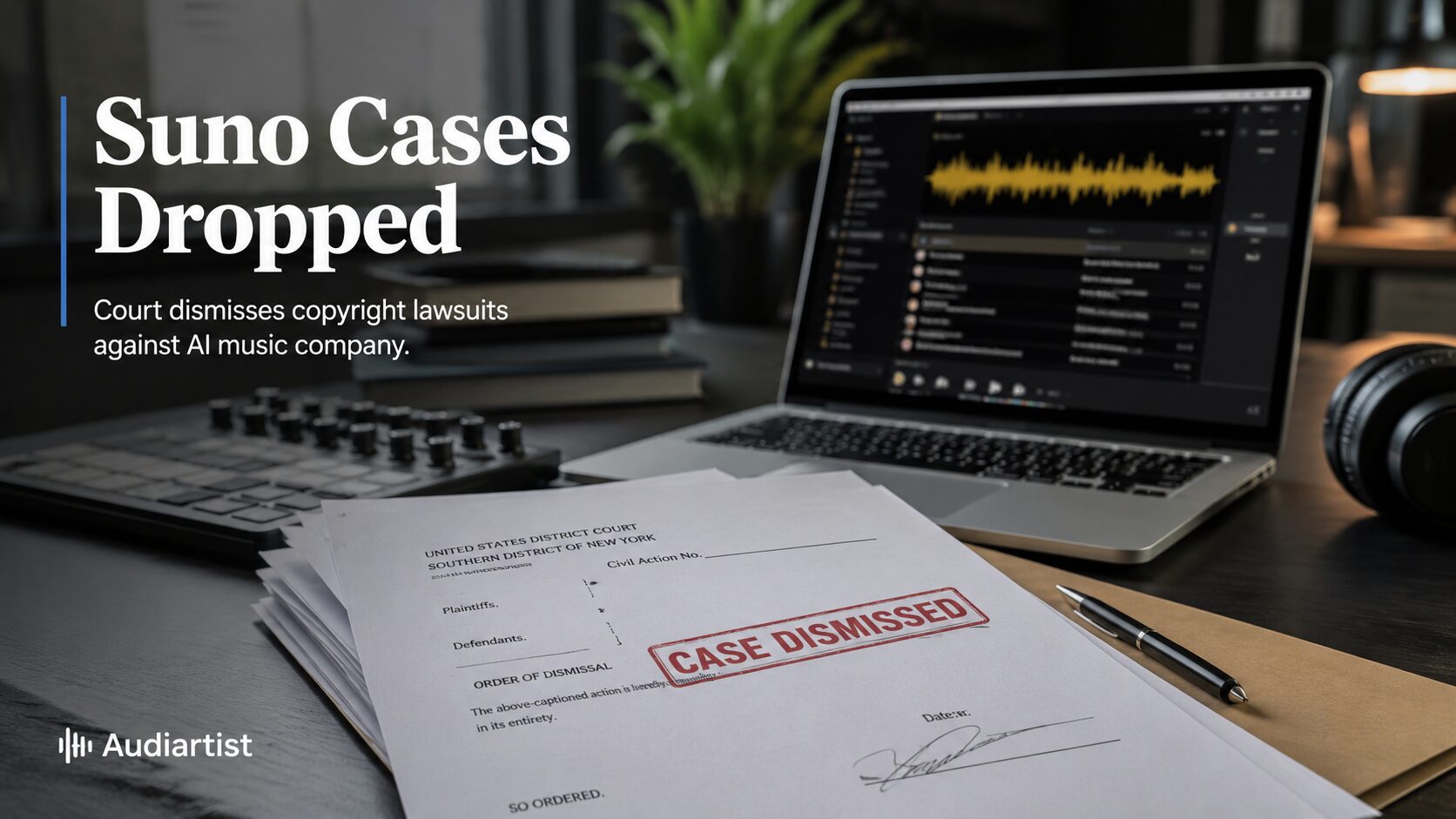

Two separate copyright cases against AI music company Suno have abruptly ended, just as the company is reshaping its policies and signing new licensing deals with the music industry. But the dismissals are very different, and neither proves that Suno won the underlying copyright debate.
Two copyright lawsuits targeting Suno have been voluntarily dropped within days of each other, adding another unexpected twist to the rapidly changing legal battle surrounding generative AI music.
The cases were brought separately by instrumental music duo The American Dollar, operating through Poseidon Wave Media, and by Jamendo, the music licensing company owned by Winamp Group. Both had accused Suno of using copyrighted music without authorization in connection with the development of its generative AI technology.
Neither plaintiff has publicly explained why it decided to terminate its case. That absence of explanation is precisely what makes the development interesting.
Key Facts
- The American Dollar dismissed its case with prejudice, meaning the same claims cannot simply be refiled.
- Jamendo dismissed its lawsuit without prejudice, leaving open the possibility of bringing the case again.
- No public explanation for either dismissal has been provided.
- Jamendo had sought at least €17.8 million in damages and profits.
- Suno still faces major copyright disputes elsewhere, so these dismissals do not end its legal exposure.

Photo: RDNE Stock project / Pexels
The Two Dismissals Are Not the Same
The legal distinction between the two withdrawals is important.
The American Dollar’s action was dismissed with prejudice. In practical terms, that closes the door on refiling the same case. Jamendo, by contrast, withdrew its lawsuit without prejudice, which generally leaves it free to pursue the claims again later.
This means headlines suggesting that Suno has suddenly defeated two copyright challengers would be misleading.
There has been no court judgment clearing Suno in either case. No judge ruled that its AI training practices were lawful. The plaintiffs themselves chose to stop the proceedings.
And crucially, the public dismissal notices do not explain why.
What We Do Not Know
There is currently no public evidence establishing that Suno paid a settlement, reached a private licensing agreement or offered another concession to either plaintiff. Those possibilities may naturally attract speculation, but without documentation or statements from the parties, they remain speculation.
The American Dollar Had Accused Suno of Using 236 Protected Works
The American Dollar’s litigation was not a minor complaint.
According to reporting on the amended case, Poseidon Wave Media alleged that Suno had ingested 236 copyrighted recordings and compositions connected to the duo when training its generative models. The plaintiffs argued that AI-generated outputs could devalue and substitute traditional human-created music.
The fact that the case has now been dismissed with prejudice makes the lack of explanation particularly notable.
An attorney representing The American Dollar told Digital Music News that neither he nor his client was able to comment on the development.
That silence does not prove the existence of a private agreement. It simply leaves one of the most obvious questions unanswered: why permanently abandon a case that had recently been amended and appeared to be moving forward?
Photo: Brett Sayles / Pexels
Jamendo’s Case Raised a Different and Potentially Significant Question
Jamendo’s lawsuit focused heavily on a dataset originally created for research purposes.
The company alleged that Suno had improperly used material from the MTG-Jamendo Dataset, which contains more than 55,000 tracks. Jamendo said the dataset had been made available for non-commercial research and that commercial exploitation required a separate paid license.
The complaint alleged that an early model connected to Suno’s development had been trained partly on approximately 919 hours of Jamendo audio. Jamendo accused Suno of copyright infringement, breach of contract, unjust enrichment and unfair business practices.
Jamendo said it had previously invoiced Suno for the disputed use and ultimately sought an injunction along with actual damages and profits of at least €17.8 million.
Now that case has also disappeared, at least temporarily.
Because the dismissal is without prejudice, however, Jamendo retains more legal flexibility than The American Dollar. It could theoretically return to court depending on future developments.
The Timing Is Difficult to Ignore
The dismissals come during a remarkable transformation at Suno.
Over recent months, the company has moved toward a more industry-friendly model, introducing stronger transparency measures, watermarking and fingerprinting plans, tighter download policies and a growing number of commercial relationships with music rights holders.
Suno has also moved into licensed partnerships, including its agreement with Warner Music Group and its newly announced global alliance with BMG.
It would therefore be tempting to connect the lawsuit withdrawals directly to Suno’s broader policy overhaul.
But that connection has not been demonstrated publicly.
The timing can reasonably be described as notable. It cannot yet be described as proof that a settlement or licensing agreement caused either dismissal.
Audiartist Analysis
The real story is not that Suno has “won.” The real story is that the legal environment around Suno is becoming increasingly fragmented: some rights holders are fighting it, others are licensing it, some have settled, and now two plaintiffs have voluntarily stepped away without publicly explaining why.
Suno’s Copyright Problems Are Far From Over
Anyone interpreting the two dismissals as the end of Suno’s copyright troubles would be mistaken.
Universal Music Group and Sony Music remain involved in substantial US litigation with Suno. Digital Music News reported that the parties were still participating in discovery-related proceedings this week.
There are also artist-led class actions involving a growing number of musicians, producers and songwriters.
And in Germany, Suno recently suffered a significant legal defeat against collecting society GEMA. On July 31, a Munich court ruled that Suno had infringed copyrights represented by GEMA and ordered the company to disclose relevant revenues, with damages still to be determined. Suno said it disagreed with the ruling and was considering its options, including an appeal.
Reuters reported that more than 1,800 artists were also supporting class-action litigation involving Suno and Udio.
In other words, two cases disappearing does not make the broader legal battle disappear with them.
Photo: Giuseppe Di Maria / Pexels
Is the AI Music Battle Moving From Courtrooms to Licensing Tables?
The larger question is whether the music industry’s relationship with generative AI is beginning to enter a new phase.
During the first wave of generative music, the dominant narrative was confrontation. AI companies built increasingly powerful systems, while labels, publishers and artists questioned whether copyrighted music had been used without permission.
That confrontation has not disappeared.
But alongside the lawsuits, a parallel market is emerging in which AI companies and traditional rights holders negotiate licenses, creator participation rules and new revenue models.
This creates an unusual environment where the same AI company can simultaneously be a defendant, a licensing partner and a technology provider to different parts of the music industry.
Suno may be one of the clearest examples of that transition.
The Danger of Reading Too Much Into the Dismissals
There is another reason to remain cautious.
Legal cases can end for many reasons that have nothing to do with whether the underlying allegations were strong or weak.
Litigation is expensive. Discovery can be complicated. Jurisdiction matters. Plaintiffs may decide that another legal venue offers a better opportunity. Parties can also resolve disagreements privately.
Without statements from Jamendo, The American Dollar or Suno, assigning a specific explanation would be premature.
Digital Music News also noted one particularly interesting possibility regarding Jamendo: the recent GEMA victory in Germany may affect strategic decisions about where European rights holders choose to pursue AI copyright claims. That remains an interpretation rather than a confirmed explanation for Jamendo’s withdrawal.
What the Dismissals Mean
- Suno has two fewer active copyright cases.
- Neither dismissal establishes that Suno’s training practices were lawful.
- The American Dollar’s specific case is effectively closed.
- Jamendo retains the possibility of returning with its claims.
- No public settlement terms have been disclosed.
- Suno continues to face substantial copyright litigation elsewhere.
A Bigger Shift Is Taking Place Around Suno
The most significant part of this story may eventually turn out to be the context rather than the dismissals themselves.
Suno is changing.
The company that initially became famous for generating complete songs from simple text prompts is increasingly positioning itself as a professional music technology platform that can work with established artists, publishers and record companies.
At the same time, the traditional music business is changing its approach to AI.
Some companies are continuing to pursue copyright claims aggressively. Others are deciding that licensing and participation may offer more value than years of litigation.
Those two strategies can coexist, and for the moment they do.
Conclusion
The sudden disappearance of the Jamendo and The American Dollar lawsuits is unquestionably good news for Suno in the narrow sense that two active legal disputes have been removed from its immediate docket.
But it would be wrong to describe the development as a decisive legal victory.
No court cleared Suno of the allegations in either case. Jamendo can potentially return. Other major lawsuits remain active, and Suno has already suffered an important copyright ruling in Germany.
What makes these dismissals fascinating is the unanswered question behind them.
Why now?
Until one of the parties explains what happened, the answer remains unknown.
What is increasingly clear, however, is that the battle over AI music is no longer happening exclusively in courtrooms. It is also moving into licensing negotiations, commercial partnerships and private agreements that could ultimately shape the future of generative music just as much as any judicial ruling.