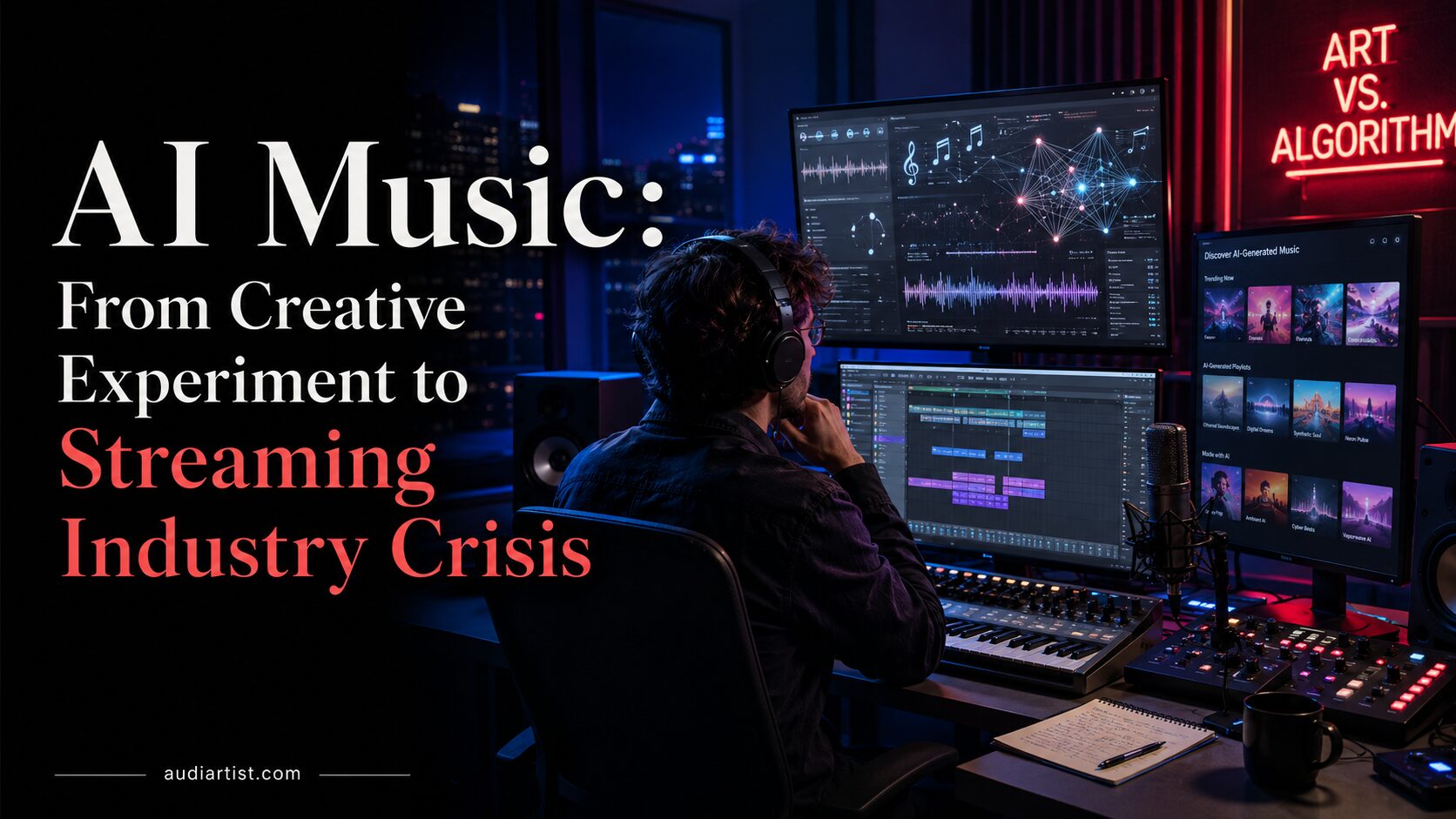

Artificial intelligence did not enter the music industry with a single dramatic announcement. It arrived gradually, first as a practical tool for generating visuals, analysing audiences and accelerating creative workflows. Then it became capable of producing complete songs, imitating voices, flooding streaming catalogues and challenging the economic value of human musicianship.
Across its reporting, Audiartist has followed that transformation from early optimism to growing concern. Read chronologically, these articles show how quickly AI music moved from creative assistance to one of the most divisive issues facing artists, labels, distributors and streaming platforms.
February 2025: AI Arrives as a Creative Tool for Musicians
One of Audiartist’s earliest major explorations of artificial intelligence focused not on synthetic songs, but on visual creation.
Published in February 2025, The Best AI Video Generators for Musicians presented AI as a practical promotional resource.
Independent artists could create music videos, teasers and social media content without hiring a complete production team. At this stage, artificial intelligence appeared mainly as an assistant. Musicians still created the songs, while AI helped build the visual material surrounding them.
The promise was accessibility. Artists with limited budgets could compete in a music economy increasingly dominated by short-form video, visual branding and constant online promotion.
September 2025: Algorithms Begin Judging the Music
By September 2025, Audiartist was examining a more analytical role for artificial intelligence in Predicting Song Popularity With Deep Learning.
The article explored research using spectrograms, streaming metadata and neural networks to estimate whether a song might achieve commercial success.
This marked an important shift. AI was no longer simply helping musicians create or promote their work. It was beginning to evaluate music and identify the recordings most likely to attract an audience.
The traditional music executive relied on instinct, cultural knowledge and experience. The new model promised predictions built from enormous datasets. Whether those systems could recognise originality, emotional impact or the next cultural movement remained far less certain.
September 2025: AI Slop and Fake Artists Enter Streaming
Only days later, the tone became considerably darker.
AI Slop, Fake Artists, and the Streaming Crisis examined the rise of mass-produced synthetic music, invented artist identities and cloned voices.
The concern was no longer the existence of AI-generated music alone. It was the industrial scale at which it could be created and distributed.
- Streaming royalties risked being diluted by huge volumes of synthetic content.
- Listeners could lose trust in playlists and artist identities.
- Real musicians had to compete with catalogues produced almost continuously.
- Generic tracks could be uploaded without artistic intention or audience demand.
The phrase “AI slop” described music created primarily to occupy catalogue space, capture algorithmic recommendations or generate small quantities of revenue across thousands of releases.

October 2025: Spotify Promises Responsible AI
In October, Audiartist reported a more corporate response in Spotify and Major Labels Join Forces to Build Responsible AI in Music.
Spotify’s discussions with major record companies suggested that the largest music businesses were no longer attempting to stop generative technology completely. Instead, they were exploring a controlled and commercially licensed version of it.
The expression “responsible AI” sounded reassuring, but it immediately raised another question: who would define responsibility?
Major labels and global platforms could negotiate licences and access large catalogues. Independent musicians risked remaining outside the room while the future rules of artificial intelligence were being written.
December 2025: Deezer Draws a Line
In December, Deezer vs the AI Deluge documented one of the clearest platform responses of the year.
Deezer developed systems to identify fully AI-generated music, exclude it from editorial playlists and prevent it from entering recommendation systems.
The platform did not completely ban synthetic recordings. Instead, it attempted to separate catalogue availability from active promotion.
This distinction mattered. Recommendation algorithms determine which artists are discovered, streamed and eventually paid. Removing fully generated tracks from those systems reduced their ability to compete directly with human-created releases.
Deezer also connected mass AI uploads with streaming fraud. Synthetic catalogues could be combined with automated listening activity to extract royalties from the same economic pool supporting real musicians.
February 2026: AI Music Becomes Interactive
In February 2026, Audiartist examined a different vision in Napster 2026 and Real-Time AI Music.
The revived Napster concept moved beyond selecting finished recordings from a catalogue. It imagined listeners participating in the creation of music through generative systems operating in real time.
This represented a fundamental change in streaming. A traditional platform delivered completed songs. A generative platform could produce personalised audio that changed according to the user, mood, activity or environment.
The question was no longer simply whether AI music could compete with musicians. It was whether some listeners would eventually prefer endlessly customised sound instead of following artists at all.
March 2026: Streaming Reaches the Point of Overload
The Streaming Overload: 253 Million Tracks and the Battle for Attention placed AI music inside a wider crisis of abundance.
Streaming had fulfilled its original promise by making an enormous quantity of music available. Yet unlimited supply created a different problem: millions of tracks could be technically accessible while remaining practically invisible.
Generative AI accelerated that imbalance. Music could be produced and distributed faster than listeners could possibly discover it.
Attention, trust and curation were becoming more valuable than catalogue size. For musicians, releasing a track was no longer enough. Artists increasingly had to prove that a real identity, story and creative intention existed behind the recording.

March 2026: Ownership Becomes the Central Question
AI Music Generators Exposed addressed the legal uncertainty hidden behind the apparent simplicity of generating a song from a written prompt.
A platform may give a subscriber permission to distribute a generated track, but that does not automatically guarantee strong copyright ownership.
Questions remain around training data, similarity to existing works, platform terms and the amount of genuine human authorship involved.
A generated song may therefore be easy to publish but considerably harder to defend, license exclusively or protect from imitation.
March and April 2026: Deezer Turns Detection Into Infrastructure
Audiartist continued following Deezer through two connected reports.
Deezer Profitability 2025: AI Fraud, Sonos and the B2B Shift showed how the company was treating AI fraud as a structural business issue rather than a temporary cultural debate.
Then, Deezer’s AI Detection Strategy Could Redefine Music Streaming documented the platform’s ambition to provide its detection technology to other organisations.
Deezer was no longer acting only as a streaming service. It was positioning itself as an infrastructure provider capable of helping rights organisations, distributors and music companies identify synthetic material.
Detection was becoming a commercial service and potentially a new industry standard.
April 2026: Who Owns Music Created With Suno?
Who Really Owns Music Created With Suno? examined the rights users receive when generating songs through one of the most widely discussed AI platforms.
The answer could depend on the subscription level, the platform’s terms, the creation process and whether the resulting work contained sufficient human contribution to receive copyright protection.
The central warning was clear: commercial permission is not necessarily the same as unquestionable ownership.
An artist planning distribution, sync licensing or long-term catalogue development must understand that distinction before building a professional strategy around generated music.
April 2026: The Cultural Backlash Becomes Open
Is AI Music the Revenge of the Talentless? moved from legal analysis to direct editorial confrontation.
The article challenged the idea that writing a prompt should automatically be treated as equivalent to songwriting, instrumental performance, vocal technique, sound design or years of production experience.
The title was provocative, but it reflected a genuine frustration among musicians. Generative services often use the language of creative democratisation, while allowing users to imitate genres, voices and production styles without understanding the work behind them.
The debate had become cultural as well as technical. It concerned the meaning of talent, authorship and artistic identity.
May 2026: Platforms Become Music Producers
YouTube’s AI Music Replacement Tool Could Reshape the Market for Functional Music examined a system capable of replacing copyrighted audio in videos with generated alternatives.
This placed artificial intelligence directly inside the creator economy.
Instead of licensing a track from a composer, production library or independent artist, a video creator could potentially use a replacement supplied by the platform itself.
The risk was particularly serious for functional music: background tracks, corporate music, creator soundtracks and low-budget synchronisation work.
AI was no longer merely generating songs. It was beginning to replace a commercial function traditionally supplied by working musicians.
May 2026: Spotify Explores AI Remixes
Spotify AI Remixes: A New Era for Fan-Made Music explored the possibility of listeners transforming existing songs through authorised generative tools.
The concept offered new opportunities for interactive listening and remix culture, but also blurred the boundary between listener, producer and rights holder.
If fans can transform recordings through official AI systems, the industry must determine how royalties, approvals, credits and derivative rights are distributed.
The remix may become a new form of engagement, but only if the original musicians remain visible and properly compensated.
June 2026: Musicians Challenge the Major Labels
AI Music, Major Labels, and Musicians’ Rights covered the legal action involving the American Federation of Musicians, Universal Music Group and Warner Music Group.
The dispute shifted attention away from famous singers and record owners toward the session musicians whose performances exist inside major catalogues.
If recordings are used to train generative systems, should the performers who played on those recordings receive additional consent, credit or compensation?
The case showed that ownership of a master recording may not resolve every contractual and ethical question associated with AI training.
June 2026: Human Identity Becomes a Competitive Advantage
What Independent Artists Must Learn From the New Streaming Reality argued that verification, consistency and authenticity were becoming essential.
Inside a catalogue filled with anonymous projects, automated releases and synthetic identities, the human story behind the music had become increasingly valuable.
Independent musicians could no longer rely only on uploading tracks. They needed recognisable profiles, coherent visual branding, real communication and proof that listeners were following an actual creative journey.
June 2026: The Volume Becomes Impossible to Ignore
Deezer’s AI Music Crackdown reported the extraordinary volume of fully generated tracks being delivered to the platform.
Later, Deezer AI Music Detector Puts Streaming Platforms Under Pressure examined a public-facing detection system.
Listeners, journalists and playlist curators could investigate whether particular recordings had been identified as fully generated by artificial intelligence.
Transparency was no longer only an internal technical process. It had become something listeners increasingly expected from streaming services.
July 2026: Labels, Platforms and Courts Take Control
By July, the AI music debate had entered a more aggressive legal and economic phase.
Music Industry Pushes for Official AI Labels on Streaming Platforms argued that visible disclosure could help listeners distinguish between human-made, AI-assisted and fully generated recordings.
Tidal Stops Paying Royalties on Fully AI-Generated Music documented one of the strongest economic policies introduced by a major platform.
Tidal allowed compliant synthetic tracks to remain accessible but removed their eligibility for royalties. Availability no longer guaranteed economic equality with music created and performed by people.

July 2026: Sony Escalates the Udio Conflict
Sony Music Escalates AI War With New Udio Lawsuit Over 30,000 Songs reported a major expansion of the copyright conflict.
Sony alleged that a substantial catalogue of protected recordings had been used in connection with Udio’s training process.
The case highlighted a growing divide between the major labels. Some rights holders were moving toward licensing agreements with artificial intelligence companies, while Sony continued pursuing litigation.
The music industry was no longer united around one strategy. Some companies wanted to license the technology. Others wanted courts to decide whether its foundations were lawful.
July 2026: AI Success Exists, but Remains Concentrated
AI Music Streams Rise but Remain Highly Concentrated added important context to the growing panic around synthetic music.
Several AI-associated recordings had achieved significant numbers, but those successes remained exceptional inside a market processing trillions of streams.
AI music was highly visible in industry discussions and upload statistics. It had not automatically replaced listener demand for established human performers.
July 2026: Most AI Music Finds Almost No Audience
The latest chapter arrived with 93% of AI Music Gets Almost No Plays, New Study Finds.
The study examined the mass-distribution strategy surrounding generated music and found that the overwhelming majority of identified AI tracks received almost no meaningful public attention.
This result creates a striking contradiction. Artificial intelligence can flood distribution systems, generate legal conflict and dominate industry headlines without necessarily attracting listeners.
The machine can publish continuously. It cannot automatically create cultural relevance.
From Useful Tool to Structural Conflict
Read chronologically, Audiartist’s reporting shows a clear evolution.
In early 2025, artificial intelligence was mainly presented as a practical creative and promotional assistant. By the end of that year, the discussion had shifted toward fake artists, cloned voices, streaming fraud and catalogue saturation.
During 2026, the issue became structural. Platforms introduced detection systems, recommendation restrictions, disclosure labels and royalty exclusions. Musicians, unions and major labels entered legal battles over training data, consent and compensation.
The central question is no longer whether artificial intelligence belongs in music. It already exists throughout production, promotion, discovery and distribution.
The real conflict concerns where assistance ends and replacement begins.
Human Music Still Holds the Essential Advantage
AI systems can imitate genres, generate arrangements and produce enormous catalogues. What they cannot guarantee is that listeners will care.
Music is not valuable only because sound exists. It becomes meaningful through identity, performance, context, risk, memory and the relationship between artists and their audiences.
The latest studies suggest that synthetic abundance is not the same as cultural impact. Most generated tracks disappear almost immediately, while the legal and technical systems required to manage them become increasingly expensive.
Final Verdict
Audiartist’s reporting documents one of the fastest transformations in modern music history.
Artificial intelligence began as a useful creative assistant. It became a generator, a competitor, a source of fraud, a legal battlefield and eventually a test of whether streaming platforms still value human authorship.
The next phase will probably not involve a complete victory for either side. AI tools will remain part of production and promotion, while fully automated catalogues will face stronger detection, labelling and monetisation restrictions.
The industry must now establish rules that separate responsible assistance from exploitation, licensed innovation from unauthorised training and genuine creative work from industrial content production.
The machine has learned how to generate music. The harder question is whether the music industry will remember how to protect the people who gave it something worth learning from.