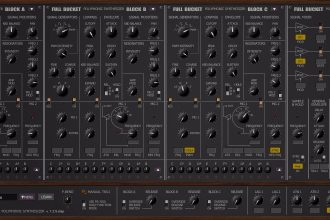
Sunset Circuits: A Free Six-Engine Vintage Synth
Six synthesis architectures, 54 presets and serious sound-design tools inside one genuinely free virtual instrument.
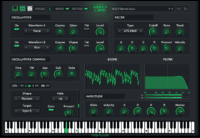
Sunset Circuits is a free and open-source virtual synthesizer developed by Dusk Audio. Released in July 2026 and already updated to version 1.0.1, the instrument combines six vintage-inspired synthesis engines inside a single, consistent interface.
It can produce warm analog-style pads, aggressive monophonic basses, FM keys, modular textures and sequenced acid lines without requiring several separate plugins. There is no time-limited trial or restricted free edition. The complete instrument can be downloaded legally from the developer’s official website.
What Is Included?
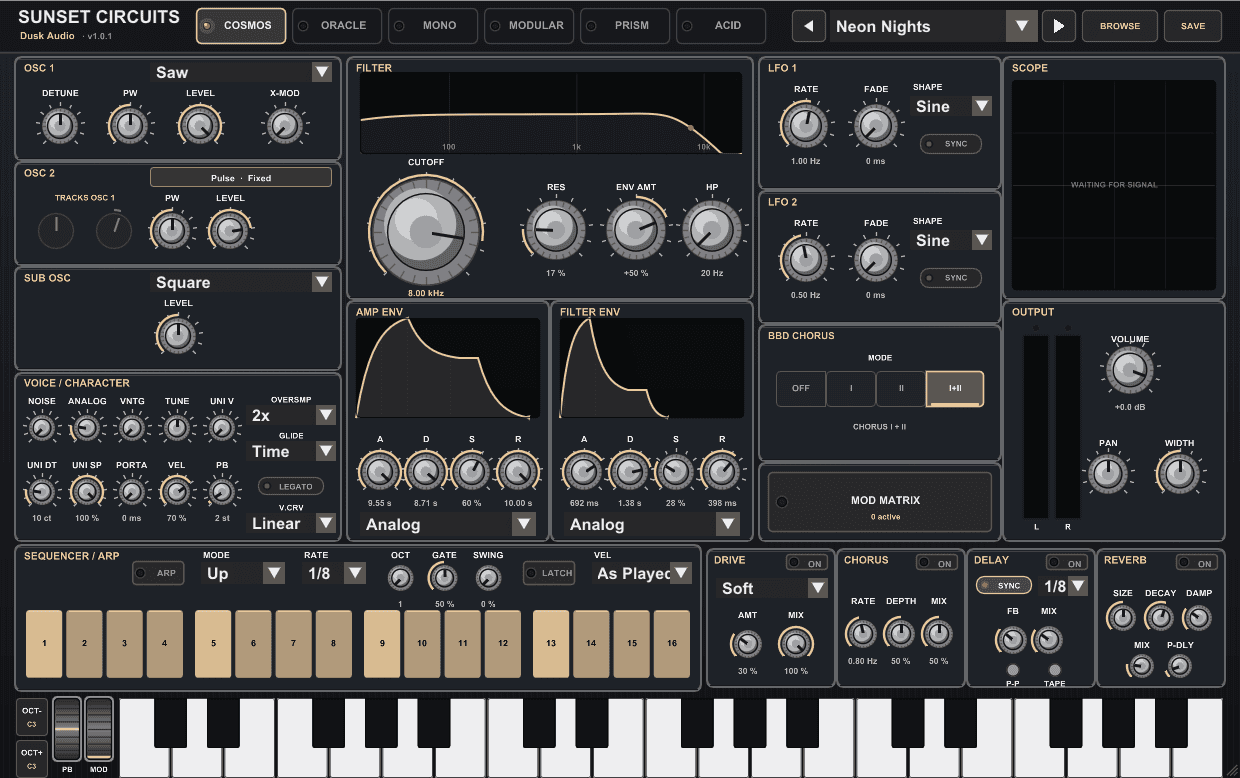
Sunset Circuits is built around six selectable synthesis modes. Changing the mode does more than load a different preset. It changes the voice architecture, oscillator behavior, filter character and specialist controls of the instrument.
- Cosmos: A six-voice DCO poly synth with a built-in bucket-brigade-style chorus for pads, chords and classic early-1980s textures.
- Oracle: A five-voice analog-style poly synth with two oscillators, a self-oscillating filter and poly-modulation routing.
- Mono: A monophonic engine with two oscillators, a sub oscillator, ring modulation and hard sync for basses and leads.
- Modular: A semi-modular engine with three oscillators, linear FM, sample and hold, a ladder filter and spring-style reverb.
- Prism: A four-operator FM synth with eight routing algorithms, operator feedback and individual envelopes.
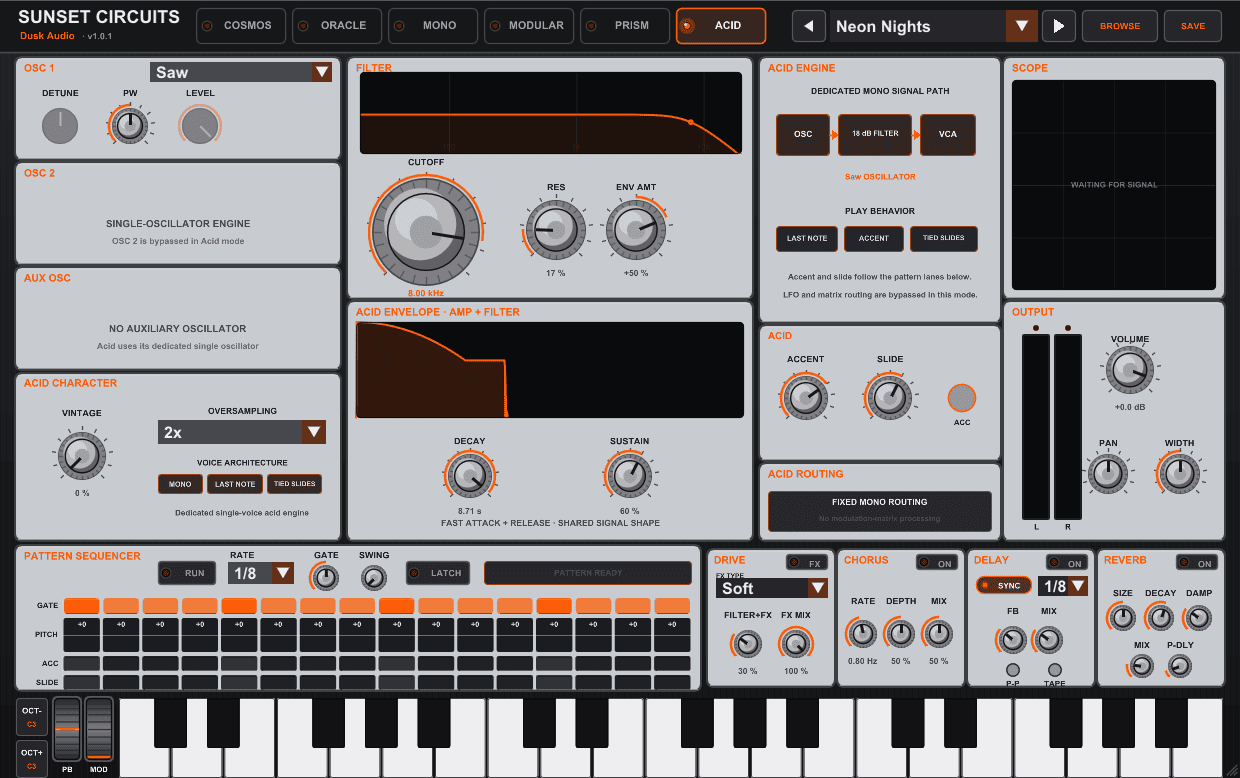
- Acid: A focused bassline engine with accent, slide, a diode-ladder filter and a sixteen-step sequencer.
The plugin also includes 54 factory presets, a searchable preset browser and a personal user preset library.
Main Features
Despite its broad collection of synthesis engines, Sunset Circuits keeps the workflow relatively straightforward. The main layout remains familiar when switching modes, allowing producers to move between different synthesis methods without relearning the entire interface.
An eight-slot modulation matrix can route envelopes, LFOs, velocity, aftertouch, key tracking and sample-and-hold signals to destinations including pitch, filter cutoff, amplitude, pan and effect parameters.
The instrument also includes a tempo-synchronised arpeggiator and step sequencer with rate, swing, octave and accent controls. Acid mode expands this concept with separate lanes for gate, pitch, accent and slide.
The internal effects chain provides drive, chorus, delay and reverb. Modular mode uses a spring-style reverb treatment that works particularly well for drones, experimental sequences and cinematic sound design.
Oversampling can be set to 1x, 2x or 4x, giving users the option to improve the quality of driven and highly resonant sounds while managing CPU consumption.
Best Uses
Cosmos is a natural choice for synthwave, pop, house and cinematic pads. Its stable oscillators and chorus section can create wide chords without requiring a complicated modulation setup.
Mono is better suited to bass lines, leads and short sequences that need more weight. The sub oscillator can reinforce the lowest octave, while ring modulation and hard sync add harmonic aggression when required.
Prism handles digital timbres such as electric pianos, metallic percussion, bells, plucks and bright FM basses. Its eight algorithms provide enough variation for useful preset design without introducing the complexity of a much larger FM workstation.
Modular is one of the most interesting modes for sound designers. Sample and hold, oscillator cross-modulation and spring reverb can generate evolving drones, transitions and unstable textures that feel less predictable than conventional subtractive patches.
Acid is designed for monophonic sequences. Its accent and slide lanes make it useful for classic acid house, techno, electro and modern peak-time arrangements.
Production Tips
Start by selecting the engine that best matches the role of the sound. Cosmos and Oracle are the most suitable choices for polyphonic chords, while Mono and Acid are designed around focused monophonic parts. Prism is the logical starting point for digital tones, and Modular is better for movement and experimentation.
Build the oscillator and filter balance before adding effects. A patch that only works with a large amount of reverb can quickly disappear inside a busy mix. Use the internal reverb for character, then place larger spatial effects on an auxiliary channel when more control is required.
For bass sounds, keep the stereo width conservative and check the result in mono. With pads and atmospheric parts, modulation can be routed subtly to pan, filter cutoff or oscillator pitch to create movement without making the sound unstable.
Use 1x or 2x oversampling while composing to reduce CPU usage. Switch to 4x when exporting bright, distorted or highly resonant patches if the additional processing improves the result.
Compatibility
Sunset Circuits is available for Windows, macOS and Linux. The available formats include VST3, CLAP, LV2 and Audio Unit, depending on the operating system.
- Windows: Windows 10 or later
- macOS: macOS 10.15 or later, with Intel and Apple Silicon support
- Linux: x86_64 and ARM64 builds with supported system libraries
- DAW: A compatible 64-bit host
- Sample rates: 44.1 kHz to 192 kHz
Installation is manual. After downloading the appropriate archive, copy the plugin file into the standard folder used by your operating system and rescan the plugin list inside your DAW.
Version 1.0.1 introduced corrections for preset handling, interface resizing, oscillator behavior, FM accuracy and several engine-specific details. Installing the latest available build is therefore recommended.
Final Verdict
Sunset Circuits offers considerably more than a basic free synthesizer. Its six engines provide genuinely different approaches to sound creation, while the shared layout keeps the workflow coherent and accessible.
The 54 presets provide a useful starting point, but the modulation matrix, sequencers, internal effects and engine-specific controls give the instrument enough depth for custom sound design. It should be particularly useful for electronic music, house, synthwave, techno, cinematic production and experimental composition.
It may not replace every specialist synthesizer already installed in a large studio, but it can certainly replace several questionable plugins hiding in the folder marked “I might use this one day.” Six synth engines and no invoice is a rather convincing argument.
Download Sunset Circuits from the official website:
« `