Noise Engineering is known for instruments that favor unusual digital character over predictable analog imitation. Virt Vereor follows that philosophy with three synthesis algorithms, expressive modulation, multimode filtering and fast patch randomization.
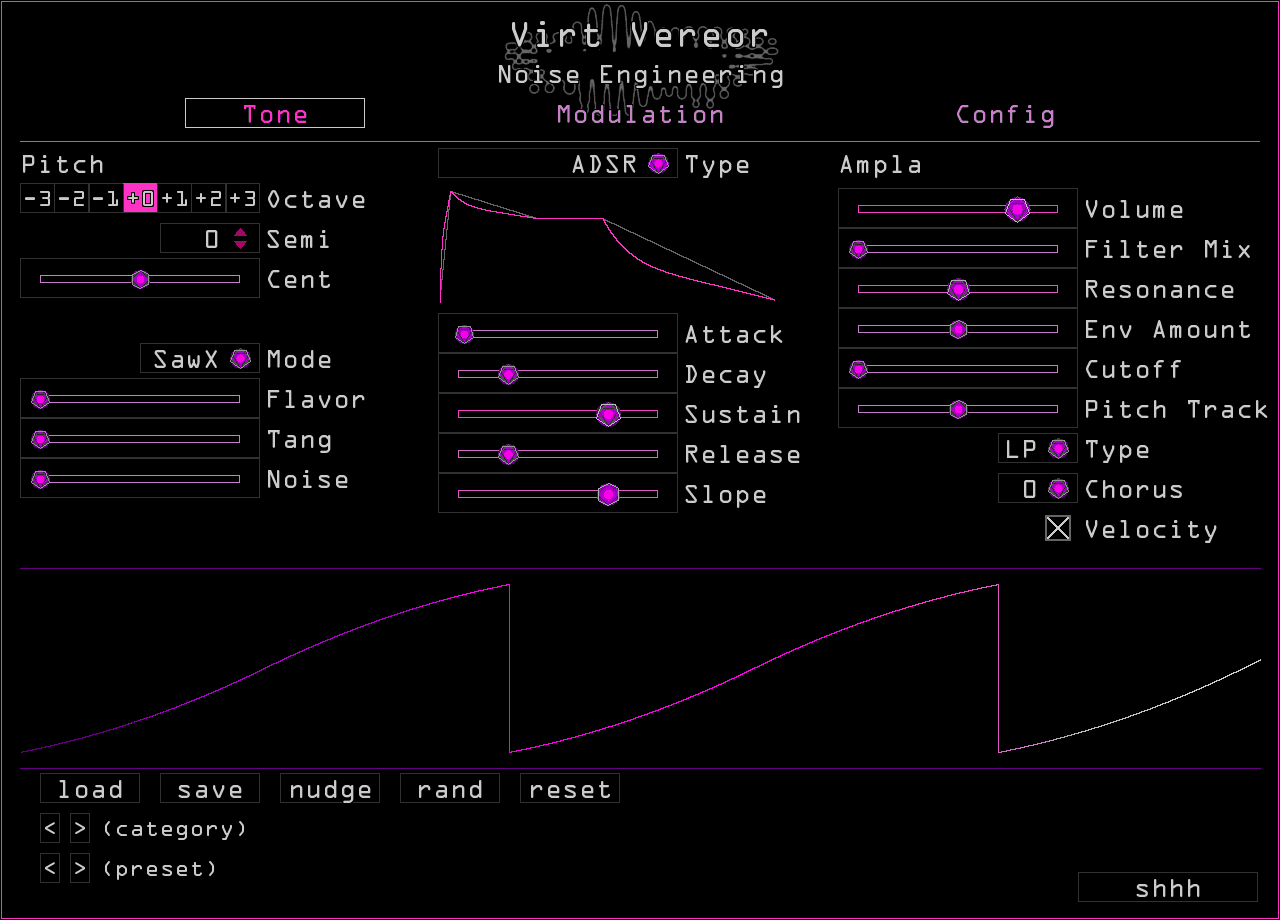
What Is Virt Vereor?
Virt Vereor is a free 64-bit software synthesizer included in the Noise Engineering Freequel Bundle. It is designed around three sound-generation algorithms named Bass, Sawx and Harm.
Instead of filling the interface with dozens of oscillator pages and hidden menus, each engine is shaped through three central controls: Flavor, Tang and Noise. Their behavior changes according to the selected synthesis algorithm.
This streamlined approach makes the plugin relatively quick to understand while still offering enough variation for detailed sound design. A patch can move from a focused electronic bass to a distorted lead, metallic sequence or unstable cinematic texture without requiring an enormous modulation matrix.
Three Distinct Synthesis Engines
Bass
Bass combines quadrature synthesis with nonlinear processing. Flavor controls oscillator saturation, Tang introduces asymmetric wavefolding and Noise adds phase modulation and noise between folding stages. It is well suited to aggressive basses, distorted plucks and unstable low-end textures.
Sawx
Sawx starts with a supersaw-inspired structure but can move far beyond conventional trance chords. It produces wide electronic leads, animated pads, metallic timbres and more aggressive industrial sounds. Tang controls oscillator chorus, while Noise introduces phase modulation from subsampled white noise.
Harm
Harm uses additive synthesis with internal distortion. Flavor changes the relationship between partials, Tang reshapes the individual harmonics and Noise combines phase-modulated noise with clipping. This engine is particularly effective for glassy sounds, digital bells and cinematic tension layers.
Envelopes, Filter and Chorus
Virt Vereor provides a conventional ADSR envelope alongside a simpler Percido mode. Percido uses time, attack-to-decay balance and envelope slope controls, making it useful for quickly programming plucks, percussion and short sequenced sounds.
The amplitude section can blend a clean VCA response with a filter-controlled signal. The multimode filter offers low-pass, band-pass and high-pass operation, plus resonance, cutoff, envelope amount and pitch tracking.
A vintage-inspired chorus provides three settings: off, moderate and strong. It can add width to leads and pads without requiring a separate effect plugin.
Deep Modulation Without a Complicated Interface
The modulation system is considerably deeper than the compact interface first suggests. Four internal LFOs can operate as traditional modulators, step sequencers or looping envelopes.
They can run freely, synchronize with the host tempo, follow the DAW transport or operate polyphonically for individual notes. Four macro controls can also affect several destinations simultaneously.
Additional modulation sources include note position, velocity, release velocity, pressure, MPE slide and a random value generated for each note. This makes Virt Vereor suitable for expressive performance as well as evolving automated patches.
The Nudge control creates smaller variations of the current sound, while Rand generates a more complete random patch. The results occasionally sound like a synthesizer discovering strong coffee for the first time, but the system remains an excellent source of unexpected starting points.
See Virt Vereor in Action
Best Uses
Techno sequences
Industrial textures
Wide synth leads
Animated pads
Metallic plucks
Cinematic tension
Expressive MPE performance
Compatibility and Installation
Virt Vereor is available as a 64-bit plugin for Windows 10 or later and macOS 10.14 or later. The officially listed formats are VST3, AU and AAX.
Noise Engineering provides native support for Intel and Apple Silicon Macs. The plugin should therefore integrate with most modern DAWs on Windows and macOS, including hosts that support VST3, Audio Unit or AAX instruments.
Downloading the plugin requires a Noise Engineering account. Installation is handled through the NE Products application, and registration uses an online browser authentication process.
Main Limitations
- A Noise Engineering account is required.
- Installation uses the NE Products manager instead of a direct plugin download.
- Online browser authentication is required.
- No Linux version is listed on the official page.
- CLAP, LV2 and standalone formats are not listed.
- The plugin is downloaded as part of the Freequel Bundle.
- The official page displays an installer build number rather than a clear semantic plugin version.
- The behavior of Flavor, Tang and Noise changes between engines, so consulting the manual is useful.
A Distinctive Free Synth for Digital Sound Design
Virt Vereor is most useful for electronic producers and sound designers who want a synthesizer with an identifiable digital character. Its three engines cover folded bass tones, supersaw-inspired textures and additive harmonic sounds, while its modulation tools provide enough depth for expressive and evolving patches.
Its main drawback is the installation workflow. An account, a dedicated installer and online authentication are required, making the process less immediate than a direct download. Linux producers are also left outside the laboratory.
Despite those limitations, Virt Vereor remains a genuinely valuable free instrument. It does not try to replace a complete workstation synth. Instead, it delivers focused algorithms, creative modulation and fast randomization tools capable of adding character to electronic music and cinematic productions.
Official Noise Engineering product page