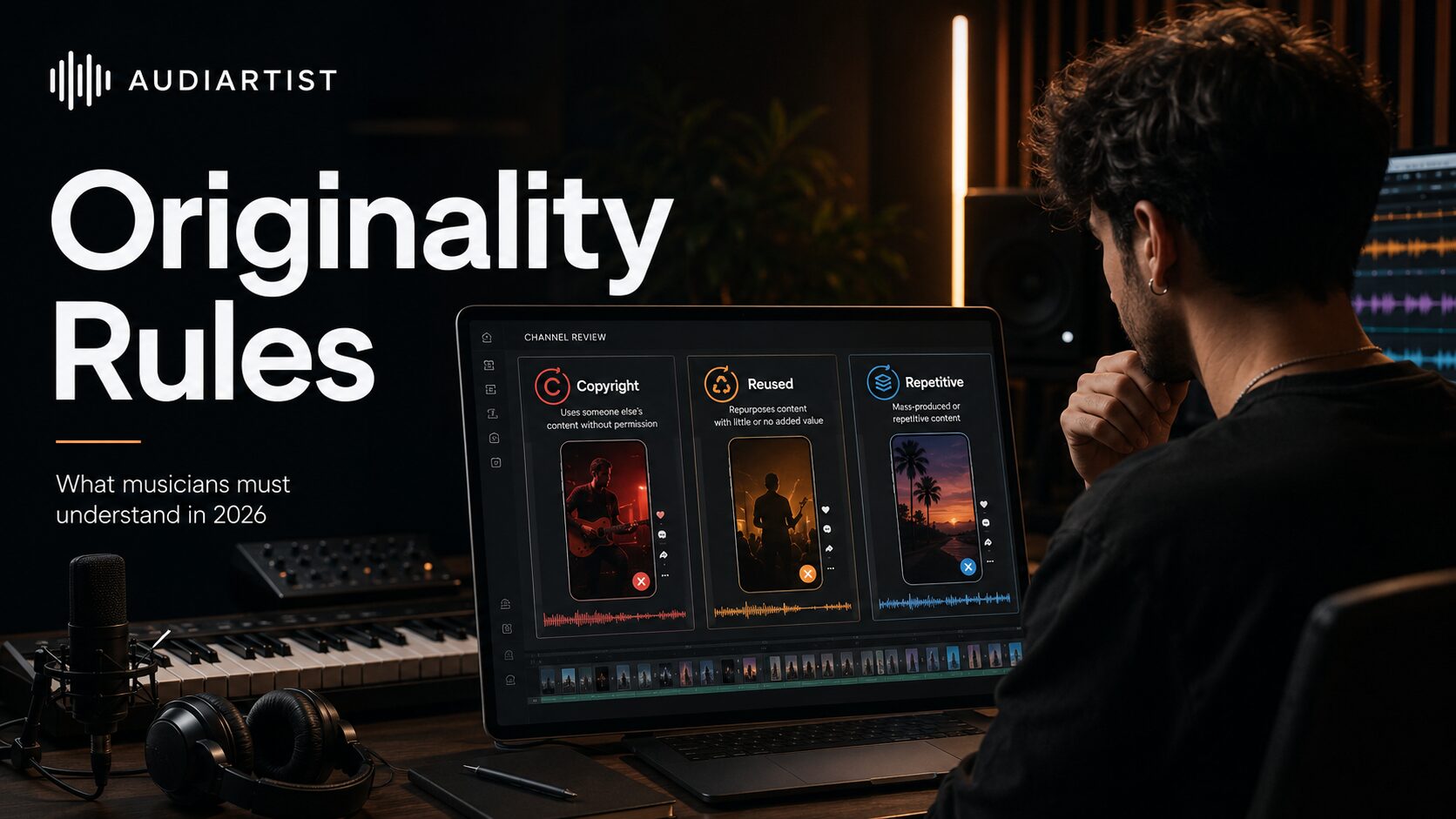

YouTube separates several issues that creators often confuse: copyright compliance, reused content and repetitive or mass-produced content. A musician may own a recording, have permission to use every element in a video and receive no copyright claim, yet still encounter monetization problems if the channel does not provide enough visible original value.
This distinction is particularly important for music channels built almost entirely around static cover artwork accompanied by audio. Such uploads may be useful for distributing a catalogue, but when dozens of videos follow the same template with minimal visual or editorial variation, the channel can begin to look repetitive rather than creatively produced.
For independent artists, labels, producers and music curators, understanding these rules is essential. The goal is not simply to avoid copyright strikes. It is to create a channel that clearly demonstrates authorship, participation and meaningful creative work.
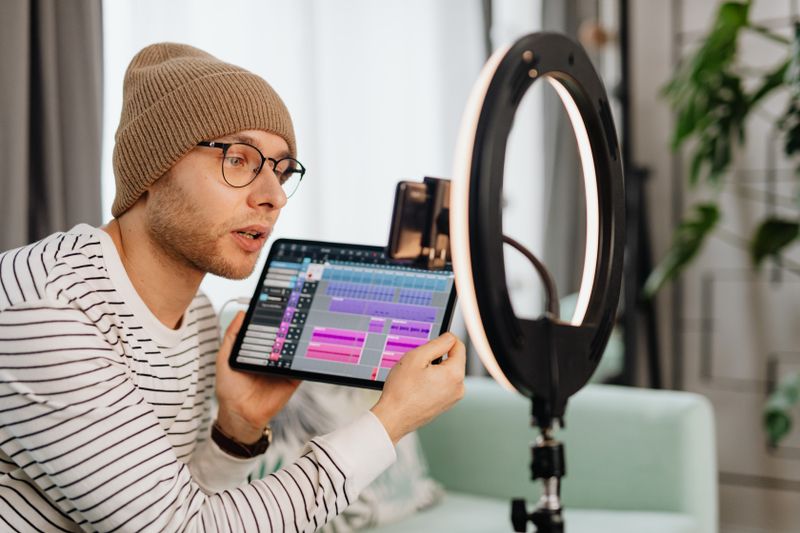
Photo by Kaboompics.com via Pexels
Three Different Rules Musicians Commonly Confuse
Many musicians use the expressions copyright, reused content and repetitive content as though they describe the same problem. They do not.
Each rule examines a different part of the video and the channel.
- Copyright concerns whether the creator has the legal right to use the music, footage, images, samples and other protected material.
- Reused content concerns whether material taken from another source has been transformed through meaningful original participation, commentary or editing.
- Repetitive or inauthentic content concerns channels whose videos appear mass-produced, interchangeable or generated from the same template with very little variation.
A video can satisfy one of these requirements while failing another. This is why a copyright licence or written permission does not automatically guarantee eligibility for the YouTube Partner Program.
What Copyright Means for a Music Channel
Copyright determines whether a creator has the legal authority to publish protected material.
For a musician, this may involve several separate rights:
- The master recording
- The musical composition
- The lyrics
- Samples used in the production
- The artwork or photograph
- Music video footage
- Footage supplied by another creator
- Third-party visualisers and animation templates
An independent artist who wrote, produced and recorded a song may own both the composition and master. However, ownership can become more complicated when co-writers, producers, featured singers, session musicians, sample libraries or record labels are involved.
A video can receive a Content ID claim even when the uploader is one of the legitimate rights holders. This sometimes happens when a distributor, label or rights-management company has registered the track in Content ID.
In that situation, the artist may need to ask the distributor to whitelist the channel or release the claim. The problem concerns rights administration, not necessarily the originality of the video.
Copyright Permission Does Not Guarantee Monetization
YouTube explicitly separates reused-content reviews from copyright enforcement.
This means a creator may have permission from the original rights holder and still be refused monetization when the uploaded material contains only minimal changes or does not clearly demonstrate original participation.
For example, imagine a music promotion channel that receives permission to publish songs from independent artists. Every upload uses the artist’s cover image, the complete audio file and a standard description.
The channel may have permission for every song. It may receive no copyright strike. However, YouTube can still examine whether the channel itself adds meaningful creative, educational or entertainment value.
Permission answers the question:
“Are you legally allowed to use this material?”
The reused-content policy asks a different question:
“What did you contribute to this video?”
What YouTube Considers Reused Content
Reused content generally involves material that already exists on YouTube or another online source and has been republished without sufficient original commentary, substantial modification or added value.
Examples that may create problems include:
- Compilations of music videos taken from other channels
- Collections of songs by different artists, even when permission has been obtained
- Short clips downloaded from Instagram, TikTok or other platforms
- Promotional videos made almost entirely from another artist’s footage
- Existing interviews divided into Shorts without new editorial context
- Concert clips uploaded without commentary or meaningful editing
- Songs changed only through pitch or speed adjustments
The crucial factor is whether viewers can clearly identify a meaningful difference between the source material and the new video.
Basic changes such as cropping, adding a logo, changing the aspect ratio or placing subtitles over an existing video may not be enough on their own.
What Can Make Reused Material Transformative?
Musicians are not prohibited from using licensed clips, archive material or footage created by collaborators. The issue is how the material is presented.
Original value can come from:
- Spoken commentary
- A critical analysis
- A production breakdown
- A clearly developed narrative
- Substantial editing that changes the viewing experience
- On-camera participation from the artist
- An explanation of how the music was created
- A comparison between several versions of a track
- Educational information about instruments, songwriting or mixing
A musician could, for example, use a short section of an existing music video while explaining how a particular scene connects to the lyrics. The resulting Short contains material from the original video, but the artist adds context, personality and a new reason to watch.
What Repetitive or Inauthentic Content Means
Repetitive content is not primarily about copying another creator. It concerns repetition within the creator’s own channel.
In July 2025, YouTube clarified that its long-standing policy on repetitious content also covers material that appears repetitive or mass-produced. The policy was renamed to place greater emphasis on inauthentic content.
YouTube did not introduce a total ban on formats, series or recurring visual identities. A channel can use the same introduction, logo, studio or presentation style across multiple videos.
The important requirement is that the substance of each upload must be meaningfully different and provide its own creative, educational or entertainment value.
A recognisable format is acceptable. An assembly line of nearly interchangeable videos is where the risk begins.
Why Static Cover Artwork Can Become a Problem
Many musicians use a simple format for their official audio uploads:
Cover artwork + complete song + title + streaming links
This format is practical. It gives the track a permanent presence on YouTube, makes the catalogue searchable and provides listeners with an official upload.
A single static-artwork video is not automatically a violation. YouTube does not state that every official audio upload must contain live footage or complex animation.
The risk grows when nearly the entire channel uses the same structure and each upload differs only through the artwork, song title and audio file.
If a reviewer opens several videos in succession and they all appear interchangeable, the channel may struggle to demonstrate sufficient visual or editorial variation.
This is especially relevant when:
- Every video uses the same visualiser template
- The artwork remains completely static
- Descriptions are copied with only the song title changed
- Videos contain no artist participation or context
- Dozens of uploads are published in a short period
- The channel appears automatically generated
- The content provides little reason to watch instead of using an audio-only service
The problem is not that the songs are identical. The problem is that the videos may appear to have been produced through the same minimal process.
Owning the Song Does Not Solve Repetition
An artist may own every master recording on the channel and still need to consider the repetitive-content policy.
Ownership proves that the music is legally theirs. It does not automatically demonstrate that the channel offers varied and engaging video content.
This can feel counterintuitive to musicians. From an artistic perspective, each track may contain a different composition, performance, arrangement and mix. From a video-review perspective, however, ten static images accompanied by ten audio files can look like the same visual product repeated ten times.
The safest approach is not to delete the official audio catalogue. It is to build additional original content around it.
Do These Rules Apply to YouTube Shorts?
Yes. YouTube’s channel monetization policies apply to Shorts, traditional long-form videos and live streams.
Shorts are not exempt simply because they are brief, vertical or built around music discovery.
Musicians should therefore avoid treating Shorts as a place to publish endless variations of the same template.
Examples of repetitive music Shorts might include:
- The same cover image with a different song excerpt every day
- Identical waveform animations across hundreds of tracks
- The same stock footage reused with minimal changes
- Repeated lyric videos created from one automated template
- Nearly identical “out now” announcements
- Multiple speed or pitch versions of the same recording
- Mass-produced videos using generic artificial-intelligence visuals
Shorts should provide a distinct creative reason to watch, not merely a different audio file placed inside the same container.
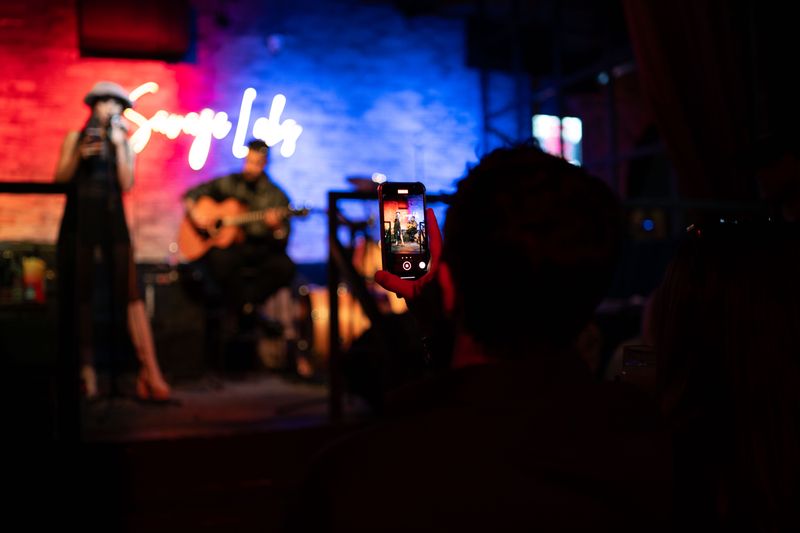
Photo by Sydney Sang via Pexels
Original Shorts Ideas for Musicians
Creating original content does not mean producing a complete music video for every Short. A smartphone, clear sound and a strong idea are often enough.
Perform the Strongest Section
Record the chorus, instrumental drop or most recognisable lyric directly to camera. A real performance immediately demonstrates the artist’s participation.
Explain the Story Behind a Lyric
Introduce one line from the song and explain what inspired it before playing the relevant section.
Show the Demo and Final Version
Compare an early voice memo, piano sketch or rough beat with the finished master.
Break Down One Production Element
Isolate the bass, vocal harmony, guitar tone or drum pattern, then show how it works inside the complete mix.
Record a Different Arrangement
Present the song as an acoustic performance, piano version, stripped vocal, live rehearsal or instrumental edit.
Explain a Creative Decision
Describe why the chorus arrives late, why the mix becomes distorted or why a specific instrument was removed.
Respond to a Listener
Use a genuine audience question as the basis for a Short. The response creates interaction while revealing more about the music.
Show the Recording Process
Capture a vocal session, guitar take, drum recording, sound-design experiment or mixing decision.
How to Turn One Song Into Ten Original Shorts
One single can generate a complete series of videos without repeating the same promotion.
- The story behind the song
- The strongest lyric performed live
- The original demo
- The final mastered version
- A vocal recording clip
- A production breakdown
- An alternative arrangement
- A listener reaction
- A mistake or rejected version
- A final performance linked to the full release
Every Short promotes the same song, but each video provides a different experience.
This is the central distinction between consistency and repetition.
Consistency builds recognition. Repetition removes the reason to keep watching.
Can Musicians Use Stock Footage?
Stock footage can be useful, especially when artists do not have access to a film crew or original performance footage. However, a licence to use stock material does not automatically make the finished video original enough for monetization.
A Short made from one unedited stock clip with a song placed underneath may look similar to thousands of other videos using the same footage.
Artists can add greater creative value by:
- Combining several carefully selected clips
- Creating a clear narrative
- Adding original performance footage
- Including spoken context
- Using custom animation or typography
- Synchronising edits precisely with the music
- Creating an identifiable visual language for the artist
- Explaining the connection between the visuals and lyrics
The licence handles copyright permission. The edit must still demonstrate creative authorship.
Lyric Videos and Visualisers: Are They Safe?
Lyric videos and audio visualisers are legitimate music formats, but they should not become completely automatic or interchangeable.
A carefully designed lyric video can provide meaningful visual interpretation. Typography, pacing, animation, colour and composition can reflect the song’s identity.
A basic visualiser can also work when it forms part of a broader channel containing performances, interviews, production content and original music videos.
The risk is greater when every upload contains:
- The same background
- The same waveform
- The same font
- The same transitions
- The same timing
- The same description
- No narrative or artist participation
Changing only the title and audio may not create enough material variation across the channel.
Official Audio Uploads Should Be Part of a Wider Strategy
Artists do not necessarily need to remove official audio videos from their channels. These uploads can still provide important catalogue access.
The stronger strategy is to surround them with content that clearly demonstrates the artist’s identity and creative process.
A balanced music channel could include:
- Official audio uploads
- Music videos
- Live performances
- Shorts recorded directly by the artist
- Production breakdowns
- Songwriting explanations
- Studio sessions
- Acoustic versions
- Interviews
- Tour and rehearsal footage
This variety helps both viewers and reviewers understand that the channel represents an active artist rather than an automated music archive.
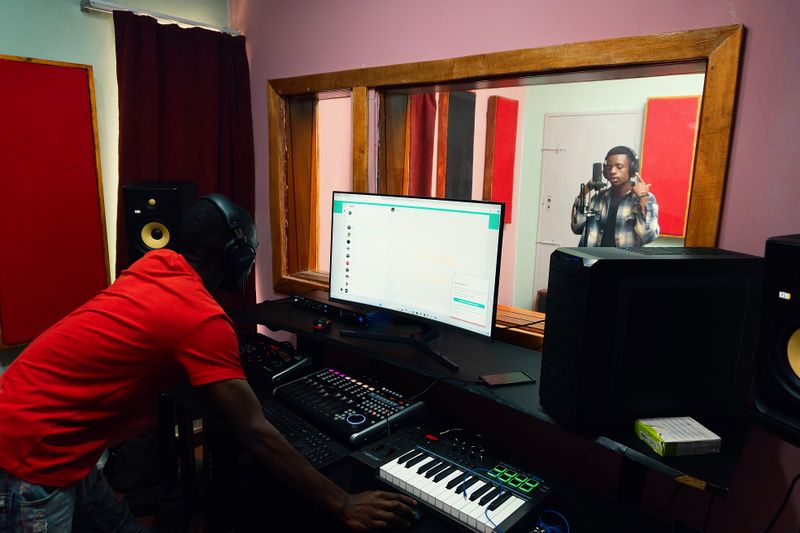
Photo by Kaiser Leo Xiv via Pexels
How YouTube Reviews a Channel
YouTube monetization reviews are not necessarily limited to one isolated upload.
Reviewers may examine:
- The main theme of the channel
- The most viewed videos
- The newest uploads
- The videos generating the greatest proportion of watch time
- Titles, thumbnails and descriptions
- The channel’s About section
- Whether the creator’s involvement is clearly visible
This channel-wide approach matters for musicians. Adding one studio vlog to a catalogue containing hundreds of identical visualisers may not be enough to change the overall impression.
Originality should be visible across the channel’s main content, metadata and presentation.
Metadata Can Help Demonstrate Authorship
Video descriptions cannot transform weak content by themselves, but they can help clarify who created the material.
A useful description might include:
- Songwriting credits
- Production credits
- Recording and mixing information
- Music video credits
- The story behind the track
- Links to official artist profiles
- Copyright and publishing information
The channel description should also explain the artist’s identity, musical project and role in producing the videos.
A catalogue filled with vague titles and copied descriptions can make authorship less obvious. Clear metadata helps establish context, although it cannot replace original video content.
Common Mistakes Made by Music Channels
Assuming No Copyright Claim Means Everything Is Fine
A video can avoid copyright claims and still fail YouTube’s originality or repetitive-content standards.
Uploading the Same Short Repeatedly
Changing the caption, colour filter or publishing date does not necessarily create a new video.
Using Permission as the Only Added Value
Permission allows publication. It does not prove that the channel transformed or contributed to the material.
Publishing Entire Artist Catalogues Through One Template
Even when every song is different, the visual experience may appear mass-produced.
Using Generic AI Visuals for Every Track
Artificial-intelligence tools are not automatically prohibited, but generic, repetitive outputs can reinforce the impression that content is being produced at scale without an authentic creative perspective.
Relying Only on Automated Visualisers
Visualisers can support a catalogue, but they should not necessarily form the entire channel strategy.
Hiding the Artist
Musicians do not need to appear on camera in every video, but viewers and reviewers should be able to understand how the artist participated in creating the channel’s content.
A Practical Originality Checklist for Musicians
Before publishing a Short, ask the following questions:
- Did I create or legally license every element?
- Is my contribution clearly visible?
- Does this video provide a different experience from my recent uploads?
- Would the Short still be interesting without the promotional link?
- Have I added performance, commentary, narrative or substantial editing?
- Does the video represent my artistic identity?
- Am I using a template because it supports the idea, or simply because it is fast?
- Could a reviewer understand how I produced the content?
- Does the channel contain enough variety beyond official audio uploads?
When several answers are negative, the video may need more creative development.
A Safer Content Structure for a New Single
A musician promoting one release could use the following structure:
Short One: Discovery
Perform the strongest fifteen seconds directly to camera.
Short Two: Context
Explain what inspired the song or one important lyric.
Short Three: Production
Show the instrumental layers, vocal effects or main sound-design element.
Short Four: Transformation
Compare the demo with the final recording.
Short Five: Participation
Answer a listener’s question or invite the audience to choose between two arrangements.
Long-Form Video
Publish the complete official audio, visualiser, live session or music video.
This system gives the channel both catalogue content and original editorial depth.
What Musicians Should Remember in 2026
The most important principles are straightforward:
- Copyright and monetization eligibility are separate issues.
- Permission does not automatically protect a channel from reused-content decisions.
- Reused content concerns material taken from existing sources without enough transformation.
- Repetitive content concerns videos that appear interchangeable or mass-produced.
- These rules apply to Shorts as well as long-form videos.
- A static-cover upload is not automatically prohibited, but a channel built almost entirely from one template may create monetization risks.
- YouTube evaluates the channel as a whole, not only one carefully selected video.
- Visible participation, storytelling, commentary and substantial editing help demonstrate original value.
Final Thoughts
YouTube Shorts in 2026 remain an important promotional opportunity for musicians, but successful channels must offer more than legal ownership of the audio.
Copyright answers whether an artist has the right to publish. YouTube’s reused and repetitive-content policies examine whether the channel provides an original, authentic and worthwhile viewing experience.
For musicians who currently publish only static artwork with complete songs, the answer is not necessarily to abandon official audio uploads. The smarter response is to expand the channel with performances, explanations, production content, alternative arrangements and original Shorts.
A cover image can present the song. It should not have to carry the entire video strategy on its pixelated shoulders.