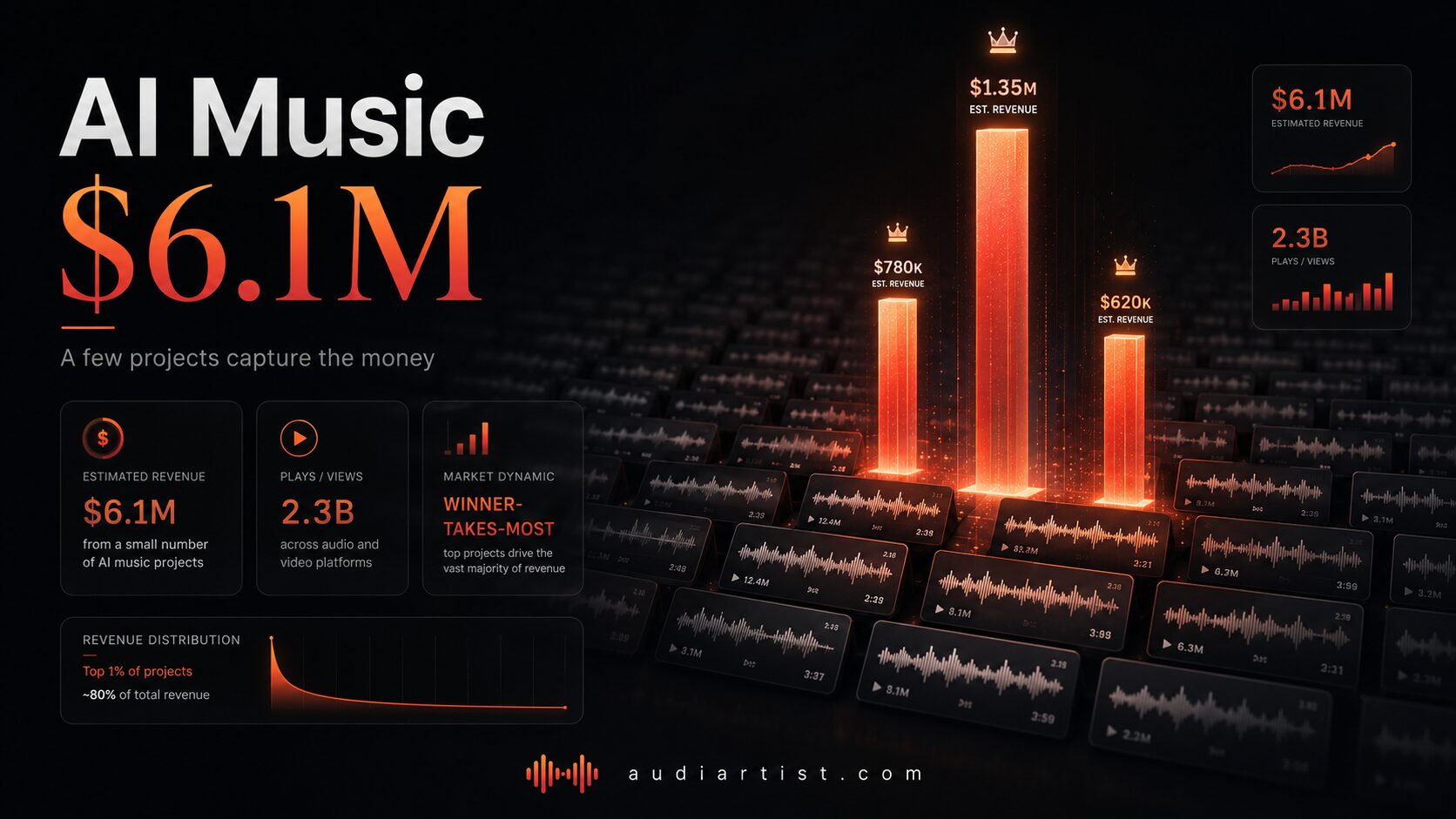

The overwhelming majority of AI-generated music attracts almost no audience, but a small group of synthetic and AI-assisted projects may already have generated millions of dollars from Spotify streams and YouTube views.
A new analysis published by video creation platform Kapwing estimates that the leading AI-associated music acts included in its Spotify and YouTube rankings have accumulated more than 2.3 billion combined streams and views.
Applying average industry rates to those figures produces theoretical gross earnings of approximately $6.1 million.
The headline is striking, particularly when placed beside recent academic research suggesting that 93% of identified AI-generated tracks remain below 1,000 Spotify plays.
Both findings can be true at the same time.
Most synthetic releases disappear without attracting a meaningful audience. A very small number of projects, however, concentrate enormous quantities of attention and may already be generating commercially significant revenue.
Kapwing Estimates Millions in AI Music Revenue
Kapwing published its analysis, titled The Most Streamed and Top-Earning AI Music Artists, on July 14, 2026.
The company began by identifying notable AI-associated music projects through the AiMCharts database. It then used Songstats to collect lifetime Spotify streams, YouTube views, playlist placements, followers and chart appearances.
To estimate revenue, Kapwing applied two standard assumptions:
- $0.004 for every Spotify stream;
- $2.12 for every 1,000 YouTube views.
The YouTube figure corresponds to the midpoint of a revenue-per-thousand-views estimate supplied by SocialBlade.
Using those rates, the Spotify acts appearing at the top of the ranking represent approximately $2.38 million in theoretical gross revenue from around 595 million streams.
The leading YouTube projects account for roughly $3.7 million in estimated advertising revenue. Combined, the two rankings approach $6.1 million from more than 2.3 billion plays and views.
These amounts are calculations, not financial statements supplied by Spotify, YouTube, distributors or the creators themselves.
Enlly Blue Leads Kapwing’s Spotify Ranking
Kapwing identifies Enlly Blue as the highest-earning AI-associated artist in its Spotify analysis.
The project had accumulated approximately 95.2 million Spotify streams when the data was collected. At an estimated rate of $0.004 per stream, that audience produces a theoretical gross total of $380,800.
Enlly Blue is presented as a synthetic blues vocalist inspired by music associated with the 1950s. The project describes its work as a combination of acoustic music, production, recording and AI-powered creativity.
Kapwing reports that the vocals, lyrics and visual identity appear to use generative systems, while the exact balance between human composition, conventional production and artificial intelligence remains less clear.
This uncertainty is important.
Enlly Blue is not necessarily equivalent to a fully automated account generating complete songs from a single prompt. The project may involve significant human selection, arrangement, editing or production.
Behind Enlly Blue, Kapwing places BOI WHAT at approximately $342,400 from 85.6 million Spotify streams.
BOI WHAT combines human-written and performed metalcore with AI-generated voices and character-based visuals. The project is therefore better described as an AI-transformed musical act than as an entirely machine-created artist.
Other highly ranked Spotify projects include Xania Monet and Breaking Rust, with estimated totals of approximately $332,000 and $317,600 respectively.
The figures show that AI-associated music is no longer limited to small experimental communities. Certain projects are reaching audiences comparable to successful independent artists with established catalogues.
Cherry Nightcore Dominates the YouTube Estimate
The largest individual figure in Kapwing’s analysis comes from YouTube.
Cherry 葵 Nightcore had accumulated approximately 941 million views, producing estimated advertising revenue of almost $2 million when calculated at $2.12 per 1,000 views.
The channel primarily publishes Nightcore-style music, a format traditionally involving accelerated tempo, raised pitch, anime imagery and remixes of existing songs.
Its inclusion in an AI music ranking illustrates the difficulty of defining exactly what qualifies as an AI artist.
Kapwing notes that Cherry Nightcore may have been classified because artificial intelligence was used in some of the underlying tracks. However, the channel has also described its production process as involving a conventional digital audio workstation.
The estimated $2 million therefore cannot automatically be described as revenue generated by completely artificial music.
It may include human-created remixes, transformed recordings, traditional editing, AI-assisted material and possibly fully generated content.
Masters of Prophecy ranks second on YouTube, with estimated earnings of approximately $652,375.
The synth-rock project uses Suno as part of its production process. Its creator, James Baker, has said that the songs combine AI performance with hours of human work devoted to lyrics, videos and other creative elements.
Once again, the boundary between artist, producer, editor and prompt operator remains difficult to draw.
The $6.1 Million Figure Is Not a Verified Payout
The most important limitation of the study is also the simplest: no platform has confirmed these payments.
Kapwing multiplied public or commercially collected audience totals by average rates. Real-world music revenue does not work through one universal price for every stream or view.
Spotify does not pay a fixed amount of exactly $0.004 every time a recording is played.
The value of a stream varies according to several factors, including:
- the listener’s country;
- whether the account is free or paid;
- the platform’s revenue in the relevant market;
- the artist’s share of total eligible streams;
- the ownership of the master recording;
- the distributor or label agreement;
- publishing and songwriting rights;
- fraud detection and royalty exclusions.
YouTube income is equally variable.
Advertising revenue depends on audience location, video format, advertiser demand, watch time, copyright claims and whether the content is eligible for monetization.
Some views may generate no advertising revenue. Other videos may be claimed by third-party rights holders, redirecting part or all of the income away from the channel that uploaded them.
The estimates should therefore be understood as broad theoretical gross values before distribution fees, rights splits, platform deductions and taxes.
They are closer to a potential revenue ceiling than to a verified bank balance.
The Category “AI Artist” Is Extremely Broad
Kapwing’s rankings bring together projects using artificial intelligence in very different ways.
One act may generate vocals, lyrics, instrumentation and artwork through AI platforms. Another may write and perform the music traditionally while using a cloned character voice. A third may transform existing recordings into new styles. Another may simply use intelligent software for part of the production process.
Placing all these cases under the same label creates a powerful headline, but it does not necessarily produce a scientifically consistent category.
At least four different types of production can currently appear under the description “AI music”:
- Fully AI-generated music: most or all creative elements are produced by a generative system from prompts.
- AI-assisted music: a human artist remains the primary creator but uses intelligent tools during production.
- AI-transformed music: human performances or recordings are altered through synthetic voices, style transfer or generative editing.
- AI-branded projects: artificial intelligence forms part of the marketing or fictional identity, even when conventional production remains important.
These categories raise different legal, ethical and economic questions.
An original composition using AI mastering should not automatically be treated like a fully synthetic album produced through hundreds of automated prompts.
Similarly, a human musician using an artificial character voice is not directly comparable to an anonymous account uploading thousands of generated tracks.
Without precise disclosure, rankings risk mixing fundamentally different creative practices.
The Artist Selection Is Also Difficult to Verify
Kapwing created its initial list of notable AI music projects using AiMCharts.
However, little public information is available about who operates the database, how projects are classified or what evidence is required before an artist is labelled as AI-associated.
An independent analysis published by AI Musicpreneur also reported that the AiMCharts website was unavailable when its author attempted to inspect the data.
This does not prove that Kapwing’s figures are incorrect.
It does mean that readers cannot easily reproduce the ranking, verify the complete selection process or determine whether comparable artists were excluded.
The problem is particularly visible with projects such as Don Bnnr, which Kapwing describes as highly successful in playlist placement while acknowledging that it is unclear why the producer was classified as an AI musician.
A ranking can calculate streams accurately and still produce a misleading conclusion when the original category is uncertain.
A Few Winners Can Coexist With Millions of Failures
The estimated success of these projects does not contradict research showing that most AI-generated songs receive almost no attention.
Instead, it confirms how concentrated the streaming economy has become.
A recent academic preprint examining AI slop in music streaming found that 93% of identified AI-generated tracks remained below 1,000 Spotify plays.
Only a tiny fraction reached commercially meaningful levels.
This is consistent with Kapwing’s ranking. A handful of highly visible projects generate tens or hundreds of millions of streams, while the overwhelming majority disappear almost immediately.
The same unequal distribution exists in human music, but generative tools can intensify it by dramatically increasing the number of available recordings.
An AI creator can release hundreds of songs while a traditional musician is still completing one album.
The probability of success remains extremely small, but the cost of each failed attempt can approach zero.
This encourages a strategy based on volume. Generate more songs, distribute them across more genres, create multiple fictional identities and wait for one release to connect with a playlist or social media audience.
Almost every track can fail while the overall operation remains profitable.
YouTube May Be More Valuable Than Spotify for Certain Projects
Kapwing’s figures also show that AI-associated projects do not depend exclusively on traditional audio streaming.
Cherry Nightcore’s estimated YouTube revenue is considerably larger than Enlly Blue’s theoretical Spotify earnings.
This highlights the importance of visual identity, fictional characters and high-volume content channels.
AI projects can generate music, cover art, animated visuals, lyric videos and social content using connected workflows. YouTube allows these elements to be combined inside a monetizable video product.
A channel can also attract viewers who are interested in anime imagery, remix culture, fictional personalities or unusual genre combinations, even when the music alone would struggle to build the same audience on Spotify.
For synthetic projects, the visual character may become as important as the song.
Spotify primarily monetizes listening. YouTube monetizes attention around a complete audiovisual format.
This difference may explain why certain AI-associated channels can generate exceptional view totals without becoming equally prominent on audio streaming services.
Streams Do Not Automatically Prove Genuine Popularity
Large numbers require careful interpretation, particularly in an environment where artificial content can be combined with artificial consumption.
Deezer has reported that fully AI-generated music represents only a small percentage of listening on its platform, despite accounting for more than half of daily uploads during peak periods.
The company has also stated that a significant proportion of streams attached to detected AI music has been fraudulent and excluded from royalty calculations.
Kapwing’s study does not claim that the artists in its ranking used fraudulent methods.
However, suspicious growth patterns have been reported around some projects. Masters of Prophecy, for example, reportedly gained tens of millions of YouTube subscribers during a short period, including sudden increases that were difficult to connect to new videos or visible engagement.
Followers, views and streams can therefore indicate reach without proving that every account represents a genuine, active fan.
This issue is not exclusive to AI music. Human artists, labels and promotional networks have also manipulated streaming figures.
Generative technology simply makes the complete system easier to automate. Music can be created automatically, distributed automatically and potentially consumed by automated accounts.
The result is a closed industrial loop that can resemble a music business without requiring a real audience.
Rights Ownership Could Reduce the Final Revenue
Even when streams are genuine, the creator behind an AI project may not control every dollar associated with them.
Some AI music uses remixes, recognizable compositions, fictional character voices, protected visual identities or stylistic imitation.
YouTube’s Content ID system may redirect revenue when copyrighted recordings or compositions are detected.
Streaming distributors may also remove releases or withhold royalties when ownership cannot be demonstrated.
AI-generated vocal performances can create further legal risk when they resemble identifiable artists. The same applies to generated artwork based on protected characters or brands.
A project may theoretically generate hundreds of thousands of dollars from its audience while receiving far less after claims, ownership disputes and contractual deductions.
The calculation of gross platform value is therefore only the beginning of the financial story.
The Money Is Real, but the Map Remains Unclear
Kapwing’s analysis should not be dismissed simply because its figures are estimates.
The underlying audience totals show that AI-associated music projects can attract major levels of attention.
More than 95 million Spotify streams for Enlly Blue and almost one billion YouTube views for Cherry Nightcore represent substantial digital consumption, regardless of the exact amount paid.
The study also demonstrates that AI music is developing multiple commercial models.
Some projects behave like streaming artists. Others operate like YouTube content channels, remix brands, fictional performers or multimedia franchises.
The weakness lies in treating all of them as one clearly defined category.
Until platforms introduce consistent AI-generated and AI-assisted metadata, researchers will continue relying on external databases, public descriptions and visual evidence to determine how the music was created.
That process will inevitably produce errors and disputed classifications.
AI Music Is Developing the Same Winner-Takes-Most Economy
The estimated $6.1 million does not mean that generative music has become an easy source of income.
It reveals the opposite.
A tiny number of projects appear to capture most of the available audience, while millions of tracks receive little or no engagement.
The business model resembles the wider streaming economy, but with production costs reduced to an unprecedented level.
Human musicians often need to invest in instruments, recording, mixing, mastering, artwork and promotion before discovering whether an audience exists.
AI publishers can test dozens of voices, identities and genres at a fraction of that cost.
This gives them more opportunities to find a successful format, but it does not guarantee listener interest.
Artificial intelligence can manufacture supply. It still cannot manufacture genuine attachment at the same speed.
An Estimate That Still Deserves Attention
Kapwing’s $6.1 million figure should not be presented as audited income.
It is based on flat average rates, third-party audience data and a list of artists whose classification is not always transparent.
Some projects appear to be fully synthetic. Others combine human writing, performance, production, remixing and AI transformation. Several sit somewhere between those categories.
Nevertheless, the analysis captures an important shift.
AI-associated music is no longer producing only novelty tracks and short-lived experiments. Its most successful projects are building large audiences, entering playlists, appearing in charts and creating economic value across streaming and video platforms.
The real figure may be lower after deductions, or higher if additional projects were missed.
What matters is that revenue is beginning to concentrate around synthetic identities and AI-driven production systems before the industry has agreed on consistent definitions, disclosures or royalty rules.
Ninety-three percent of AI music may remain almost completely ignored. The remaining few percent are beginning to look less like a technical demonstration and more like a business.