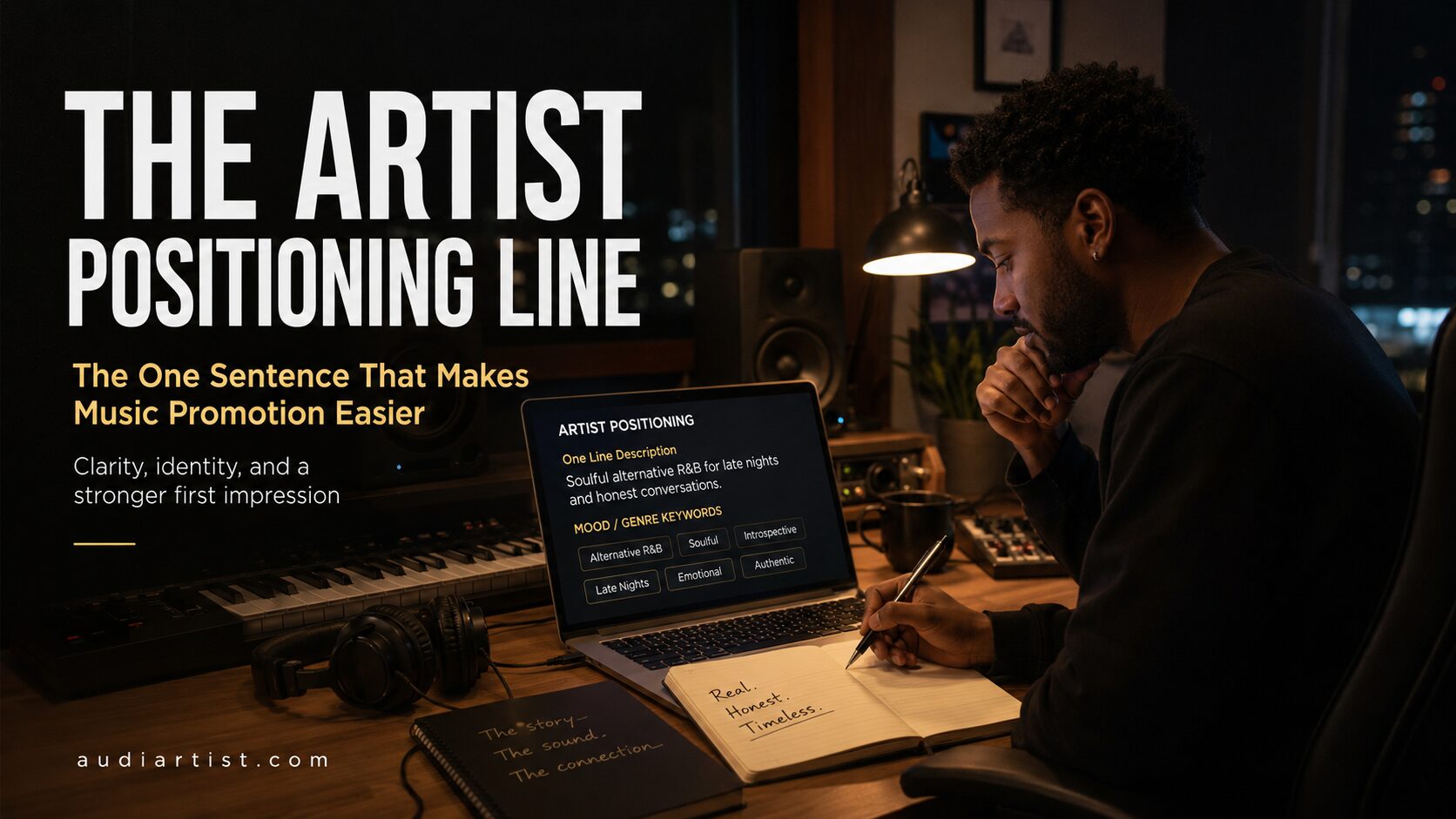

The Artist Positioning Line: The One Sentence That Makes Music Promotion Easier
The music may be good. The production may be serious. The artwork may look professional. The artist may post regularly, pitch to playlists, send emails, create short videos, and keep every profile updated. Yet when a new listener, curator, journalist, blogger, playlist owner, or potential fan lands on the project, one basic question remains unanswered: what exactly is this artist?
That question sounds simple, but it is one of the most powerful forces in music promotion. In a crowded release environment, listeners do not have time to decode every artist from scratch. Curators do not have time to listen without context. Journalists do not have time to build a story for someone who cannot explain their own. Social media users do not stop scrolling for vague identities. If the artist cannot create a clear first impression, the campaign becomes heavier than it needs to be.
This is where the artist positioning line becomes essential. It is a single sentence that defines the artist’s musical world in a way that is clear, memorable, and useful. It is not a slogan. It is not a biography. It is not a fake marketing phrase. It is a strategic sentence that helps people understand the sound, audience, mood, and identity of the project quickly.
A strong artist positioning line can improve almost every part of music promotion: playlist pitching, social media bios, press releases, smart link pages, Spotify profiles, email outreach, artist websites, YouTube descriptions, ad copy, interviews, and release campaigns. It gives the artist a center of gravity. Without it, every campaign starts from zero.

Why Artist Positioning Matters More Than Ever
Music discovery has become incredibly fast. A listener may discover a song through a reel, a playlist, a short video, a blog headline, a radio mention, a recommendation, or a streaming algorithm. In each case, the artist has only a few seconds to create recognition. The song may do the emotional work, but the positioning gives the listener a reason to understand where the music belongs.
Positioning is not about limiting creativity. Many artists fear that defining themselves too clearly will make the project feel smaller. In reality, the opposite is often true. A precise identity makes the artist easier to discover, easier to recommend, and easier to remember. It creates an entry point.
An undefined artist may describe their music as “a mix of different influences,” “something unique,” “emotional and powerful,” or “not really one genre.” These statements may be true, but they do not help anyone. They are too vague to guide a listener, too soft for a pitch, and too generic for SEO. A positioning line turns that fog into a clear signal.
In music promotion, clarity is not decoration. It is conversion. The easier an artist is to understand, the easier it becomes for people to take the next step.
The Difference Between a Positioning Line and a Bio
An artist bio tells the story. A positioning line opens the door.
A biography can include origin, influences, career background, releases, collaborations, awards, personal journey, creative philosophy, and future direction. It gives depth. But most people will not read a full bio until they already care. The positioning line works earlier. It is the first sentence that helps a stranger decide whether they want to know more.
For example, “independent producer from France making electronic music” is technically informative, but it is not positioned. It tells us a location and a broad genre. It does not tell us the experience. Compare that with a line such as “cinematic Afro house built for late-night dance floors and emotional sunrise sets.” The second version immediately creates a world. It tells us the mood, the genre area, the listener context, and the energy.
A strong positioning line does not need to explain everything. It needs to make the artist easier to place in the listener’s mind. That first mental placement is powerful. Once someone understands where the artist belongs, the music has a better chance of being heard with the right expectations.
The Four Elements of a Strong Artist Positioning Line
A useful positioning line usually combines four elements: sound, audience, mood, and distinction. The exact formula can vary, but the best lines help answer four hidden questions at once.
What does the music sound like? This does not always mean naming one genre. It can include sonic references, atmosphere, instrumentation, production style, or energy. A line might mention deep house, lo-fi, cinematic pop, dark techno, synthwave, indie folk, Latin urban, alternative R&B, or experimental electronic textures. The genre gives the listener orientation.
Who is it for? This does not mean reducing the audience to demographics. It means identifying the listening context or emotional tribe. Is the music for late-night drivers, club selectors, bedroom producers, nostalgic synth lovers, study sessions, underground dance floors, emotional pop fans, or cinematic trailer listeners?
What does it feel like? Mood is often more powerful than genre. A track can be warm, tense, melancholic, hypnotic, euphoric, intimate, elegant, raw, futuristic, nostalgic, spiritual, or aggressive. Mood gives the artist emotional shape.
What makes it different? This is the most delicate part. The line should suggest distinction without sounding exaggerated. “Unique” is weak because everyone uses it. “Genre-defying” is often vague. Stronger distinction comes from specific combinations: analog synth textures with modern club pressure, acoustic songwriting with cinematic production, lo-fi nostalgia with jazz harmony, Afro house rhythms with darker electronic atmospheres.
When these four elements work together, the artist becomes easier to pitch, describe, and remember.
Why Vague Artist Descriptions Do Not Convert
Many independent artists avoid precise descriptions because they want to stay open. They do not want to be boxed in. They have many influences. They love several styles. They want the music to speak for itself. This instinct is understandable, but it can create serious promotion problems.
Vague language forces other people to do too much work. A curator receiving hundreds of submissions does not want to guess whether a track fits a playlist. A journalist does not want to invent the artist’s angle. A listener scrolling through social media does not want to decode a project from a cryptic caption. If the artist does not provide a clear frame, the audience may move on before the music gets a fair chance.
Words like “authentic,” “different,” “emotional,” “fresh,” “powerful,” and “unique” can be useful only when supported by specifics. On their own, they are too general. They say how the artist wants to be perceived, but not what the listener will actually experience.
The goal is not to remove mystery. Mystery can be part of an artist’s identity. But even mystery needs shape. A dark, cinematic, ritual-inspired electronic project is mysterious in a way people can understand. “A unique musical universe” is not enough.

How Positioning Improves Playlist Pitching
Playlist pitching becomes much stronger when the artist has a clear positioning line. Curators are not only listening for quality. They are listening for fit. A track can be well-produced and still be wrong for the playlist. A strong positioning line helps the curator understand the track’s context before pressing play.
Instead of writing, “Here is my new single, I hope you like it,” an artist can frame the submission more precisely: “This is a hypnotic Afro house track with warm percussion, deep vocal textures, and a late-night club atmosphere.” That sentence immediately tells the curator where the track might belong.
The positioning line also helps artists avoid pitching to the wrong playlists. If the sentence clearly points toward dark cinematic techno, there is no reason to send the song to sunny tropical house playlists. If the line defines the project as intimate lo-fi with jazz-inspired textures, high-energy EDM playlists are not the right target. The clearer the positioning, the less energy is wasted.
Good pitching is not about sending music everywhere. It is about helping the right people understand the right track faster.
How Positioning Improves Social Media
Social media is often where unclear positioning becomes most visible. An artist may post studio clips, memes, release links, personal photos, playlist screenshots, visualizers, and random thoughts, but the audience never forms a clear picture. The profile feels active, yet difficult to remember.
A positioning line can act as the creative compass for content. If the artist is positioned around cinematic electronic music for late-night emotional listening, the visuals, captions, colors, video ideas, and storytelling should support that world. If the artist is positioned around raw guitar-driven rock with live energy, the content should not feel like a generic pop campaign.
This does not mean every post must repeat the same sentence. The positioning line works behind the scenes. It gives the artist a filter. Does this post strengthen the world I am building? Does this caption match the mood of the music? Does this visual help new people understand the project? Does this clip make the right listener curious?
When the answer becomes yes more often, social media stops feeling random. It becomes a recognizable extension of the music.
How Positioning Helps With SEO
Artist positioning is not only useful for human readers. It also helps search engines understand the content around the artist. A clear positioning line naturally introduces keywords related to genre, mood, scene, and listening context. That can improve the way an artist appears in blog articles, interviews, website pages, YouTube descriptions, press releases, and music discovery searches.
An artist described only as “an independent musician with a unique sound” gives search engines very little to work with. An artist described as “a French Afro house producer blending tribal percussion, deep electronic textures, and melodic club energy” creates a far richer keyword environment. The sentence is still human, but it also carries useful search information.
This matters for long-term discovery. Not every listener arrives on release day. Some discover artists through Google, YouTube, playlist pages, music blogs, social profiles, and platform search. Clear positioning makes the artist easier to categorize, recommend, and connect to relevant topics.
SEO does not mean stuffing keywords into every sentence. It means using accurate language that reflects the artist’s sound and audience. A good positioning line does that naturally.
The Positioning Line as a Filter for Decisions
A strong positioning line does more than improve communication. It helps artists make better decisions.
When the artist understands the project’s core identity, it becomes easier to choose artwork, write captions, select playlists, design visuals, plan videos, accept collaborations, target ads, pitch blogs, and decide which songs belong in the release schedule. The positioning line becomes a filter.
If a collaboration does not support the artist’s world, it may not be the right move. If a visual looks attractive but does not match the music, it may confuse the audience. If a playlist has a big following but the wrong mood, it may produce passive streams rather than real fans. If a song feels too far from the project’s identity, it may need a side alias, a different campaign, or more development.
This kind of clarity protects the artist from scattered promotion. It keeps the project coherent without making it rigid.
How to Write Your Artist Positioning Line
The best way to begin is to avoid trying to sound impressive. Start by being accurate. Write down the genre or musical area, the emotional mood, the listening context, and the detail that makes the project recognizable.
A simple structure can help: “I make [genre or sound] for [audience or context], blending [distinctive elements] with [emotional or cultural mood].” This structure is not meant to be copied mechanically. It is a starting point.
For example, a lo-fi artist might write: “Mellow lo-fi instrumentals for late-night focus, blending soft piano textures, dusty drums, and nostalgic warmth.” A synthwave producer might write: “Retro-futuristic synthwave for neon nights, built with cinematic melodies, driving basslines, and 1980s-inspired tension.” A Latin urban artist might write: “Latin urban pop with sensual melodies, reggaeton pulse, and a cinematic edge designed for night-drive playlists.”
The strongest lines are specific without becoming overloaded. If the sentence includes too many genres, too many adjectives, and too many promises, it becomes heavy. The goal is clarity, not a full press kit.
What to Avoid
A weak positioning line often makes one of three mistakes. It is too vague, too inflated, or too complicated.
Too vague sounds like this: “An independent artist creating emotional music with a unique sound.” That could describe thousands of musicians. It does not create memory. Too inflated sounds like this: “A revolutionary artist changing the future of music forever.” Unless the artist can truly support that claim, it sounds artificial. Too complicated sounds like a sentence with five genres, six moods, and no clear center.
The best positioning lines feel confident but not forced. They do not scream. They guide. They help listeners recognize the project without feeling like they are reading an advertisement.
Artists should also avoid building the entire line around comparisons to famous names. “For fans of” references can be useful in pitches, but the artist’s own identity should still stand on its own. The goal is not to sound like a smaller version of someone else. The goal is to become easier to understand.
Testing the Line in the Real World
A positioning line is not finished because it looks good in a notebook. It needs to work in the real world. Artists should test it across several situations: a social bio, a playlist pitch, an email introduction, an artist website, a release description, and a spoken explanation.
If people understand the project faster, the line is doing its job. If curators respond more clearly, that is a good sign. If listeners repeat the same words back, even better. If the line feels awkward, too long, or disconnected from the music, it needs refining.
The strongest positioning often becomes obvious over time. Artists may notice that fans describe the music in a certain way, or that one mood keeps returning in comments. They may discover that a certain genre tag produces better playlist results, or that one visual identity creates stronger recognition. The positioning line should listen to the audience as much as it guides them.
It can evolve. An artist’s identity is not frozen forever. But at each stage, the project needs a clear sentence that reflects where it stands now.
Using the Positioning Line Across a Release Campaign
Once the line is strong, it should become part of the release ecosystem. It can appear in the artist bio, press release opening, website introduction, Spotify profile, YouTube about section, playlist pitches, and smart link page. It can also guide shorter social captions without being repeated word for word.
For a new single, the positioning line can be adapted into the track pitch. If the artist’s overall identity is “melodic Afro house with cinematic atmosphere and late-night club energy,” a specific song might be described as “a darker, percussion-driven Afro house single built around hypnotic vocals and sunrise tension.” The artist identity stays consistent, while each release gets its own angle.
This balance matters. The positioning line gives continuity. The single description gives freshness. Together, they help the campaign feel both recognizable and alive.
Why Clarity Makes Artists More Memorable
People remember what they can describe. If a listener cannot explain an artist to a friend, the artist becomes harder to spread. Word of mouth depends on clarity. So does press. So does playlist pitching. So does search. So does branding.
A clear positioning line gives people language. It helps a curator understand the fit. It helps a journalist frame the story. It helps a listener recommend the artist. It helps the artist stay consistent across platforms. It reduces friction at every point of discovery.
This does not mean every artist needs to become predictable. Some of the most interesting artists are difficult to categorize. But even complex artists benefit from a clear entry point. A door does not need to explain the whole house. It only needs to let people in.
One Sentence Can Change the Campaign
Music promotion often feels like a battle for more: more posts, more playlists, more ads, more content, more platforms, more releases, more links, more visibility. But sometimes the most powerful improvement is not more activity. It is sharper identity.
The artist positioning line is small, but its impact can be enormous. It clarifies the project, strengthens pitches, improves SEO, guides content, supports branding, and helps listeners understand why the music deserves attention.
Independent artists do not need to sound like marketing departments. They need to sound clear. They need one sentence that opens the door before the song begins.
Because in a world where thousands of tracks arrive every hour, the artists who are easiest to understand often get the first chance to be heard.
Discover more independent music promotion strategies, artist resources, and playlist insights on Audiartist.