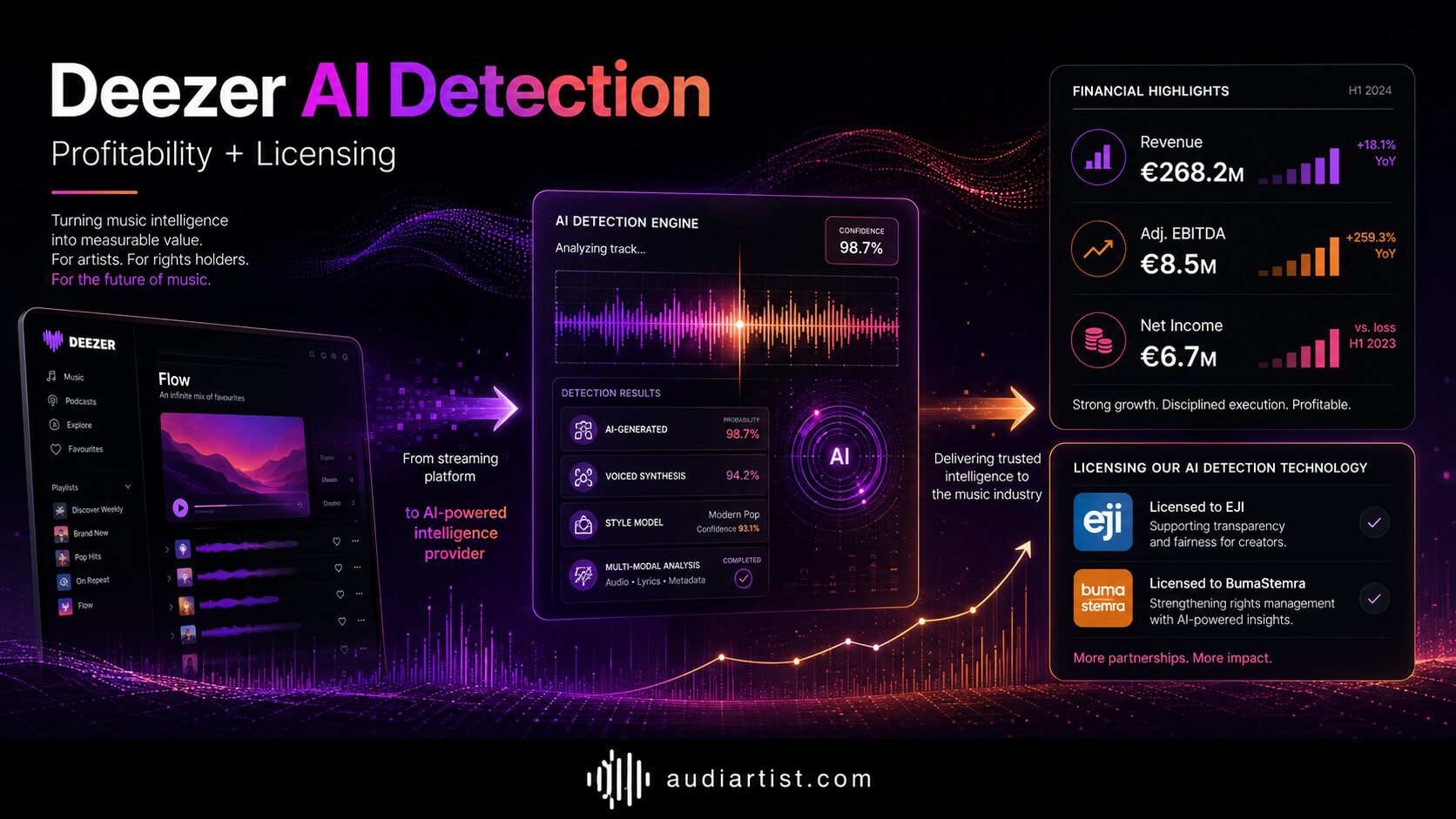

Deezer has delivered another profitable half-year while beginning to transform its proprietary AI music detection technology into a commercial product for collecting societies, rights holders and other music businesses.
The French streaming company reported revenue of €268.2 million for the first six months of 2026, an increase of 0.4% compared with the same period last year.
The headline growth appears modest, but the figures reveal a significant shift inside Deezer’s business. Direct subscriptions continued to expand, operating costs declined and the company moved from a net loss of €7.6 million in the first half of 2025 to a positive net income of €6.7 million.
At the same time, Deezer is beginning to monetize one of its most visible technological investments. Its AI detection system is no longer used exclusively to identify synthetic music on Deezer’s own platform. Collecting societies in Hungary and the Netherlands have now licensed the technology to analyse recordings and protect their members’ rights.
The development creates a new strategic possibility for Deezer. The company may remain considerably smaller than Spotify, Apple Music and YouTube, but it could become an important infrastructure provider in the music industry’s attempt to identify, classify and manage fully AI-generated recordings.
Deezer Reports €268.2 Million in Half-Year Revenue
Deezer generated total revenue of €268.2 million during the six months ending June 30, 2026, compared with €267.1 million a year earlier.
Revenue increased by 0.4% at both current and constant exchange rates, in line with the company’s expectations.
The overall result combines three very different trends.
Direct subscription revenue increased by 6.7% to €185.2 million. Partnerships revenue declined by 7.6% to €70.7 million, while advertising and other revenue fell by 27.5% to €12.3 million.
The decline in partnership revenue was primarily connected to the gradual end of Deezer’s agreement with Mercado Libre. The company says this part of the business began to stabilize sequentially during the second quarter after several periods of decline.
Other revenue was affected by the expiry of a content licensing agreement during the fourth quarter of 2025.
Deezer’s results therefore do not show strong growth across the entire company. They show that an expanding direct subscription business is compensating for weaker revenue from partnerships and ancillary activities.
Direct Subscriptions Become Deezer’s Main Growth Engine
Deezer ended June 2026 with 5.8 million direct subscribers, an increase of 8.7% from 5.3 million a year earlier.
In France, its direct subscriber base reached 3.9 million, representing growth of 8.4%. Direct subscribers outside France increased by 9.2% to approximately 1.9 million.
This growth is strategically important because direct customer relationships generally give Deezer greater control over pricing, engagement and retention than subscriptions distributed through telecommunications companies or commercial partners.
Direct revenue increased by €11.6 million during the period, from €173.6 million to €185.2 million.
However, the average monthly revenue per direct subscriber declined by 2.1% to €5.40 excluding VAT. Subscriber growth is therefore producing additional revenue even as the average contribution from each direct account decreases slightly.
Partnership subscriptions moved in the opposite direction. Their number fell by 20.2%, from 3.9 million to 3.1 million, although partnership ARPU increased by 19.1% to €3.70 per month.
Deezer’s total reported subscriber base consequently declined by 3.5% to 8.9 million.
This distinction matters. Looking only at total subscribers would suggest contraction. Looking specifically at direct customers shows that Deezer is growing in the part of its business it considers most strategically valuable.
Deezer Posts Positive EBITDA and Net Income
Adjusted EBITDA reached €8.5 million during the first half of 2026, compared with €2.1 million during the same period in 2025.
The €6.3 million improvement was supported by strict control of sales, marketing and administrative expenses, together with a slight increase in adjusted gross profit.
Adjusted EBITDA represented 3.2% of total revenue, up from 0.8% one year earlier.
Operating income reached €6.5 million, compared with an operating loss of €7 million in the first half of 2025. Net income improved by €14.3 million to reach a positive €6.7 million.
The results indicate that Deezer’s profitability is no longer based solely on an adjusted performance measure. The company also produced positive operating income and positive net income under its reported financial statements.
Deezer described its profitability as sustainable, although the relatively narrow margins show that continued cost discipline will remain necessary.
Free Cash Flow Requires Additional Context
Deezer generated €37.4 million in free cash flow during the first half of 2026, compared with €1 million a year earlier.
The figure is impressive, but it should not be interpreted as entirely recurring operational cash generation.
The company recorded a €31.1 million positive change in working capital, including a significant one-off advance payment received under a partnership agreement.
Higher adjusted EBITDA and limited capital expenditure also supported the result.
Cash and cash equivalents reached €99.8 million at the end of June, up from €65.4 million at the end of December 2025. Net cash increased to €95 million.
This stronger financial position gives Deezer more flexibility to invest in product development, marketing, partnerships and artificial intelligence. Nevertheless, the exceptional advance means that the first-half free cash flow figure should not automatically be used as a guide for future periods.
AI Music Detection Becomes a Commercial Product
The most distinctive part of Deezer’s strategy concerns its proprietary AI music detection technology.
The system was originally developed to identify recordings created entirely with generative platforms such as Suno and Udio. Deezer uses the technology to label detected tracks and exclude them from editorial and algorithmic recommendations.
The platform says it now receives close to 90,000 fully AI-generated tracks every day. At peak levels during June 2026, synthetic recordings represented more than half of all daily music delivered to Deezer.
These uploads account for only a small share of genuine listening activity, but they create significant problems for catalogue management, royalty allocation and streaming fraud detection.
Deezer is now positioning its identification technology as a service that can be licensed by external organizations.
This marks an important change. AI detection is moving from an internal moderation expense to a potential source of business-to-business revenue.
Hungarian Performers’ Society EJI Licenses the Technology
Hungary’s Bureau for the Protection of Performers’ Rights, known as EJI, has acquired usage rights for Deezer’s AI Detection solution.
The agreement allows EJI to analyse publicly available recordings and identify the presence of generative artificial intelligence.
EJI represents performers and distributes royalties connected to the use of recorded performances. Fully synthetic recordings create a particular challenge for such organizations because they may generate usage data without involving a recognizable human performer.
Reliable detection can help a collecting society distinguish between recordings involving human participation and content created entirely through generative systems.
EJI described the agreement as a way to support a more proportionate distribution of royalties and became the first Hungarian collective management organization to obtain this capability.
For Deezer, the partnership was an initial demonstration that its research could be sold outside its own streaming platform.
BumaStemra Extends the Commercial Model
BumaStemra, the Dutch collecting society representing composers and music publishers, has also licensed Deezer’s AI detection tool.
The organization represents approximately 38,000 members and is using the technology to improve its ability to differentiate between AI-generated and human-created music.
BumaStemra had already been testing AI detection at the level of individual musical works and publisher catalogues. Access to Deezer’s technology expands that effort as the volume of synthetic content delivered to digital platforms continues to grow.
The EJI and BumaStemra agreements show that demand for AI detection exists beyond streaming services.
Collecting societies need to understand what kinds of recordings are entering their databases, which works involve protected human contributions and whether royalty systems are being exposed to synthetic content or automated fraud.
Record labels, distributors, publishers and music licensing companies may face similar requirements.
Deezer for Business Creates a Wider Commercial Framework
Deezer has incorporated AI Detection into its expanded Deezer for Business offering.
The business-to-business division now covers five areas: partnerships, music as a service, advertising, professional music solutions and AI detection.
This structure shows that Deezer no longer wants to compete only for individual streaming subscribers.
The company is also selling technology, licensing expertise, catalogue access and music infrastructure to other brands and organizations.
Its recent agreement with Winamp follows the same logic. Deezer will provide white-label streaming technology and a licensed global catalogue for Winamp’s planned premium subscription service.
AI detection adds another specialized product to that portfolio. Unlike a consumer subscription, it addresses a technical problem affecting the complete music value chain.
Why AI Detection Could Become Valuable
The commercial opportunity is being created by the extraordinary growth of generative music.
Music distribution systems were developed for a market in which recording and releasing a song required time, equipment and financial investment. Generative platforms can now produce thousands of recordings within hours.
Distributors, streaming services and rights organizations are receiving more content than human moderation teams can realistically examine.
Automated detection may help them answer several important questions:
- Was a recording created entirely by a generative system?
- Does it contain a human performance?
- Should it be eligible for specific royalties or recommendations?
- Is the account uploading unusual quantities of synthetic content?
- Are streams connected to the recording genuine or manipulated?
- Has the use of AI been properly disclosed in the metadata?
No detection tool can resolve all these issues independently, but it can provide a first layer of classification at a scale that manual review cannot match.
The industry’s need for such systems is likely to increase as AI music becomes easier to generate and harder for ordinary listeners to recognize.
Detection Must Not Confuse Assisted and Fully Generated Music
The value of Deezer’s technology will depend heavily on its accuracy and the way its results are used.
There is an important difference between a song created entirely through a generative platform and a human recording that uses AI-assisted mastering, restoration, stem separation or sound design.
A detection system that treats every use of machine learning as equivalent could penalize legitimate artists and producers.
Deezer currently focuses its public policy on fully AI-generated music rather than recordings that merely use intelligent production tools.
This distinction must remain clear when the technology is licensed to external organizations.
Detection results should also be treated as evidence for further review rather than an automatic legal judgment. False positives could affect royalties, distribution access and the reputation of human artists.
Transparency about accuracy, confidence levels and appeal procedures will therefore be essential.
Deezer Is Building a Different Competitive Position
Deezer cannot match Spotify, Apple or YouTube through scale alone.
Its strategy increasingly appears to involve differentiation through specialized technology, direct subscriber relationships and services for other companies.
The company has already positioned itself around artist-centric remuneration, AI transparency, fraud prevention, playlist analysis and licensed remixing.
Commercializing AI detection fits naturally into that identity.
Spotify and Apple Music may have larger audiences, but Deezer has made AI classification one of its most visible public commitments. Selling the underlying technology could allow the company to benefit even when synthetic content appears on platforms or in catalogues it does not control.
In that sense, Deezer is attempting to become part of the infrastructure used to manage the AI music economy.
Profitability Gives Deezer More Strategic Freedom
Positive earnings and a stronger cash position arrive at an important moment.
Developing reliable audio detection requires research, training data, engineering talent and continuous adaptation as generative models change.
A company operating under constant financial pressure would struggle to maintain that investment.
Deezer’s improving profitability gives it greater flexibility to continue developing the technology while exploring new licensing agreements.
The company has confirmed its financial guidance for 2026. It expects full-year revenue to remain stable compared with 2025 while maintaining positive adjusted EBITDA and generating positive free cash flow for a third consecutive year.
Deezer also plans to increase selective investments during the second half, provided those investments produce measurable returns.
From Streaming Platform to Music Technology Provider
Deezer’s first-half results reveal a company in transition.
Its direct subscription business is growing, profitability has improved and the balance sheet is considerably stronger. Partnership revenue remains under pressure, total subscriber numbers have declined and part of the cash flow improvement resulted from an exceptional payment.
The financial story is therefore positive, but more complex than a simple return to growth.
The AI strategy may prove even more significant.
By licensing its detection system to EJI and BumaStemra, Deezer has shown that its technology can serve collecting societies as well as streaming platforms. AI Detection has now become one of the commercial pillars of Deezer for Business.
The company is effectively turning one of the streaming industry’s largest problems into a potential new revenue source.
AI-generated music continues to multiply faster than genuine listener demand. Every new synthetic upload creates additional work for distributors, platforms and rights organizations attempting to protect royalties and maintain transparent catalogues.
Deezer may never be the largest music streaming platform. It could still become one of the companies paid to help the rest of the industry determine whether the music was created by people at all.