AOFN Audio has released Grizzly, a free stereo modulation plugin inspired by the unconventional character of the classic Gristleizer circuit.
Released in July 2026, Grizzly combines amplitude modulation, rhythmic gating, filter movement, stereo animation and circuit-inspired drive inside a deliberately direct interface. There are no preset browsers, hidden pages or decorative control panels. The plugin provides ten knobs, two processing modes and enough instability to make a perfectly sensible drum loop reconsider its life choices.
What Is Grizzly?
Grizzly is a stereo audio effect developed by AOFN Audio for producers who want to introduce rhythmic movement and filter modulation into drums, guitars, synthesizers, vocals and complete buses.
The plugin is inspired by the Gristleizer, an experimental modulation circuit associated with the early industrial music scene. Its distinctive behaviour came from using a low-frequency oscillator to control either the amplitude or filtering of an incoming signal.
Grizzly translates that concept into a modern plugin while retaining the slightly aggressive and unpredictable personality that made the original approach so interesting.
Two Main Processing Modes
Grizzly provides two operating modes named VCA and VCF.
VCA Mode
VCA mode controls the amplitude of the incoming audio.
At slower modulation speeds, the effect behaves like a traditional tremolo. Increasing the depth produces more noticeable volume movement, while square and saw waveforms can create harder rhythmic cuts and gated patterns.
When the modulation speed rises beyond approximately 20 Hz, the effect begins to move into audio-rate amplitude modulation. This introduces metallic and ring-modulation-style tones that can substantially alter the harmonic character of the source.
VCA mode can be used for:
- Slow tremolo effects
- Rhythmic pumping
- Chopped vocal patterns
- Gated drum loops
- Pulsing synthesizer pads
- Metallic audio-rate modulation
VCF Mode
VCF mode uses the internal oscillator to open and close a low-pass filter.
This produces repeating tonal movement rather than direct volume modulation. Depending on the waveform, speed, bias and depth settings, the result can range from gentle filter breathing to aggressive autowah and dub-style cutoff pulses.
VCF mode is particularly effective on sustained sounds because the filter movement introduces variation without requiring new notes or additional automation.
It can be used for:
- Autowah-style guitar effects
- Moving synthesizer basslines
- Slow filter sweeps
- Rhythmic dub pulses
- Animated pads and drones
- Industrial filter patterns
Four LFO Waveforms
The internal low-frequency oscillator includes four waveform options:
- Triangle
- Square
- Saw up
- Saw down
The triangle waveform creates smoother movement and is suitable for tremolo, gradual filter sweeps and breathing modulation.
The square waveform moves abruptly between two values. It is useful for rhythmic gating, hard filter pulses and mechanical chopping effects.
The two saw waveforms create directional movement. Saw up can repeatedly build toward an open or louder state, while saw down moves in the opposite direction.
Free-Running and Tempo-Synchronized Modulation
Grizzly can operate freely between 0.01 Hz and 30 Hz.
At the lowest settings, one modulation cycle can unfold very slowly, making the plugin useful for ambient textures and gradual tonal movement. Faster settings produce conventional tremolo and filter effects before eventually reaching metallic audio-rate territory.
The oscillator can also synchronize with the tempo of the DAW. Available note divisions extend from 1/1 to 1/32, allowing the modulation to follow the rhythmic structure of a project.
Tempo synchronization is particularly useful on drums, arpeggios, basslines and vocals because the effect can be locked directly to the groove.
Shape Control
The Shape parameter changes the behaviour of selected oscillator waveforms.
With the triangle waveform, Shape adjusts the symmetry of the cycle. The modulation can move from a fast rise and slower fall to a balanced shape or the opposite movement.
With the square waveform, Shape changes the duty cycle. This determines how long the waveform remains in its high or low state during each cycle.
A short active stage can create brief rhythmic accents, while a longer stage produces wider gates and sustained filter openings.
Offset and Bias
Offset and Bias provide deeper control over how the modulation interacts with the signal.
Offset changes how much of each oscillator cycle drives the effect. Negative settings can restrict the effect to a smaller section of the cycle, producing silence or reduced activity between individual pulses.
Positive settings allow more of the cycle to remain active, creating smoother and more continuous modulation.
Bias changes the resting position of the effect.
In VCA mode, it determines the amount of attenuation that remains between modulation peaks. In VCF mode, it controls the basic brightness of the filter when the oscillator is at its lowest point.
These two controls are important for moving beyond conventional tremolo. They allow producers to create asymmetrical movement, uneven pulses and deliberately unstable rhythmic behaviour.
Drive and Circuit-Inspired Character
The Drive control provides between -12 dB and +24 dB of gain before the modulation stage.
Lower settings can reduce the signal before processing, while positive values push the audio harder into the modelled circuit.
This can add warmth, saturation and additional harmonic texture before the amplitude or filter modulation takes place.
On clean guitars, electric pianos and synthesizers, moderate drive can make the effect feel less clinical. Higher settings are more appropriate for industrial drums, distorted basses and experimental sound design.
Stereo Movement With Spread
The Spread control offsets the oscillator phase between the left and right channels.
At low values, both channels move together. Increasing Spread causes the channels to reach different points in the modulation cycle, producing wider stereo motion.
This can create effects similar to auto-panning, ping-pong gating and alternating filter movement.
Spread can be particularly effective on mono synthesizers, drum loops, backing vocals and static samples that need additional movement across the stereo field.
Strong stereo modulation should still be checked in mono because extreme differences between the left and right channels can alter the perceived balance when both channels are combined.
Using Grizzly on Drums
Drums are one of the most effective sources for Grizzly.
A synchronized square waveform in VCA mode can transform a conventional loop into a chopped rhythmic pattern. Shape and Offset can then adjust the duration and position of each pulse.
VCF mode can create repeating filter movement while preserving more of the original dynamics. This works especially well on percussion loops, hi-hats and parallel drum buses.
Applying the plugin in parallel makes it possible to blend an aggressively processed signal beneath the original drums without removing their main transients.
Using Grizzly on Synthesizers
Slow triangle modulation can introduce movement into pads, drones and sustained chords.
For bass sounds, VCF mode can create repeating filter pulses that remain synchronized with the arrangement. Increasing Drive adds more harmonic information before the filter begins moving.
At faster settings, VCA mode can turn simple waveforms into metallic and inharmonic textures. Recording the processed result as audio creates additional material for resampling, pitching and further editing.
Using Grizzly on Vocals and Guitars
Vocal phrases can be transformed into rhythmic chops without manually editing every syllable.
A tempo-synchronized square waveform provides harder cuts, while triangle modulation creates smoother movement. Spread can separate processed vocal layers across the stereo image.
On guitar, VCF mode works as an automated filter effect, while VCA mode can produce tremolo ranging from subtle vintage movement to extreme industrial gating.
No Presets and No Menus
Grizzly does not include a preset browser.
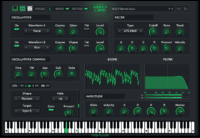
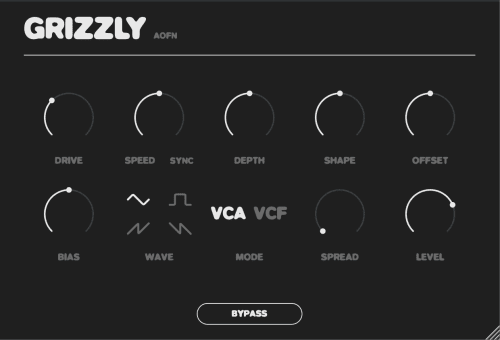
The complete interface remains visible at all times, with controls for Drive, Speed, Depth, Shape, Offset, Bias, Wave, Mode, Spread and output Level.
This design encourages producers to create settings directly rather than browse through factory presets. It also makes the plugin faster to understand once the relationship between Offset, Bias and Shape becomes clear.
Formats and Compatibility
- Windows: VST3
- Windows requirements: Windows 10 or Windows 11, 64-bit
- macOS: VST3 and Audio Unit
- macOS requirements: macOS 12 or later
- Mac processors: Apple Silicon and Intel
- Current version: 1.0.0
- Plugin type: Stereo modulation audio effect
No VST2, AAX, CLAP, Linux or standalone edition is currently listed.
How to Download Grizzly
Grizzly is available free of charge from the official AOFN Audio website.
An email address is required to receive the installer and accompanying read-me file. The developer indicates that the address may also be used for occasional product news.
No purchase, subscription or paid upgrade is required to access the complete plugin.
Download Grizzly from the official AOFN Audio website
Important Limitations
Grizzly is a focused modulation effect rather than a complete multi-effects processor.
It does not include an envelope follower, step sequencer, modulation matrix, multiband processing or preset management system.
Its character is also intentionally less controlled than a transparent modern tremolo or filter plugin. Producers looking for perfectly smooth and neutral movement may prefer a more conventional modulation tool.
Grizzly becomes most interesting when it is used for rhythmic asymmetry, aggressive filtering and effects that are allowed to behave slightly badly.
Final Verdict
Grizzly is a distinctive free modulation plugin for producers who want more personality than a standard tremolo or automated low-pass filter.
Its VCA and VCF modes cover amplitude movement, rhythmic gating, autowah, filter pulses and audio-rate modulation, while Shape, Offset and Bias provide detailed control over the behaviour of every cycle.
For Industrial, Techno, Electronic Rock, Synthwave, Experimental, Ambient and cinematic sound design, Grizzly offers an immediate way to transform static material into moving and frequently unruly textures.
With a clear interface, modern plugin formats and no restricted premium edition, it is one of the more characterful free VST3 releases of 2026.