
Hammer & Meißel: A Free Polyphonic Modal Filter for Experimental Sound Design
Keytracked modal, formant, comb and low-pass filtering with custom resonant materials, MIDI polyphony and unusual physical-modeling textures.
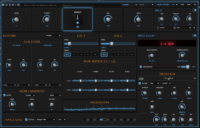
Hammer & Meißel by Florian Mrugalla is a free, open-source effect that sits somewhere between a resonator, polyphonic filter bank and playable physical-modeling instrument. Feed it drums, noise, synths or recorded audio, then use MIDI notes to impose tuned resonances and harmonic structures on the incoming material. The result can move from subtle spectral shaping to bell-like chords, metallic percussion and completely transformed textures.
A Polyphonic Modal Filter You Can Play With MIDI
Hammer & Meißel is keytracked and polyphonic. Its resonant filters follow note information, so the effect can turn an incoming sound into pitched material rather than behaving like a conventional static EQ or filter.
You can select notes from the interface or play the effect from a polyphonic MIDI input. That makes it particularly interesting for processing drums, noise and atonal recordings into harmonically controlled textures.
Four Processing Stages Per Voice
Each voice combines an ADSR envelope with several resonant processors working together. The modal and formant filters can create complex harmonic peaks, the comb filter adds strongly pitched coloration, and a low-pass stage controls the brighter resonances.
- ADSR envelope generator
- Modal filter
- Formant filter in parallel
- Comb filter
- Low-pass filter
Hear Hammer & Meißel in Action
Create Your Own Resonant Materials
The material editor is one of the plugin’s defining features. Partials can be moved manually, but Hammer & Meißel can also analyze a dropped audio sample and use it as the starting point for a custom modal material.
This turns the plugin into a deeper sound-design tool: the resonant structure itself can be designed instead of relying only on fixed factory models.
Modal, Comb and Stereo Character Controls
The material can be transposed and reshaped with controls for blend, spread, harmony, force and resonance. Additional modulation depth and stereo-width controls allow the resonant partials to move beyond a narrow mono filter-bank sound.
The comb section includes feedback and unison controls, while the low-pass damping control can soften very bright or metallic results.
Three Modulation Sources for Evolving Textures
A dedicated modulation envelope can operate in three different ways: as a tempo-synced ADSR, as an envelope follower reacting to the source audio, or as a Perlin-noise randomizer.
That combination is useful for rhythmic gating, source-following resonances and slowly changing organic textures without drawing long automation curves.
It Can Behave Like an Instrument Too
A built-in noise source means Hammer & Meißel does not always need external audio to become useful. By exciting its resonant filters internally, the effect starts behaving more like an unusual synth or resonator instrument.
- Tuned metallic percussion
- Bell-like chord layers
- Experimental drum processing
- Resonant drones
- Physical-modeling textures
- Sound-design transitions
At a Glance
Developer: Florian Mrugalla
Type: Keytracked polyphonic modal filter / resonator effect
Per voice: ADSR, modal filter, formant filter, comb filter and low-pass filter
Control: Key selector and polyphonic MIDI input
Modulation: Tempo-sync ADSR, envelope follower and Perlin noise
Custom materials: Manual partial editing and sample drag-and-drop
License: GPL-3.0 open source
Price: Free
Download Hammer & Meißel for Free
Get the current free version directly from the official developer page.
Final Thoughts
Hammer & Meißel is not another conventional filter. Its combination of MIDI-playable resonances, editable modal materials, comb filtering and organic modulation makes it useful for producers who want to turn ordinary source material into pitched, physical and often unpredictable textures. For experimental electronic music and sound design, it offers a distinctive workflow at no cost.