
Sidechain ducking is one of the most recognizable movement tricks in modern production. It makes synths breathe around the kick, pushes pads out of the way, gives basslines more pulse and creates that familiar pumping feel heard across house, EDM, techno, pop, lo-fi and electronic music. The problem is that traditional sidechain routing can slow down the session, especially when all you want is a simple rhythmic volume dip.
Little Duck by Snorkel Audio is built for that exact moment. This free VST plugin gives producers tempo-synced ducking without needing an external sidechain input. Pick a rate, shape the curve, set the depth and the plugin locks to the host tempo. Simple. Musical. No cable archaeology required.
As a free sidechain ducker plugin, Little Duck is designed for producers, beatmakers, mixing engineers and home studio users who want fast rhythmic pumping inside a DAW. It is not a full compressor, and it does not pretend to be one. It is a focused producer tool for clean, quick, tempo-based ducking.
What Is Little Duck?
Little Duck is a free tempo-synced ducker plugin developed by Snorkel Audio. Instead of using a routed sidechain signal from another track, it creates a rhythmic volume dip based on the host tempo. This lets producers achieve a sidechain-style pumping effect without setting up a compressor, routing a kick track or building a dedicated ghost trigger.
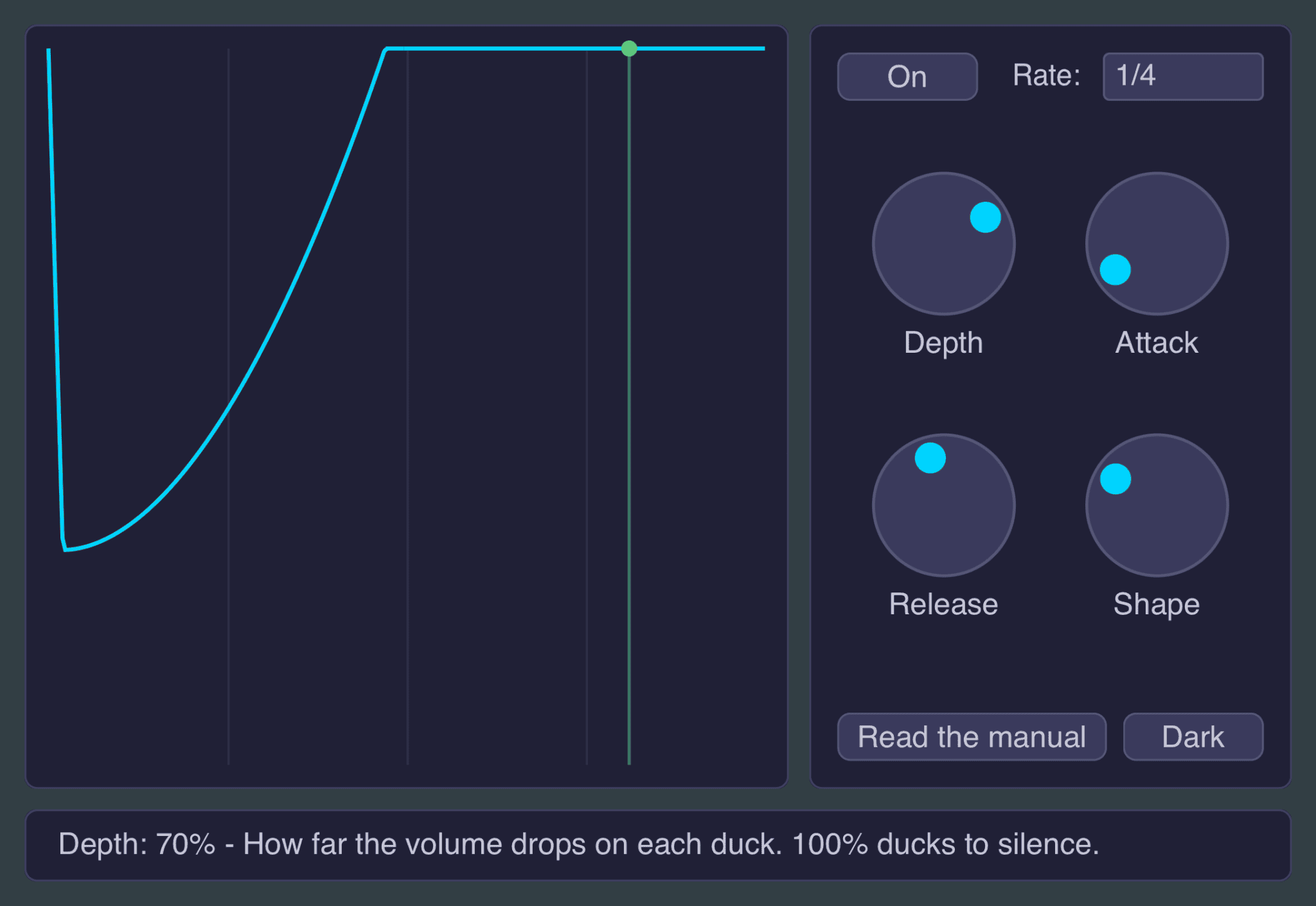
The plugin is built around four main controls: Depth, Attack, Release and Shape. It also includes rate selection, so the ducking movement can follow musical timing divisions inside the DAW. The workflow is direct: choose the rate, decide how deep the volume dip should be, then shape how the signal ducks and recovers.
This makes Little Duck especially useful when the goal is musical movement rather than technical compression. It is not about transparent dynamic control. It is about rhythm, groove and space.
Why This Free VST Plugin Matters for Producers Now
Sidechain-style pumping has moved far beyond classic EDM. It appears in house, techno, pop, ambient, lo-fi, synthwave, trap, hyperpop, future bass and cinematic electronic music. Sometimes the effect is obvious and dramatic. Sometimes it is subtle, only helping a pad or synth part breathe around the drums.
Little Duck matters because it removes friction from that process. Traditional sidechain compression is powerful, but it can be overkill for simple rhythmic ducking. You need a trigger source, routing, threshold settings, ratio, attack, release and gain staging. For many production situations, the producer does not need a full compressor. They just need the sound to move.
A free sidechain VST plugin that works without routing is valuable because it lets producers make fast decisions. It can turn a static chord progression into a pulsing layer, create space for a kick, add bounce to a bassline or make a transition feel more alive.
For home studio producers, this is particularly useful. It keeps the workflow clean and avoids the classic problem of spending ten minutes building a sidechain setup for an effect that should have taken ten seconds. The duck is small. The time saved is not.
Main Features
- Free tempo-synced ducker: creates rhythmic volume ducking locked to the DAW tempo.
- No sidechain routing required: works without an external trigger input.
- Rate selection: choose musical timing divisions for the pumping movement.
- Five rates: includes values from 1/1 to 1/16, with 1/4 suited to classic four-on-the-floor pumping.
- Depth control: sets how far the volume drops on each duck.
- Attack control: adjusts how quickly the ducking curve begins.
- Release control: shapes how the signal returns after the dip.
- Shape control: changes the curve character, from subtle movement to a stronger scoop.
- Live curve display: shows the ducking shape visually.
- Cycle-synced scope: helps users see what plays through and what gets reduced.
- Desktop support: available as VST3 and AU depending on operating system.
- iPad support: AUv3 version is listed for iPad workflows.
Sound, Workflow and Creative Use
Little Duck is not designed to color the sound like saturation, compression or tape processing. Its character comes from movement. It makes sounds breathe, pump, dip and return in time with the track.
On pads, Little Duck can create instant rhythmic motion. A sustained chord that feels static can become a pulsing layer behind the drums. This works especially well in house, synthwave, EDM, ambient and melodic techno, where long harmonic parts often need movement without additional notes.
On basslines, the plugin can create space for the kick or simply add bounce. A subtle setting can help the low end feel cleaner, while a deeper setting creates a more obvious pumping effect.
On vocals, Little Duck can be used creatively for rhythmic gating-style movement. It is not a vocal mixing essential in the traditional sense, but it can work on vocal chops, backing phrases, atmospheric ad-libs and processed hooks.
On reverb and delay returns, it can be very useful. Ducking a reverb send in time with the groove can keep the mix cleaner while preserving space. Ducking a delay return can make echoes feel more rhythmic and less cluttered.
The Most Important Controls Explained
Rate
The Rate control determines how often the ducking cycle happens. Little Duck locks this movement to the host tempo, so the effect stays rhythmically connected to the track.
A 1/4 rate is useful for the classic four-on-the-floor pumping sound, especially in house, EDM and techno. Faster settings can create more energetic movement, while slower settings can create larger breathing effects across pads, drones or atmospheric layers.
This is one of the main reasons Little Duck is faster than traditional sidechain compression. You do not need a kick trigger to define the groove. The plugin follows the DAW tempo directly.
Depth
Depth sets how much the signal drops during each ducking cycle. At lower values, the effect can be subtle, adding movement without making the volume change too obvious. At higher values, the pumping becomes much stronger and more dramatic.
This control is crucial for musical balance. A deep setting can work well on pads, FX returns and aggressive EDM-style synths. A lighter setting may be better for bass, vocals, melodic loops or mix elements that need movement without disappearing.
Depth is also the control that decides whether Little Duck behaves like a mix utility or a creative effect. Both uses are valid, but they sit in different places in the arrangement.
Attack
Attack shapes how quickly the volume drops at the start of each ducking cycle. A faster attack creates a sharper dip, which can feel more rhythmic and more obvious. A slower attack creates a smoother transition into the duck.
For classic pumping, a faster attack often works well because the signal clears space immediately. For softer movement, a slower attack can feel more natural and less mechanical.
Attack is especially important when using Little Duck on sounds with strong transients. A sharp synth stab, percussion loop or vocal chop may need a different attack shape than a long pad or reverb tail.
Release
Release controls how the signal returns after the duck. This is one of the most musical controls in any ducker because it defines the groove of the recovery.
A short release can make the sound return quickly, creating a tighter rhythmic pulse. A longer release can make the movement smoother and more wave-like. The right setting depends on the tempo, genre and source material.
On house and EDM tracks, release often helps define the bounce. On ambient and cinematic material, it can create a more elegant breathing motion. The duck may be little, but the release does a lot of emotional administration.
Shape
Shape changes the character of the ducking curve. Instead of only controlling how deep or fast the dip is, it adjusts the contour of the movement itself.
This matters because two ducking curves can have the same depth and rate but feel completely different. One can sound smooth and subtle. Another can feel sharp, scooped and very obvious. Shape lets producers move between those behaviors without adding a complicated compressor-style interface.
For creative pumping, stronger shapes can bring more energy. For transparent space-making, gentler shapes usually work better.
Live Curve Display
Little Duck includes a live curve display that shows the ducking shape visually. This is useful because pumping effects are both rhythmic and dynamic. Seeing the curve helps producers understand how the plugin is moving the signal.
The cycle-synced scope also makes it easier to judge what is passing through and what is being ducked. This is especially helpful when working quickly, because it gives visual feedback without turning the plugin into a technical dashboard.
Who Should Use Little Duck?
Little Duck is best suited to producers who want sidechain-style movement without routing complexity. House, EDM, techno, synthwave, pop, lo-fi, trap and ambient producers will probably find immediate uses for it.
Beatmakers can use it to create bounce on samples, chords and melodic loops. Electronic producers can use it on pads, basslines, synths and FX returns. Mixing engineers can use it as a fast utility when a sound needs rhythmic space rather than full compressor behavior.
Home studio users should also pay attention. A free audio plugin that solves a common workflow issue quickly can become more valuable than a complex processor that takes longer to set up than the idea itself.
Best Use Cases for Producers and Mixing Engineers
- Classic EDM pumping: create a strong four-on-the-floor volume dip without routing a kick sidechain.
- House pads: make sustained chords breathe around the groove.
- Bass movement: add bounce or create space for the kick.
- Reverb ducking: keep ambience present while reducing clutter in rhythmic sections.
- Delay return control: make echoes move with the track instead of washing over the mix.
- Vocal chop motion: add pulsing movement to processed vocal phrases.
- Lo-fi samples: create soft rhythmic breathing on loops and textures.
- Transition design: automate Depth and Rate to increase movement before a drop or section change.
Compatibility and Download Details
Little Duck is available as a free download from Snorkel Audio. The official page lists AUv3, VST3 and AU support, with desktop and iPad workflows covered depending on host and platform.
On macOS, Little Duck is listed as a VST3 or Audio Unit plugin. On Windows, it is listed as a VST3 plugin. For iPad, the developer lists AUv3 support, making it suitable for compatible iPad music production hosts.
Because Little Duck is an audio effect, it should be inserted on the track or return channel that needs rhythmic ducking. No external sidechain signal is required. Producers can simply choose a rate, adjust the curve and let the plugin follow the DAW tempo.
Official website: Visit the Little Duck page on Snorkel Audio
Download link: Download Little Duck for free
Why This Type of Free Plugin Matters
Free plugins are often valuable when they remove friction from common production tasks. Little Duck does exactly that. Sidechain-style ducking is used constantly in modern music, but the traditional setup is not always necessary.
A dedicated free sidechain ducker plugin gives producers a fast way to create movement without breaking the session flow. That matters because production is often about momentum. The fewer steps between hearing a problem and solving it, the better.
Little Duck also shows how simple plugins can still be serious tools. It does not need a massive feature list to be useful. It focuses on one job, makes that job quick and gives enough visual feedback to help users shape the result confidently.
For independent artists and home studio producers, this kind of free VST plugin is especially welcome. It gives access to a professional rhythmic effect without requiring paid tools or complex routing knowledge.
What Happens Next?
Little Duck has the kind of focused design that could make it a regular utility in many sessions. Producers who already know traditional sidechain compression may still use it when speed matters. Beginners can use it to understand pumping and ducking without first learning the full sidechain routing process.
Its usefulness will likely depend on how easily it fits into different DAWs and mobile setups. Since it is available for desktop formats and listed for AUv3 workflows, it has a broad target audience.
The most interesting future use may come from producers who treat it creatively rather than only as a sidechain replacement. Ducking reverbs, delays, noise layers, ambience, field recordings and vocal textures can create movement that feels more arranged and less static.
Final Verdict
Little Duck by Snorkel Audio is a smart, focused and practical free sidechain ducker plugin for producers who want rhythmic pumping without routing. It does one job clearly: it ducks audio to the beat using tempo-synced movement, simple controls and a visual curve display.
Its strongest points are speed, simplicity and musical usefulness. Depth, Attack, Release and Shape provide enough control to move from subtle breathing to classic EDM-style pumping, while the rate selection keeps everything locked to the DAW tempo.
For house, EDM, techno, pop, lo-fi, synthwave and electronic producers, Little Duck is easy to recommend. It will not replace every sidechain compressor in a serious mix, but it does not need to. When the track needs quick movement, instant bounce and less routing drama, this free audio plugin gets the ducking done. Quietly heroic, as ducks often are.